Carbon Nanotubes (CNTs) – The Cylinders of Tomorrow
From the Laboratories of Project Clean Up (10/17/2025)
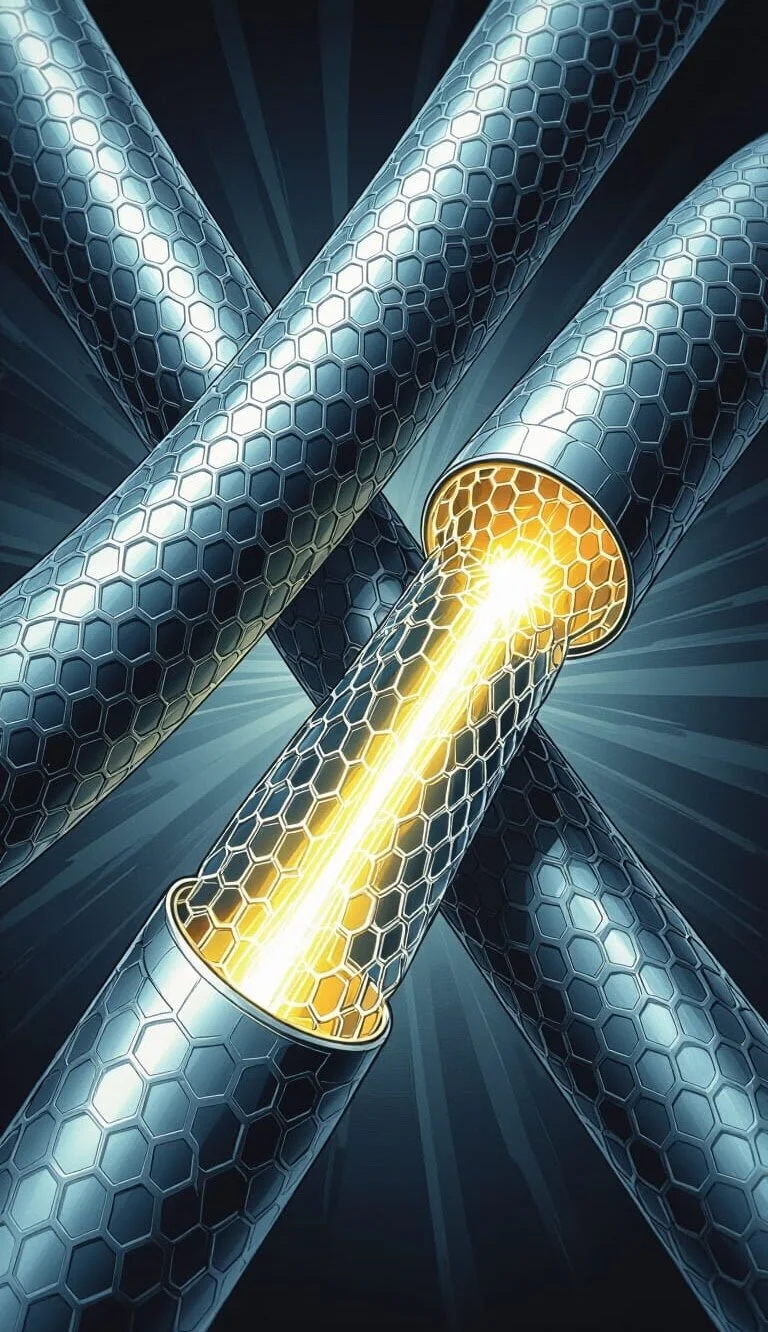
Carbon Nanotubes (CNTs) are a revolutionary class of advanced materials formed by rolling up a single layer of graphene (a one-atom-thick sheet of carbon) into a seamless cylinder. These cylindrical nanostructures possess a combination of properties that make them truly unique: they are among the strongest and stiffest materials known, exhibit exceptional flexibility, and are superior electrical and thermal conductors. These qualities have placed CNTs at the center of development for a new generation of high-performance products, including advanced composite materials for aerospace and automotive industries, ultra-fast transistors in electronics, and highly sensitive biosensors for medicine.
The CNT Promise: Sustainability Through Extreme Performance
The application of CNTs offers substantial environmental benefits. By creating composite materials that are dramatically lighter and stronger than conventional materials, CNTs enable the manufacture of lighter vehicles and aircraft, leading to significant fuel and energy savings. Their high conductivity enhances the performance and efficiency of batteries and solar cells, accelerating the transition to renewable energy. Furthermore, CNTs are being explored for environmental remediation, acting as highly efficient, reusable filters and adsorbents for removing heavy metals and organic pollutants from water. This duality—enabling both superior product performance and cleaner environmental solutions—makes CNTs a cornerstone of sustainable material design.
Beyond Strength: Navigating the Nanomaterial Lifecycle
While the potential of Carbon Nanotubes is vast, their nanoscale form presents unique challenges for environmental management. As with any nanomaterial, there is a risk of environmental release if disposal methods are inadequate. Furthermore, managing the end-of-life for products containing complex CNT-polymer composites can be difficult, as the strong bonds that provide product performance complicate traditional recycling and breakdown. This is where the core expertise of PCU Laboratories becomes vital. Our ongoing research into breaking down complex material architectures, including the targeted deconstruction of persistent carbon-based nanostructures, ensures that these materials, once their utility is over, can be safely and responsibly managed. Our commitment to a truly circular future demands that we develop clear, clean pathways for the full lifecycle of even the most advanced materials. As always, the critical first step in any material's journey towards a clean end-of-life is proper disposal. Learn more about our vision for a sustainable future and how you can contribute at projectcleanup.com.