Perfluoropolyethers (PFPEs) – The Ultimate Lubricant and the Catalytic Solution
From the Laboratories of Project Clean Up (12/12/2025)
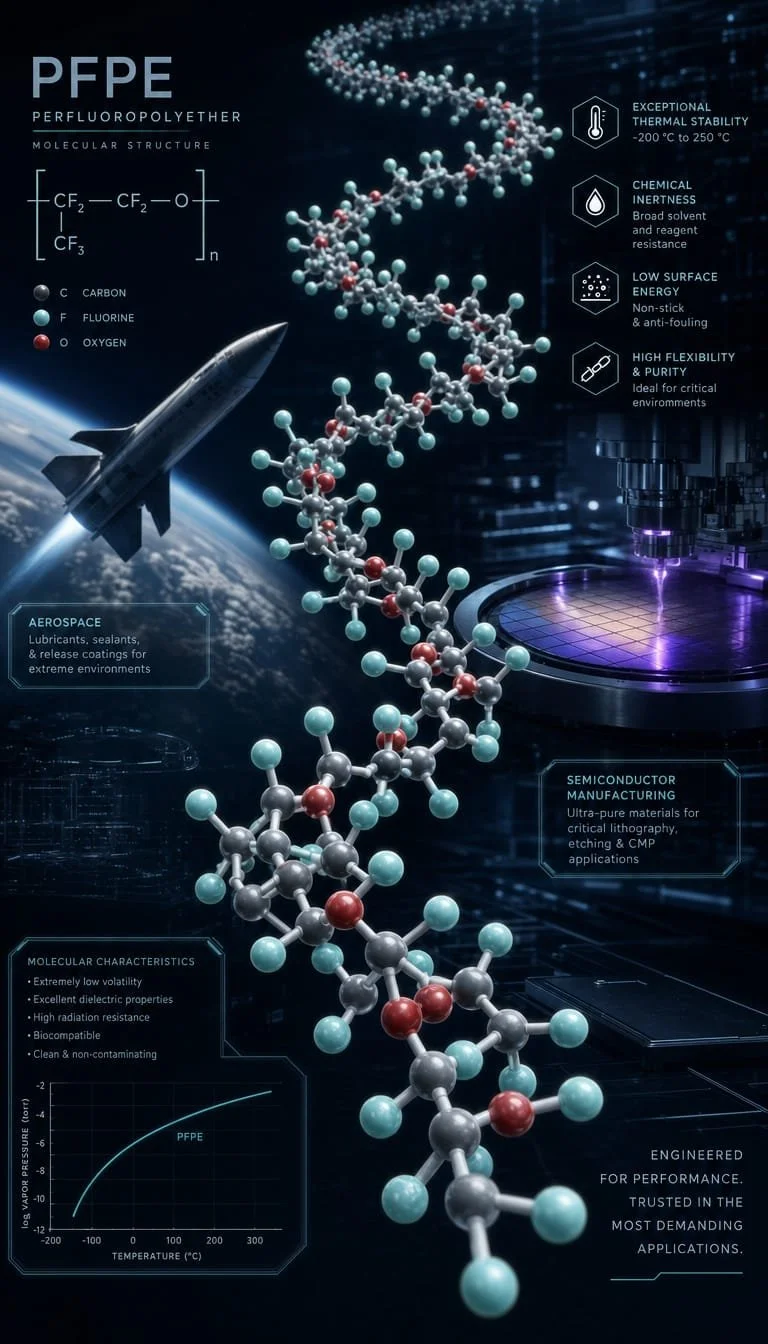
Perfluoropolyethers (PFPEs) are a complex class of high-molecular-weight fluorinated polymers characterized by chains containing carbon, fluorine, and oxygen atoms linked by ether bonds (-CF2O-). For over three decades, PFPEs have been the gold standard in high-performance applications where conventional lubricants fail. Their chemical inertness, high dielectric strength, resistance to radiation, and exceptional thermal stability make them indispensable for extreme environments, including thin-film lubrication on computer hard drives, vacuum pump oils in semiconductor and pharmaceutical manufacturing, and fluid media in critical aerospace and military systems. Their structure can vary (K-type, Z-type, Y-type), but their performance is uniformly superior.
The Persistence Problem: Advanced Materials, Environmental Challenge
Despite their vital role in advanced technology, PFPEs are classified as PFAS and are extremely resistant to natural environmental degradation (hydrolysis, photolysis, and biodegradation). While they are generally considered non-toxic and less prone to bioaccumulation than legacy compounds like PFOA, the persistence of the C-F and C-O-C bonds means that PFPEs released through wear, vaporization, or disposal will remain in the environment indefinitely. Their use in industrial settings leads to contamination of wastewater, soil, and air, underscoring the urgent need for a definitive end-of-life plan for even the most specialized fluorinated polymers.
Degrading PFPEs: PCU’s Lewis Acid Catalyst Solution
The challenge of degrading PFPEs is a key focus area at Project Clean Up (PCU), and fortunately, the science offers a clear pathway. Unlike the purely alkyl chain of PFOS, the ether linkages in PFPEs introduce a specific site of reactivity. Laboratory studies have long suggested that PFPEs degrade through catalytic processes in the presence of strong Lewis acids (such as metal oxides or fluorides, like AlF3). These Lewis acids attack the oxygen atoms in the polymer's backbone, facilitating a cleavage reaction. This degradation mechanism is a direct confirmation of the research pioneered by PCU Laboratories. Our advanced catalytic approach, which utilizes optimized Lewis acid systems and other strong catalytic agents, is specifically designed to exploit this vulnerability, rapidly and safely dismantling the PFPE polymer into simple, manageable fragments, which are then mineralized.
A Holistic Solution: Managing the End-of-Life of Specialized Waste
The application of PFPEs highlights the need for targeted waste management within specialized industrial and high-tech sectors. While these materials are used in controlled environments, their disposal or accidental release requires a high-tech solution. Our commitment at PCU is to provide the proven scientific tools—like the Nexus unit's Lewis acid-based process—to neutralize this advanced chemical waste. Ensuring that high-tech industrial waste streams containing PFPEs are channeled for specialized degradation is crucial for preventing the long-term contamination of our environment. Learn more about our vision for a sustainable future and how you can contribute at projectcleanup.com.