(10/30/2026)
From the Laboratories of Project Clean Up
A metamaterial is not defined by its chemistry, but by its structure. It is a material engineered to have properties that do not exist in naturally occurring materials. In the realm of acoustics, this means creating physical structures that are smaller than the wavelength of the sound you are trying to block.
1. The Sub-Wavelength Labyrinth
Sound is simply a pressure wave moving through the air. When a soundwave hits a traditional solid wall, some of it bounces back, and some of it vibrates the wall, passing through to the other side.
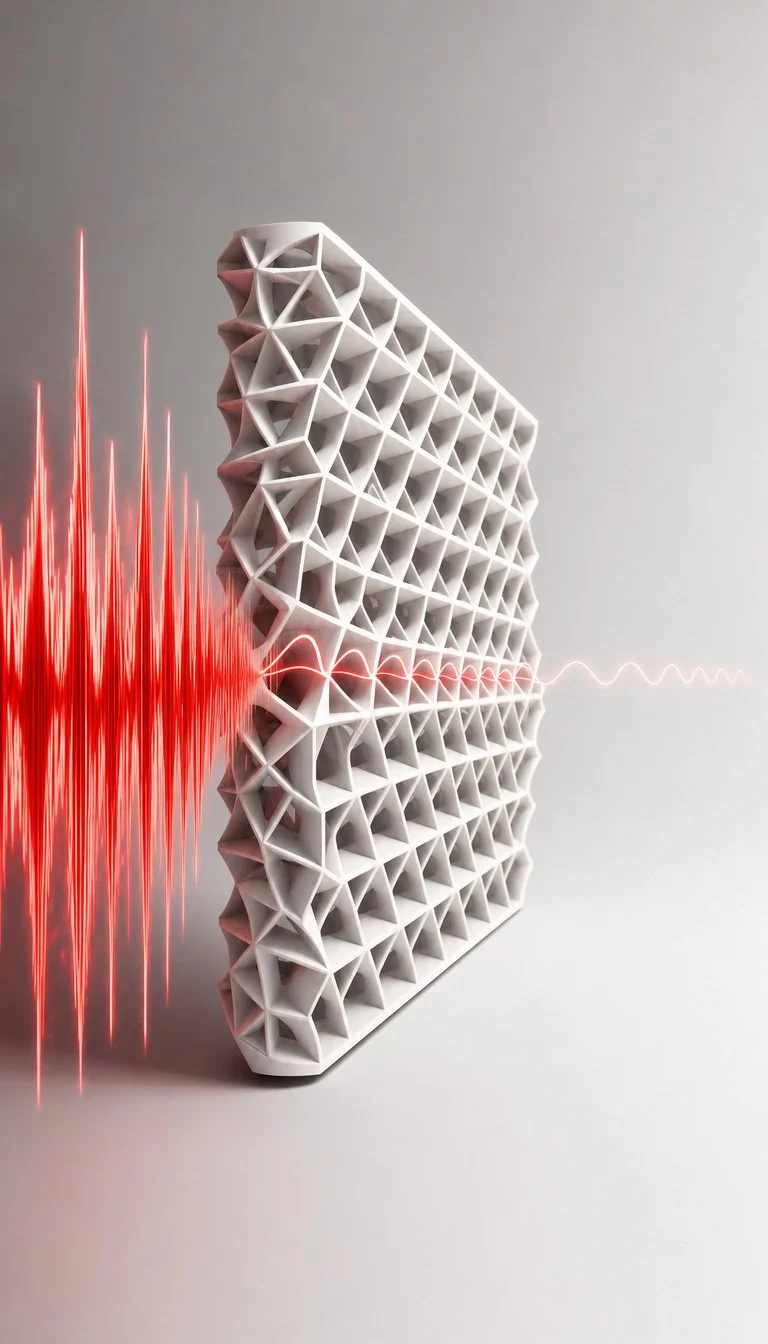
An acoustic metamaterial interacts with the wave differently. The surface of a metamaterial is covered in microscopic, mathematically calculated structures (often acting as tiny Helmholtz resonators). When a soundwave hits these structures, the wave is essentially swallowed into a tiny geometric labyrinth. The soundwave bounces around inside these microscopic chambers, interfering with itself. Through the physics of destructive interference, the soundwave effectively cancels itself out. The kinetic energy of the sound is converted into a microscopic, undetectable amount of heat, and absolute silence emerges on the other side.
2. The Open-Air Barrier
The most revolutionary application of acoustic metamaterials in the 2026 urban landscape is the Open-Air Sound Barrier.
Because metamaterials rely on geometry rather than solid mass to stop sound, they do not need to be airtight. Imagine a massive, noisy HVAC cooling tower on the roof of a biogenic apartment building. If you box it in to stop the noise, it cannot pull in the air it needs to function.
By surrounding the HVAC unit with a metamaterial grating, you create a barrier that allows wind, air, and light to pass through perfectly unhindered. But when the specific frequency of the noisy fan tries to pass through the grating, the geometry catches it and traps it. We can now soundproof highways, airports, and industrial fans without building massive, airflow-restricting concrete walls.
3. The Lifecycle Standard: Escaping the Foam Trap
Under the PCU Lifecycle Standard, the elimination of traditional acoustic foam is a massive ecological victory.
The Legacy Flaw: 20th-century soundproofing relied on polyurethane foams and fiberglass. Polyurethane is derived from toxic petrochemicals, is highly flammable (requiring toxic chemical fire retardants), and is virtually impossible to recycle. It ends its life crumbling into toxic microplastics in a landfill.
The PCU Solution: Geometric Bio-Polymers and Recycled Aluminum.
Because metamaterials rely on their shape rather than their substance, we can manufacture them out of anything.
The 2026 generation of PCU acoustic baffles are 3D-printed using completely benign, compostable bio-polymers (like PHA) or cast from infinitely recyclable aluminum. When an acoustic metamaterial panel reaches the end of its life, it isn't a toxic liability. The aluminum is simply melted down and re-cast, or the bio-polymer is sent to the industrial composter.
We have replaced a toxic chemical reliance with a pure, infinitely recyclable mathematical equation.
The 2026 Vision: The Cloaked City
At Project Clean Up (PCU), we are redesigning the sensory experience of the urban environment. The city of the future is dense and highly active, but it is no longer loud. By treating sound not as an unstoppable force, but as a wave that can be bent, trapped, and cancelled through elegant geometry, we are restoring peace to the public space. We are proving that true advanced engineering doesn't just look better; it sounds better, too.