Level 1: The Master Bioreactor in Your Backyard
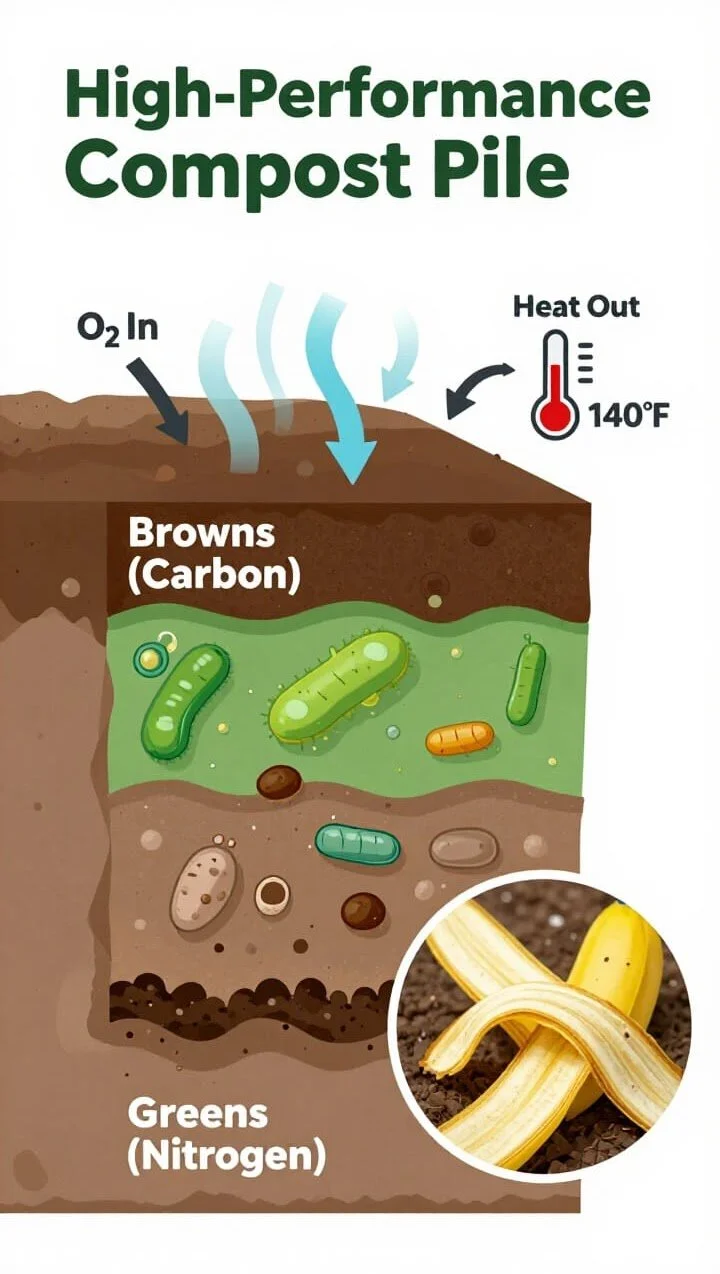
When you hear the word "bioreactor," you probably picture a gleaming steel tank in a pharmaceutical lab. But you can build one of the most effective bioreactors on Earth using nothing but scrap wood and wire mesh. We call it a compost pile, but today, we are going to look at it like scientists. (01/16/2026)
The Mission: Your household produces a stream of organic waste—food scraps, paper, cardboard, and yard trimmings. Sending this to a landfill is a waste of energy. Your mission is to harness the power of thermophilic (heat-loving) bacteria to break this complex waste down into humus, a nutrient-rich soil amendment that restores the earth.
The Science: Biostimulation at Home Remember when we discussed biostimulation—injecting nutrients to help microbes work? Composting is the exact same process. You are the engineer managing the C:N Ratio (Carbon to Nitrogen).
The "Browns" (Carbon): Dried leaves, cardboard, paper, sawdust. These provide the energy for the microbes.
The "Greens" (Nitrogen): Vegetable scraps, coffee grounds, fresh grass clippings. These provide the protein the microbes need to grow and multiply.
The Protocol: To run your bioreactor efficiently, you aim for a ratio of roughly 30 parts Carbon to 1 part Nitrogen.
Layering: Start with a thick layer of coarse "Browns" for airflow. Add a layer of "Greens." Cover immediately with more "Browns" to filter odors (a simple bio-filter!).
Aeration: Your microbes are aerobic (they need oxygen). If the pile smells bad, it’s gone anaerobic. Turn the pile with a pitchfork to inject oxygen—this is manual bioventing.
Moisture: The pile should feel like a wrung-out sponge. Too dry? The microbes go dormant. Too wet? They drown.
The Result: If you balance these factors correctly, the pile will heat up, sometimes reaching 140°F (60°C). This isn't from the sun; it is the metabolic heat generated by billions of bacteria feasting on your waste. You have successfully engineered a high-energy biological breakdown.