The Gut-Brain Axis: Who is Really in Control?
(06/12/2026)
The Concept: We have a lot of phrases about our stomachs. We say we have a "gut feeling" about a decision, or "butterflies in our stomach" when we are nervous. For a long time, science thought these were just biological metaphors—the brain sending stress signals down to the digestive tract.
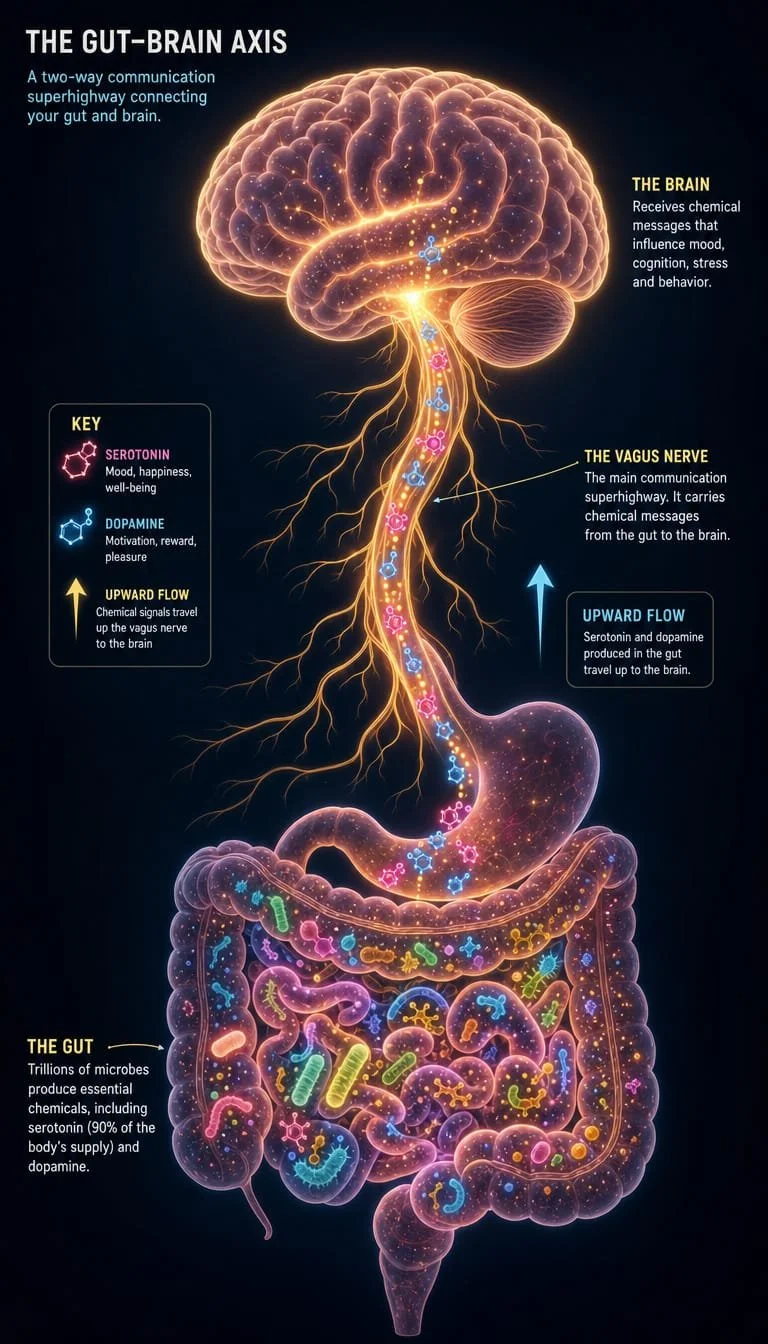
We now know it is a two-way street, and the traffic flowing up from the gut is just as heavy as the traffic flowing down. The ecosystem inside your intestines is in constant, direct communication with your brain. This connection is so powerful that scientists often refer to the gut as the "Second Brain."
The Science: The Vagus Nerve Information Highway The physical bridge between your brain and your gut is called the vagus nerve. It is one of the longest nerves in your body, running from your brainstem all the way down into your abdomen.
Think of the vagus nerve as a massive fiber-optic cable. But the microbes in your gut don't just passively sit at the end of this cable; they actively transmit data across it. They do this by manufacturing the exact same chemical messengers—neurotransmitters—that your brain uses to think and feel.
The Chemical Arsenal: When we think of mood-regulating chemicals, we think of the brain. But look at where these chemicals are actually produced:
Serotonin: The "happy" chemical that regulates mood, sleep, and digestion. Roughly 90% of your body's serotonin is manufactured in the digestive tract, heavily influenced by your gut bacteria.
Dopamine: The "reward and motivation" chemical. About 50% of your dopamine is produced in the gut.
GABA: A chemical that calms the nervous system and reduces anxiety. Several specific strains of gut bacteria actively synthesize it.
The Consequence: Cravings and Mood Because your microbiome can produce these neurotransmitters, it has a direct lever to pull on your mood and behavior.
This ecosystem is incredibly competitive. Different bacteria thrive on different food sources. Some bacteria thrive on dietary fiber; others thrive on refined sugar. Evolutionary biologists theorize that if your diet heavily favors sugar, the sugar-loving bacteria multiply and dominate the ecosystem.
To ensure their survival, these dominant sugar-eating microbes can release chemical signals that travel up the vagus nerve to your brain, artificially triggering intense cravings for more sugar. They can also reward you with a hit of dopamine when you eat it, or induce feelings of anxiety (by withholding calming neurotransmitters) when you don't.
You might think you really want a donut, but it is highly possible you are just experiencing the biological demands of a trillion microscopic sugar addicts living in your bioreactor. To change your mind, you sometimes have to change your microbes.