A Day in the Life: Part 1 - Morning in the Machine
(12/26/2025)
Time: 06:30 City Standard Time Location: Residential Sector 4, Unit 802 Citizen: Elias, Senior Biosystems Technician
The sunrise doesn't happen outside; it happens inside. Elias wakes up not to an alarm, but to his room slowly filling with a warm, amber light. The circadian lighting system, synchronized with the city's master clock, gently pulls him out of sleep.
He sits up. The room is compact—efficient—but feels spacious thanks to the smart glass window that currently displays a view of a terrestrial forest (a subscription "luxury" he pays for with discretionary credits).
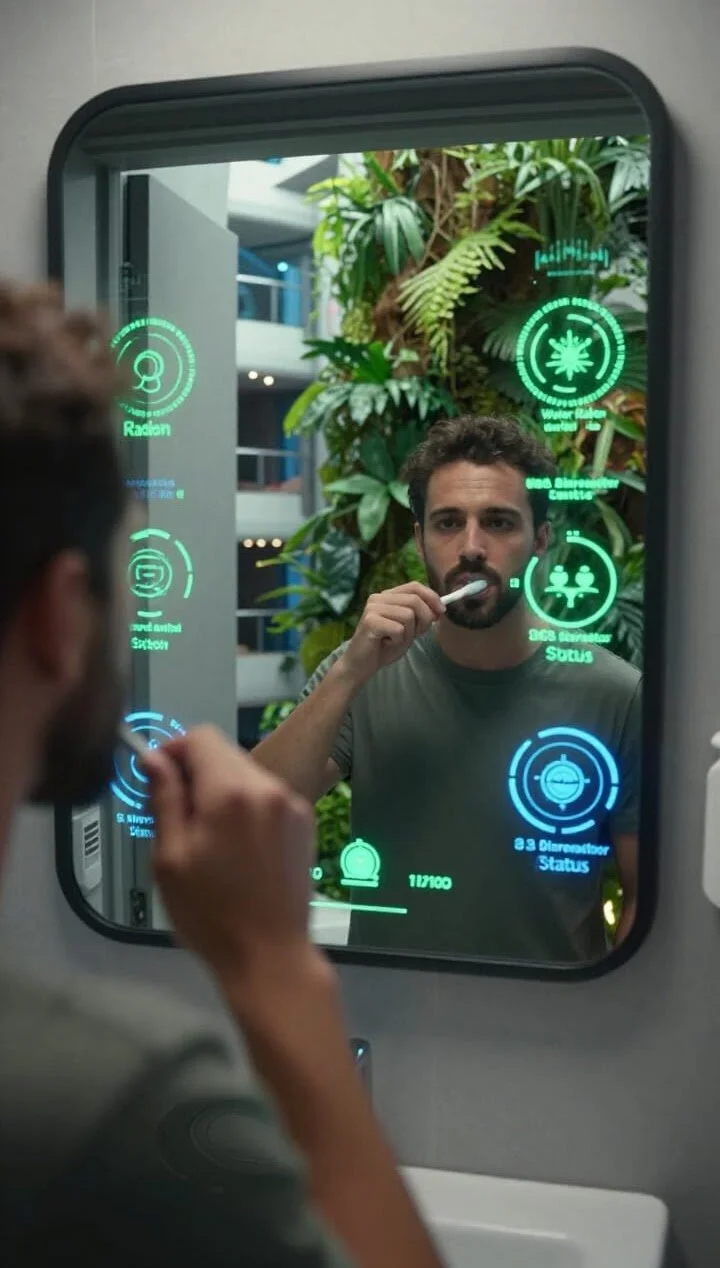
The Mirror Dashboard Elias walks to the bathroom sink. As he washes his face, the smart mirror flickers to life. It doesn't show the news; it shows reality.
Personal Ring: A glowing green circle appears in the corner. Water Allowance: 92% Remaining. Energy Credit: Surplus.
City Pulse: A small ticker at the bottom scrolls: Sector 4 Air Quality: Optimal (VOCs < 2ppb). Bioreactor 4B: Input Needed (Carbon).
He brushes his teeth. When he spits, he doesn't leave the tap running. He knows that every drop of water down that drain travels to the Living Machine in the atrium outside his door. He is intimately connected to that machine; he can practically hear the microbes working.
The Alchemical Bathroom He uses the toilet. There is no handle to jiggle, no wasteful tank of water. He presses a button, and with a sharp, pneumatic whoosh—like on an airplane—the waste is whisked away by the vacuum system.
He knows exactly where it’s going. In ten minutes, it will be in the neighborhood Bioreactor. By this afternoon, it will be methane gas powering the community kiln. By next week, the nutrients will be fertilizing the tomatoes he’ll buy for dinner. There is no "away." There is only the loop.
The Zero-Waste Breakfast In the kitchenette, Elias grabs a sealed glass jar from the cooler—"Overnight Oats" prepared by the local culinary hub. The label isn't paper; it's a permanent digital ink display on the glass: Ingredients: Local Oats, Spirulina Protein, Almond Milk (Lab-Grown).
He eats quickly. When he finishes, he doesn't look for a trash can.
The Scraps: He drops a leftover apple core into the Organic Resource Chute on the counter. A quiet whir of the macerator, and it’s gone—pumped to the digester to join the blackwater.
The Jar: He places the empty glass jar into the "Return" slot. A soft chime confirms his account has been credited. +0.5 Resource Credits.
Departure Elias grabs his tablet and steps out of his unit. He doesn't step into a hallway, but into a lush, green canyon. The center of the residential block is an open atrium spanning ten floors. The walls are not concrete; they are the Active Bio-Filters we designed—walls of ferns and mosses that hum softly as fans pull the building's air through their roots.
The air smells like rain and wet soil, not sterile conditioning.
He walks to the transit pod. On his screen, a notification pops up from the Liquid Democracy app: "Vote Request: Sector 4 wants to divert 5% of Water Reserves to the Experimental Orchard. An expert in Hydrology has requested your proxy. Do you accept?"
Elias taps "Delegate." He trusts the hydrologist. He has his own job to do.
Next Stop: The Workplace.
Analysis of the Scene In just these first 45 minutes, we see the systems in action:
Water: Strict conservation and immediate awareness via the Dashboard.
Waste: Source separation (Vacuum toilet vs. Organic Chute vs. Return Slot).
Economy: The seamless crediting system for returning materials.
Governance: The fluid, low-friction participation in decision-making.
Next week, in "Part 2: The Working Day," we will follow Elias to his job at the Resource Recovery Hub, where we will see the industrial side of the loop—the "Annihilation Core"—in action.