The Alchemical Loop: Mining the Air
(11/21/2025)
Welcome back. Today we tackle the invisible waste: the air itself. In a closed-loop city, the atmosphere is constantly being burdened. Humans and industries exhale Carbon Dioxide (CO₂). Materials off-gas Volatile Organic Compounds (VOCs). Cooking and machinery create odors and particulates.
In the linear world, we rely on the vastness of the planetary atmosphere to dilute these poisons. In our city, we do not dilute; we capture and transform. We treat the air not just as a medium for breathing, but as a gaseous mine filled with carbon and nutrients.
Step 1: The Active Bio-Filter (Eating VOCs)
Furniture, electronics, and even cleaning products release VOCs—chemicals like formaldehyde and benzene that cause "Sick Building Syndrome." To combat this, we don't just use filters that need replacing; we use biology.
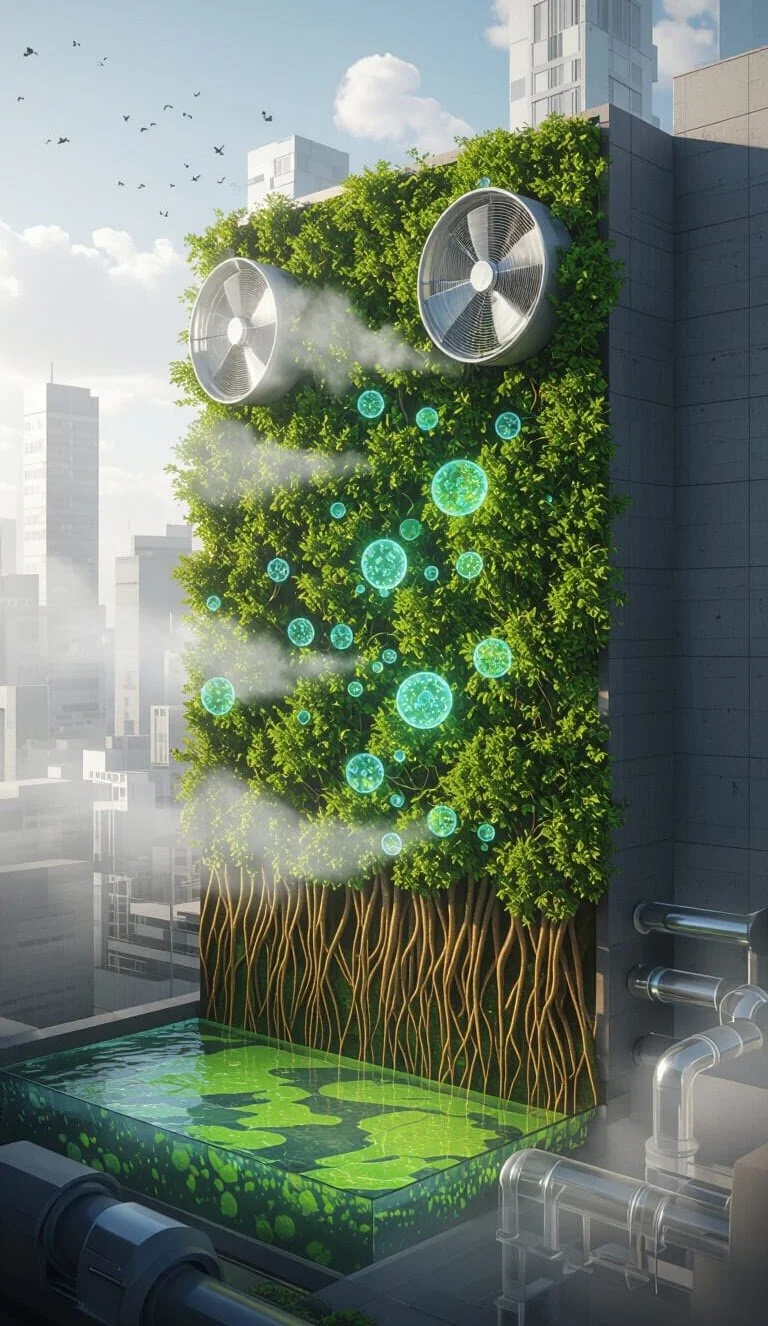
Active Phytoremediation: Throughout the city's buildings and habitats, we install Active Green Walls. Unlike standard vertical gardens, these systems use fans to actively pull air through the root zone of the plants, not just over the leaves.
The Alchemy: It is not the leaves, but the microbes living in the root system that do the heavy lifting. These specialized bacteria break down the complex VOC molecules, turning these airborne toxins into food for the plants. The output is purified air and lush, healthy vegetation. The pollution becomes plant food.
Step 2: Carbon Capture and Utilization (The Gas-to-Fuel Loop)
CO₂ is the primary waste product of human metabolism. On the ISS, it is scrubbed and often vented. In our city, carbon is too valuable to lose.
Direct Air Capture (DAC): Integrated into the city's HVAC systems are Direct Air Capture nodes. These use solid sorbent filters (like sponge-like materials) that selectively bond with CO₂ molecules. When heated slightly, they release a stream of pure, concentrated CO₂.
The Utilization: This captured gas is piped to two critical destinations:
Algae Bioreactors: The CO₂ is bubbled into tanks of algae, which consume it to produce oxygen and high-protein food (spirulina).
Methanation Plants: Using the Sabatier reaction (as discussed in our "Critical Path" series), the CO₂ is combined with hydrogen to create synthetic methane—fuel for our rockets or backup generators. We literally turn our breath into rocket fuel.
Step 3: Electrostatic Harvesting (The Dust Loop)
Finally, we deal with particulates—dust, skin cells, pollen, and industrial smoke.
Electrostatic Precipitators: Instead of disposable HEPA filters that clog and become trash, we use large-scale electrostatic precipitators in industrial zones. These charge airborne particles, causing them to stick to collection plates like static cling.
The Recovery: Periodically, these plates vibrate, shaking the collected dust into hoppers. Because this dust is largely organic (skin, pollen) or mineral, it is sent to the Resource Recovery Hub. The organics are digested into biogas; the minerals are incorporated into building materials. Even the dust is not wasted.
The Closed Sky
By implementing these three systems, we ensure that our city's sky is never "filled" with waste. It is a dynamic, self-cleaning organ that continuously feeds the biosphere and the energy grid. We have now proven that every output of a city—solid, liquid, and gas—can be the input for something else.
We have completed the "Alchemical Loop." We have examined every waste stream and found a way to close it. Next week, for the conclusion of this series, I propose we create a Grand Synthesis: a single, master visualization and summary article that ties all these individual loops (Water, Waste, Hazardous, Air) into one cohesive "Metabolism of the City," showing exactly how they interlock to create a zero-waste society.