The Citizen Interface: The City Dashboard – Seeing the Invisible
(12/05/2025)
Welcome to the "software" of our city. In the linear cities of the past, infrastructure was buried underground and out of mind. You flipped a switch, and light appeared; you flushed a toilet, and waste vanished. This invisibility bred apathy.
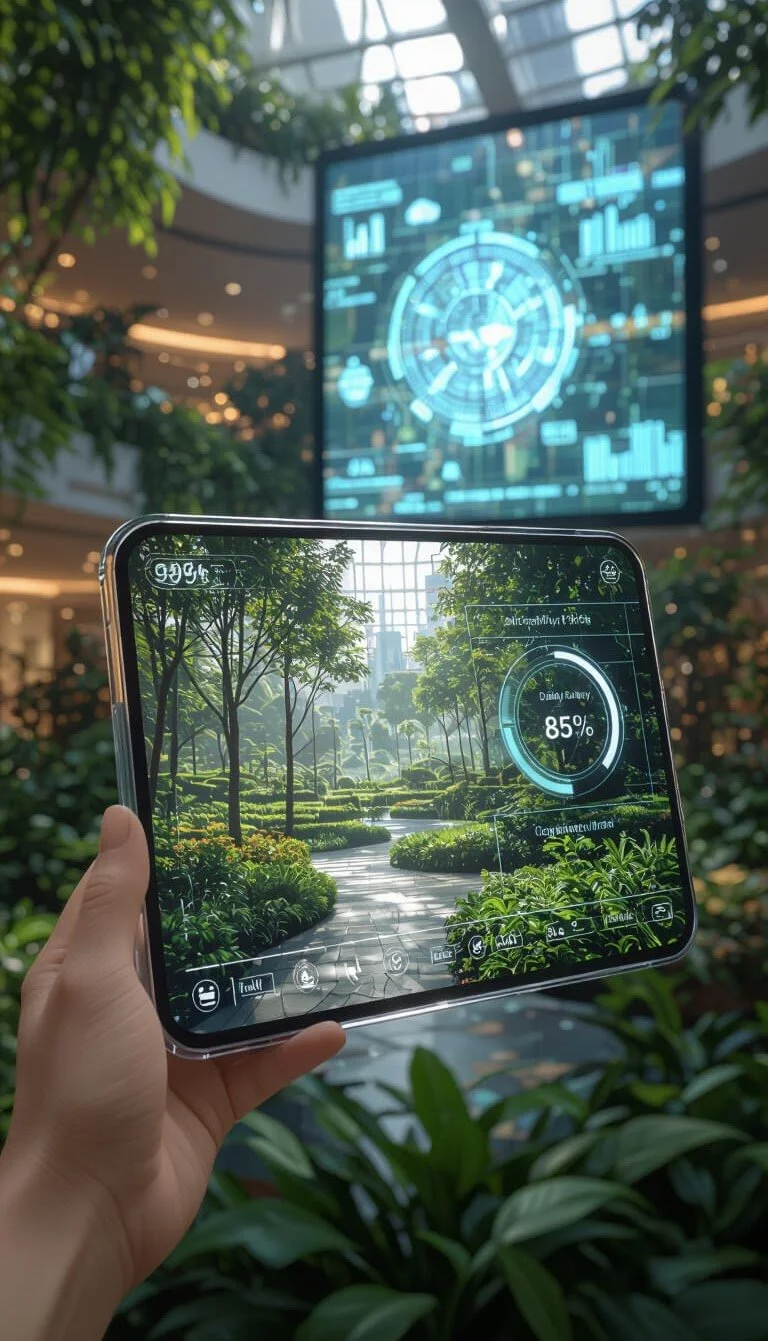
In our closed-loop city, survival depends on awareness. We cannot hide the loops; we must reveal them. This is the function of the City Dashboard—a pervasive, augmented-reality interface accessible on every personal device, smart mirror, and public display. It turns the city into a "Glass House," where every flow of energy and matter is visible, transparent, and beautiful.
Layer 1: The Personal Pulse (My Impact)
At the individual level, the Dashboard answers the question: "How am I doing today?"
The Resource Ring: Instead of receiving a monthly bill, citizens see a real-time, glowing ring on their interface. It tracks their daily allocation of water, energy, and carbon credits.
Behavioral Feedback: If you leave a shower running too long, the water ring turns amber. If you contribute a high volume of sorted plastic to the Resource Bank, your "Contribution Score" rises, unlocking community perks (like booking a priority slot at the music studio).
The Goal: This is not about policing; it is about gamifying stewardship. It creates a direct, instantaneous feedback loop between action and consequence, making sustainability a subconscious habit.
Layer 2: The Community Heartbeat (Our Health)
Zooming out, the Dashboard visualizes the health of the immediate neighborhood or "Block."
The Bioreactor Status: A public display in the local park might show the health of the neighborhood's Blackwater Bioreactor. Is it hungry? Does it need more carbon (food scraps)? The community can see exactly what their local system needs to function optimally.
Energy Trading: If Block A has a surplus of solar energy and Block B is running a deficit due to heavy 3D printing activity, the Dashboard visualizes the energy transfer between them. Citizens can see their neighborhood helping another, fostering a sense of interdependence and civic pride.
Layer 3: The Oracle of Truth (System Integrity)
In a system where resources are currency, data integrity is paramount. Who controls the Dashboard? How do we know the water quality readings aren't being manipulated?
The Oracle Integration: This is where we integrate the "Oracle" technology (referencing our collaboration with the Crypto team). Critical sensor data—water purity, air quality, radiation levels—is written directly to an immutable, decentralized ledger.
Radical Transparency: The Dashboard doesn't just show a green checkmark for "Safe Air." It allows any citizen to click through to the raw, unchangeable data verified by the Oracle. This builds a society rooted in absolute trust, not in politicians, but in the verified reality of their environment.
Living in the Loop
The City Dashboard changes the definition of citizenship. A citizen is no longer a passive consumer of services; they are an active, informed node in a living network. By making the invisible visible, we transform the burden of survival into a shared, engaging, and transparent game of life.
Now that we have the tool to see the system, we need to understand how we pay for it. Next week, we will explore the "Economics of Circularity"—how a society without waste redefines value, wealth, and currency.