The Critical Path, Milestone 5: The Citizen Cadre
(10/10/2025)
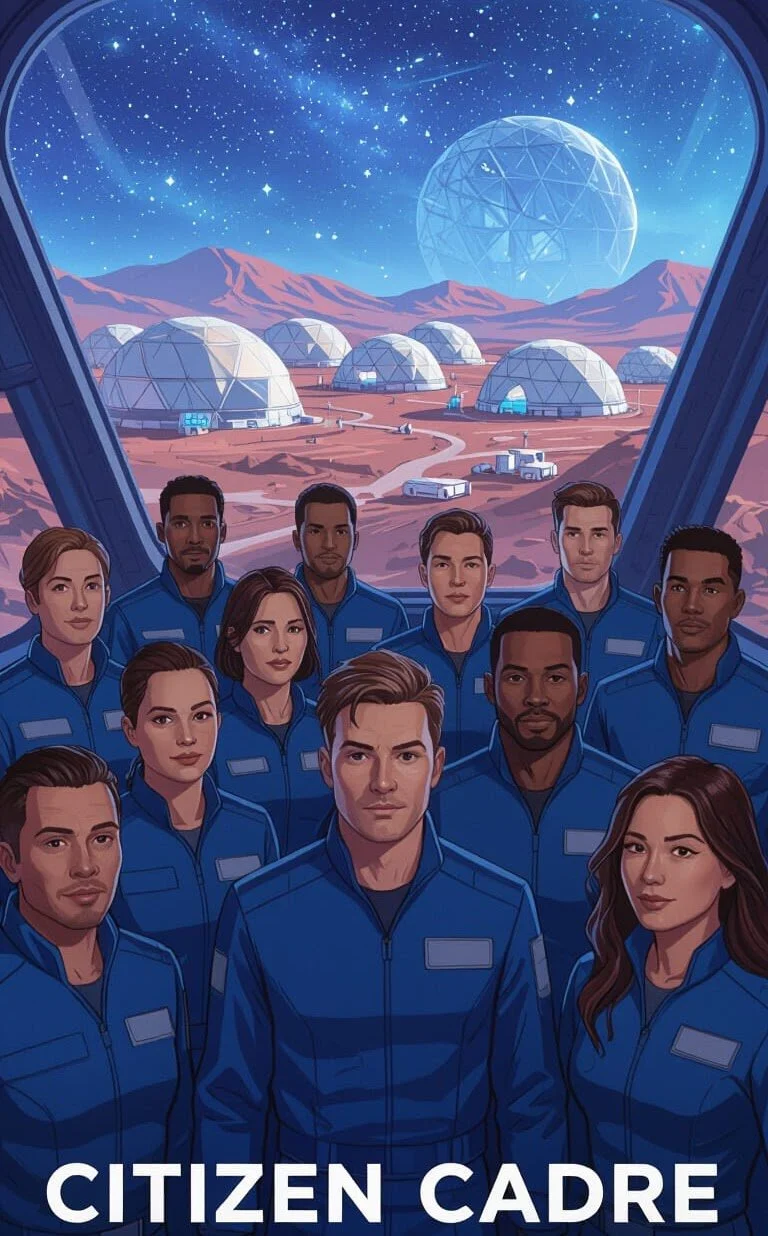
Welcome back. A city, no matter how technologically advanced, is ultimately defined by its people. The success of our first closed-loop habitat rests entirely on the selection and training of its founding inhabitants. These individuals are not passengers or colonists; they are the Citizen Cadre, the pioneers who will transform our engineered blueprint into a living, thriving society.
The Selection Philosophy: Beyond the "Right Stuff"
The traditional "Right Stuff" of astronauts—nerves of steel and ace piloting skills—is only a starting point. Technical expertise in fields like medicine, engineering, and botany is a given. Our selection process prioritizes a different, deeper set of characteristics essential for building a new community from the ground up.
Profound Empathy: The ability to understand and share the feelings of others is the most critical skill for preventing and de-escalating conflict in a closed environment.
Systems Thinking: An intuitive understanding of how individual actions impact the delicate, interconnected loops of the city's life support.
High Adaptability: A proven capacity to thrive in ambiguity and to creatively solve problems when the manual doesn't apply.
Intrinsic Motivation: A powerful internal drive to contribute to the community's shared purpose, independent of personal gain or recognition.
Candidates will be selected based on their performance in long-duration simulations within our Regenerative Systems Testbed, where their ability to collaborate under real pressure can be truly assessed.
The Training Curriculum: Forging a New Culture
The Cadre's training goes far beyond operating equipment. It is an immersive process designed to forge a resilient, multi-skilled, and cohesive new culture before they ever leave Earth.
Cross-Functional Mastery: Every citizen becomes a "master of one, jack of all trades." The biologist must be trained in basic mechanical repair; the physicist must be certified in emergency medical procedures. This creates deep redundancy and fosters mutual respect for every role required to keep the city alive.
Systems Immersion: The Cadre will spend months at a time living within the Testbed, not as a simulation, but as a full dress rehearsal. They will eat the food they grow, drink the water they recycle, and breathe the air they regenerate. They will develop an intuitive "feel" for the rhythms of the closed-loop system, learning its tolerances and capabilities firsthand.
Socio-Cultural Deliberation: Before the mission, the Cadre will use the city's governance tools to build their own social contract. They will debate, vote on, and codify their specific procedures for everything from conflict resolution and resource allocation to community celebrations. They don't just move into a new home; they build its society from the first principles, together.
Conclusion of the Series: The Human Loop
With the Citizen Cadre, our Critical Path is complete. We have laid out the milestones: a Testbed to learn, a Hub to recycle, a Grid to power, a Vanguard to build, and finally, a Cadre to inhabit and give it all meaning.
We've learned that the most elegant engineering is useless without a culture of stewardship. The final, and most important, closed-loop system is a well-selected, well-trained, and deeply connected human community.
This concludes our "Critical Path" series. We have moved from a high-level vision to a practical roadmap. The next logical step could be to produce a series of "Technical Briefs," with each installment taking a deep dive into a single piece of key technology (like the Perovskite Solar Cells or the SCWO Reactor). Or, we could explore a more narrative direction with a series like "A Day in the Life" of a citizen.
What are your thoughts on where we should focus our research next?