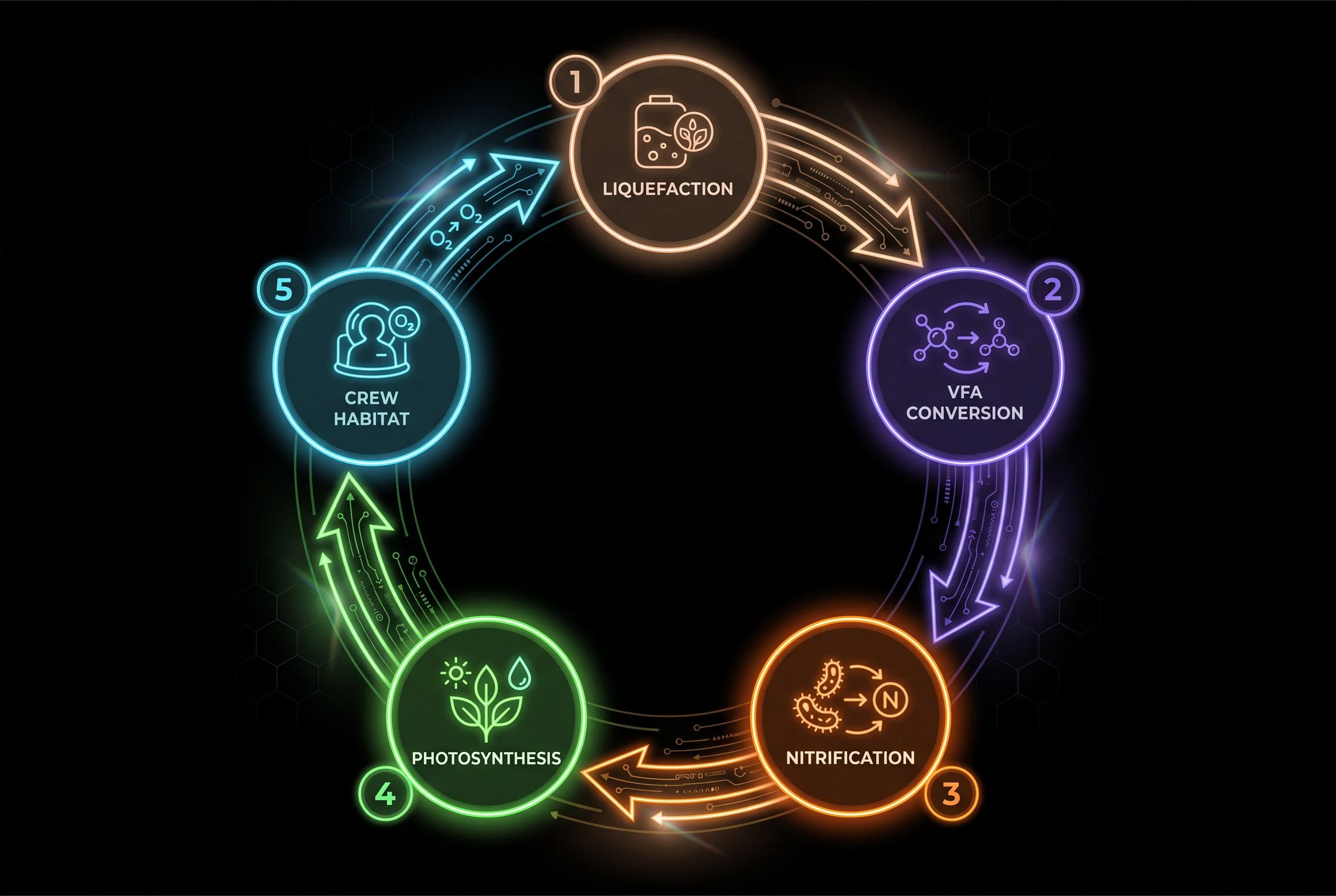
Sustaining human life beyond low-Earth orbit is fundamentally a logistics problem. A single astronaut requires roughly 0.84 kg of oxygen, 0.62 kg of dry food, and nearly 30 kg of total water (drinking, food preparation, and hygiene) per day. On the International Space Station (ISS), physicochemical Environmental Control and Life Support Systems (ECLSS) recycle water and scrub carbon dioxide, yet they remain open-loop architectures that rely on continuous cargo resupply from Earth and cannot synthesize food. For a multi-year crewed mission to Mars or a permanent lunar settlement, launching the entirety of a crew's consumable mass is financially and ballistically prohibitive.
Initiated by the European Space Agency (ESA) in 1989, the Micro-Ecological Life Support System Alternative (MELiSSA) is the longest-running and most mathematically rigorous bioregenerative life support effort in the world. Rather than attempting to replicate a massive, chaotic natural biome inside a spacecraft, MELiSSA translates the trophic cycles of an aquatic lake ecosystem into a deterministic, compartmentalized chemical engineering process. Driven solely by light energy, the system is designed to convert human metabolic waste and inedible plant biomass back into breathable oxygen, potable water, and nutritious food.
1. Historical Background & Philosophy: Engineering vs. Ecology
During the late 20th century, closed-loop life support research was dominated by holistic "ecosphere" trials, most notably the Soviet BIOS-3 facility and the privately funded Biosphere 2 project in Arizona. While these experiments demonstrated that humans could survive inside sealed environments alongside soil beds and agricultural plots, they revealed a critical flaw: complex natural ecosystems are inherently non-linear and impossible to deterministically control in small volumes. In Biosphere 2, unpredicted microbial respiration in the rich organic soil consumed oxygen faster than plants could replenish it, while excess carbon dioxide was absorbed into the concrete structure, causing ecological collapse.
Led early on by figures such as Claude Chipaux and Max Mergeay, and subsequently directed at ESA for decades by Christophe Lasseur, MELiSSA rejected the "black-box biome" model. Instead, the consortium established an engineering-first paradigm built on three foundational principles:
Strict Compartmentalization: Every biological transformation (waste breakdown, carbon conversion, nitrogen oxidation, photosynthesis) is isolated inside its own bioreactor or chamber. This prevents microbial cross-contamination and allows operators to optimize pH, temperature, and residence time for each specific organism independently.
Axenic and Defined Cultures: Rather than relying on unknown soil microbiomes, compartments utilize pure (axenic) microbial strains or strictly characterized consortia.
Deterministic Mechanistic Modeling: Before hardware is scaled or connected, the stoichiometric mass balance ($C, H, O, N, S, P$) and kinetic rates of each biological stage are mathematically modeled so the entire loop can be governed by predictive industrial control algorithms.
2. The Science: Inside the Five-Compartment Loop
The MELiSSA architecture divides the ecological recycling chain into four biological processing compartments and one consumer compartment (the crew). The diagram below illustrates how metabolic wastes are progressively mineralized and upgraded back into life-support consumables across these isolated stages:
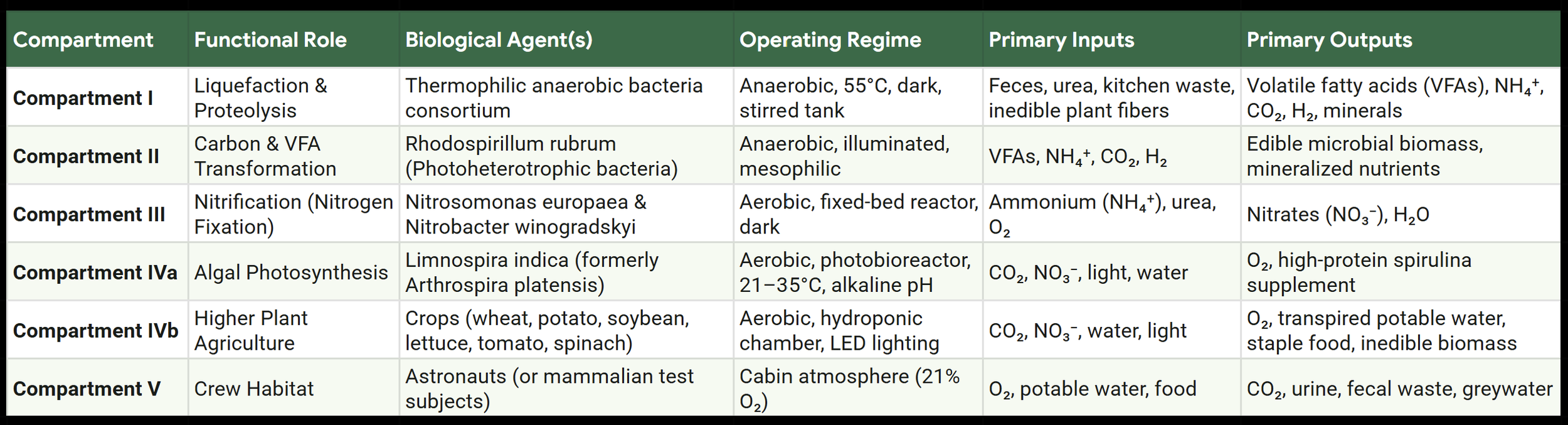
Biochemical Mechanics by Stage
Compartment I (Anaerobic Liquefaction): Raw mission wastes—fecal matter, toilet paper, kitchen scraps, and fibrous non-edible plant stems/roots—enter an anaerobic bioreactor held at thermophilic temperatures ($55^\circ\text{C}$). Operating at $55^\circ\text{C}$ accelerates enzymatic hydrolysis (proteolysis, saccharolysis, and cellulolysis) while ensuring biosafety by eradicating human pathogens. crucially, methanogenesis is intentionally suppressed so carbon is retained as soluble Volatile Fatty Acids (VFAs like acetic, propionic, and butyric acid) and $\text{CO}_2$ rather than lost as explosive methane gas ($\text{CH}_4$).
Compartment II (Photoheterotrophic Conversion): Because VFAs are phytotoxic to higher plants and cannot be directly assimilated by nitrifying bacteria, effluent from Compartment I flows into an illuminated anaerobic reactor colonized by the purple non-sulfur bacterium Rhodospirillum rubrum. Using infrared light, R. rubrum assimilates VFAs into potentially edible single-cell protein and polyhydroxyalkanoates (biopolymers), clearing the liquid stream so inorganic ammonium ($\text{NH}_4^+$) and minerals can pass forward.
Compartment III (Autotrophic Nitrification): Ammonium is toxic to plants at high concentrations and volatile in alkaline solutions. Compartment III utilizes a packed-bed biofilm reactor containing a co-culture of Nitrosomonas europaea and Nitrobacter winogradskyi. In a two-step aerobic oxidation, Nitrosomonas oxidizes ammonium into nitrite ($\text{NO}_2^-$), and Nitrobacter immediately oxidizes nitrite into nitrate ($\text{NO}_3^-$):
$$\text{NH}_4^+ + 2\text{O}_2 \longrightarrow \text{NO}_3^- + \text{H}_2\text{O} + 2\text{H}^+$$
This stabilizes nitrogen and generates the exact fertilizer ion required by cyanobacteria and higher plants.
Compartment IVa & IVb (Photoautotrophic Regeneration): Split into two complementary modules, Compartment IVa houses gas-lift photobioreactors cultivating the cyanobacterium Limnospira indica (Arthrospira platensis / Spirulina), which offers rapid, dynamically tunable $\text{CO}_2$ scrubbing and $\text{O}_2$ generation alongside protein-dense biomass. Compartment IVb comprises hydroponic Higher Plant Chambers (HPC) that provide the bulk of the crew's caloric requirements, purify water via leaf transpiration, and offer psychological benefits through fresh crop cultivation.
3. State of the Art: Ground Integration and Orbital Validation
Now managed by a consortium of 16 formal signatory partners and over 50 collaborating universities and industrial bodies across Europe, MELiSSA has transitioned from theoretical strain selection to long-duration hardware integration and flight validation.
The MELiSSA Pilot Plant (MPP) in Barcelona
The physical centerpiece of the program is the MELiSSA Pilot Plant (Claude Chipaux Laboratory), an ESA external laboratory hosted at the Universitat Autònoma de Barcelona (UAB). Operating under strict ISO 9001 industrial quality standards and cleanroom protocols, the MPP scales the loop to meet the continuous oxygen respiration requirements of one adult human (roughly $0.84\text{ kg }\text{O}_2/\text{day}$) alongside $20\text{–}40\%$ concomitant food production.
Multi-Compartment Closure: Rather than human test subjects, the MPP utilizes an isolated colony of Wistar rats in Compartment V to dynamically simulate human respiratory quotients. Researchers have successfully demonstrated continuous, multi-month gas- and liquid-phase integration linking Compartment III (ureolysis and nitrification), Compartment IVa (photobioreactor), Compartment IVb (upgraded LED-lit hydroponic Higher Plant Chamber), and Compartment V (animal isolator).
Predictive Control: The integrated compartments operate under an automated supervisory control system driven by first-principles mathematical models. If the animal crew's metabolic activity spikes (increasing $\text{CO}_2$ and depleting $\text{O}_2$), the control software automatically modulates irradiance intensity on the Limnospira photobioreactor (C4a) to match photosynthetic oxygen evolution to respiratory demand in real time.
Orbital Flight Experiments (ISS & Free-Flyers)
Because microgravity alters fluid dynamics—eliminating buoyancy-driven convection, preventing gas bubbles from rising out of liquid media, and thickening mass-transfer boundary layers around roots and biofilms—MELiSSA systematically validates its unit processes in orbit:
Arthrospira-B (2017–2018) & ARTEMISS / Arthrospira-C (2024): Flown aboard the ISS, these experiments successfully operated continuous photobioreactors in microgravity, proving that radiation exposure and weightlessness do not degrade the $\text{CO}_2\text{-to-}\text{O}_2$ conversion kinetics or genetic stability of Limnospira indica over multi-week runs.
Biorat 1 & 2: Dedicated to validating closed-loop gas exchange and metabolic control for small-mammal habitats in flight.
In Preparation for Launch (Targeting 2030 Demonstrators): Two flagship orbital experiments are currently in active preparation: URINIS (validating one-step urine nitrification in microgravity fixed-bed bioreactors) and WAPS (Water and Air management in Plant Systems, studying plant gas/water exchange in weightlessness). These feed directly into four full-scale technology demonstrators scheduled for the 2030 timeframe, including a cabin air-revitalization photobioreactor developed with Beyond Gravity and a tuberous Food Production Unit.
Terrestrial Circular Economy Spin-offs
MELiSSA's rigorous engineering has already yielded commercial Earth applications via companies like SEMiLLA IPStar. For over two decades, the Concordia Research Station in Antarctica has utilized a MELiSSA-derived greywater treatment plant to recycle wastewater for its isolated winter-over crews. Other terrestrial transfers include decentralized urine-to-fertilizer recovery units in green buildings, industrial sparkling wine $\text{CO}_2$ capture using microalgae, and high-efficiency vertical farming systems.
4. Critical Analysis: Bottlenecks and What Is Missing
Despite running for over 35 years as the gold standard of bioregenerative research, MELiSSA has not yet achieved a 100% closed-loop, human-rated system, nor has all five compartments been linked simultaneously in a continuous long-term run at full human scale. A critical evaluation exposes five fundamental scientific and engineering bottlenecks that remain unresolved.
1. The recalcitrant Lignocellulose Bottleneck (~70% Ceiling)
In a closed loop, overall system closure is dictated by the weakest link. Currently, Compartment I is that bottleneck. While thermophilic anaerobic bacteria efficiently digest human feces and simple starches, they struggle to break down recalcitrant lignocellulose—the tough structural lignin, cellulose, and hemicellulose found in wheat straw, soybean stems, and plant roots. Degradation efficiency in Compartment I typically plateaus around 70%. In a closed Mars habitat, a 30% undigested solid fraction represents a massive "carbon and mineral sink" that locks away essential elements unless supplementary physicochemical oxidation (such as supercritical water oxidation, pyrolysis, or harsh acid/alkaline hydrolysis) is added—reintroducing the exact high-energy penalties and consumables that biology was meant to avoid.
2. The Nucleic Acid Trap in Single-Cell Protein
Early concepts envisioned using fast-growing microalgae (Limnospira in C4a) and purple bacteria (R. rubrum in C2) as primary dietary staples. However, prokaryotic cells contain high concentrations of ribonucleic acid (RNA). When humans consume large quantities of microbial biomass, purine metabolism produces excess uric acid, leading rapidly to hyperuricemia, gout, and kidney stones. Consequently, untreated Limnospira can safely provide only a small fraction (roughly 5–10%) of daily caloric intake as a micronutrient/protein supplement. This forces Compartment IVb (Higher Plants) to shoulder the vast majority of food production—massively increasing the required cultivation volume, lighting power, and crop growth lag-times (weeks to months vs. hours for bacteria).
3. Equivalent System Mass (ESM) and Power Penalties
Aerospace mission planners evaluate life support architectures using ALiSSE (Advanced Life Support System Evaluator) criteria and Equivalent System Mass (ESM), which converts volume, electrical power, cooling demand, and crew maintenance time into an equivalent launch mass penalty. Bioregenerative systems carry an enormous upfront mass penalty: cubic meters of water inside bioreactors, heavy glass/steel vessels, complex peristaltic plumbing, and massive LED arrays (plus thermal radiators to reject waste heat from those LEDs). Unless a mission exceeds a critical "break-even duration" (typically estimated at 2.5 to 5+ years depending on nuclear vs. solar power availability), physicochemical systems (like Sabatier reactors paired with pre-packaged food) remain lighter and simpler than flying a full MELiSSA plant.
4. Micro-Pollutants, Xenobiotics, and Biofilm Fouling
Human urine and fecal streams are not pure chemical solutions of urea and cellulose; they contain pharmaceutical metabolites (antibiotics, painkillers, hormones), personal care biocides, and heavy metals leached from stainless steel hardware. Because Compartment III relies on delicate autotrophic nitrifying bacteria (Nitrosomonas and Nitrobacter) that have notoriously slow doubling times, even trace antibiotic or biocide breakthrough can poison the biofilm and cause catastrophic ammonia accumulation. Conversely, in microgravity, unchecked biofilm growth inside narrow tubing and optical sensors leads to rapid biofouling, clogging membranes and blinding spectrophotometric control loops.
5. Genetic Drift and the "Compartment II Question"
Operating axenic cultures under space radiation and shear stress over multiple years invites spontaneous genetic mutation (MELGEN research domain) or viral bacteriophage contamination. Furthermore, while Compartment II (Rhodospirillum rubrum) is scientifically elegant on paper, you will notice that recent MPP integration milestones routinely connect Compartments III, IVa, IVb, and V while bypassing Compartment I and II. Full end-to-end integration from raw solid fecal/fibrous waste (C1 $\rightarrow$ C2 $\rightarrow$ C3) into the plant/algal food chain remains the most fragile, least mature link in the physical pilot facility.
5. Next Steps: Closing the Gaps
To transition MELiSSA from a terrestrial laboratory demonstration into flight-ready lunar or Martian habitat infrastructure in the 2030s, the consortium's roadmap focuses on four critical steps:
Hybrid Physicochemical-Biological Pretreatment: Bridging the 70% fiber degradation wall in Compartment I by integrating compact hydrothermal, enzymatic, or electrochemical pre-treatments (and urine electro-stripping) to break down lignin and strip xenobiotic drugs before the stream hits sensitive microbial beds.
Complete 5-Compartment End-to-End Integration at MPP: Connecting the anaerobic digestion and VFA conversion stages (C1 and C2) directly into the operational C3–C4a–C4b–C5 loop at the Barcelona Pilot Plant to prove long-term trace-element stoichiometry and prevent progressive micronutrient depletion or salt toxicity.
Autonomous Micro-Sensors and AI Fault Recovery: Replacing high-maintenance laboratory analyzers with miniaturized, self-calibrating inline sensors capable of detecting biofilm drift, nitrite spikes, or trace pathogen intrusion without requiring hours of astronaut laboratory labor.
Lunar Surface Precursor Deployment: Utilizing upcoming Artemis and European lunar surface initiatives as an intermediate fractional-gravity ($0.16g$) testbed for modular subsets of the loop—specifically the URINIS nitrification reactor and the ArtEMISS photobioreactor—before committing to a full-scale closed habitat.
6. Prominent and Stable Web Resources
For direct access to technical specifications, peer-reviewed publications, and institutional updates, consult the primary portals maintained by ESA and the consortium:
MELiSSA Foundation (Official Consortium Portal): https://www.melissafoundation.org/ — The primary hub for the MELiSSA program, featuring detailed breakdowns of the scientific concept, flight experiment timelines, academic library, and partner network.
European Space Agency (ESA) – MELiSSA Engineering Portal: https://www.esa.int/Enabling_Support/Space_Engineering_Technology/Melissa — ESA's official technical documentation covering the closed-loop compartments, mathematical modeling, and agency-level programmatic objectives.
MELiSSA Pilot Plant – Universitat Autònoma de Barcelona (UAB): https://webs.uab.cat/melissapilotplant/en/ — Official portal of the Claude Chipaux external ESA laboratory in Spain, detailing pilot-scale hardware integration, ISO quality certifications, and experimental infrastructure.
SEMiLLA IPStar (Terrestrial Technology Transfer): https://semillaipstar.com/ — The official commercialization and circular-economy venture spun out of the MELiSSA consortium to deploy space-grade water, nutrient, and carbon recycling systems on Earth.
7. Engage Your AI
Would you like to see how this works in real time? Copy this prompt and paste it into Gemini Argon or chosen AI to generate an interactive architectural explorer and have some fun:
"Generate a single-file interactive React or HTML/JS/CSS widget illustrating the 5-compartment MELiSSA bioregenerative loop. The layout should feature a circular system architecture diagram on the left containing five selectable nodes: Compartment I (Liquefaction), Compartment II (Photoheterotrophic), Compartment III (Nitrification), Compartment IV (Photoautotrophic), and Compartment V (Crew). Connect these nodes with directed arrows featuring smooth CSS animations of flowing particles to represent continuous resource recycling. On the right side, build a dynamic telemetry panel. When a user clicks a node in the diagram, this panel must update to display that compartment's biological agents, temperature/pH conditions, chemical inputs/outputs, and primary engineering bottlenecks. Include a global toggle button that switches the diagram's visual state between 'Standard Mass Flow' and 'Engineering Bottlenecks'."