Chemical Tweezers – Mining the Megatons with MOFs
From the Laboratories of Project Clean Up (08/21/2026)
As we push the boundaries of technology—from the superconducting magnets in a fusion tokamak to the solid-state motors in our autonomous transit pods—our reliance on Rare Earth Elements (REEs) skyrockets.
The traditional mining of REEs is an ecological nightmare, involving the displacement of millions of tons of earth and the creation of radioactive, toxic waste lakes. Yet, ironically, millions of tons of these exact elements are currently sitting trapped in industrial slag heaps outside of steel and iron foundries around the world. The challenge has always been separation: how do you pull a single atom of Neodymium out of a sea of molten iron and silica?
In 2026, we have moved beyond brute-force acids. We are using Advanced Metal-Organic Frameworks (MOFs).
1. The Molecular Sieve
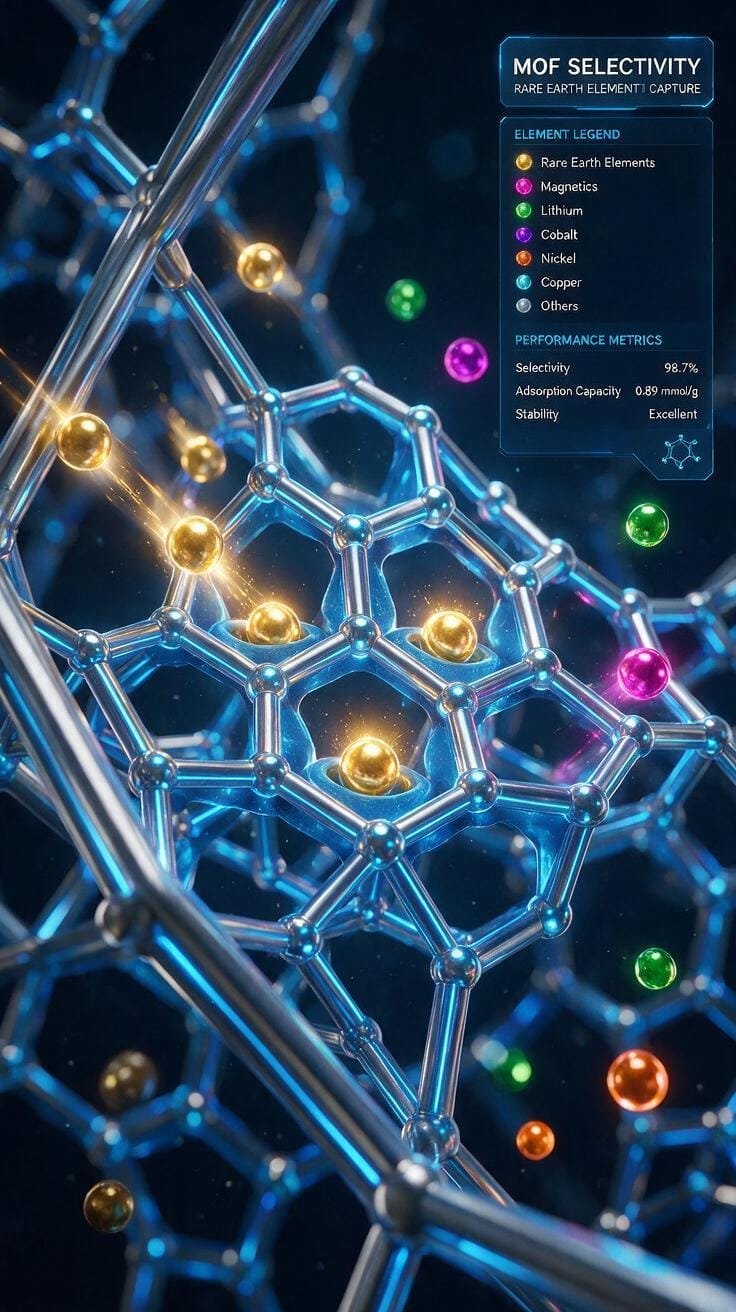
MOFs are highly crystalline, porous materials composed of metal nodes connected by organic ligands. Think of them as molecular scaffolding. Because they are synthesized from the bottom up, we can tune the exact size and chemical affinity of the "pores" in the scaffold.
For the Slag Mine project, PCU chemists engineered a MOF with pores designed to match the exact ionic radius of specific rare earth metals. When a processed liquid solution of industrial slag is passed through this MOF, the iron, calcium, and silica flow right through. But the Neodymium and Dysprosium ions fit perfectly into the pores and are chemically locked in place. They act as microscopic chemical tweezers.
2. The Data Exchange: Matching the Molecule
This level of precision chemistry only works if we know exactly what is in the waste stream. This is where the Algorithmic Commodity Exchange operates.
Factories participating in the PCU Eco-Park system stream real-time spectroscopic data of their waste outputs to the cloud. The AI constantly maps this output against the input needs of advanced manufacturers. When the algorithm detects a high enough concentration of a specific element—say, Boron for advanced radiation-shielding glass—it autonomously triggers the deployment of the exact MOF required to extract it.
3. The Lifecycle Standard: The Benign Release
Under the PCU Lifecycle Standard, the extraction material itself must be endlessly reusable.
Once the MOF is fully saturated with rare earth ions, it must be emptied. Unlike traditional ion-exchange resins that degrade or require harsh chemicals to regenerate, our advanced MOFs use a Stimuli-Responsive Release. By applying a very specific low-voltage electrical current or a mild, localized pH shift, the MOF slightly changes its shape, releasing its grip on the rare earths.
The pure elements are flushed out, ready for manufacturing, and the MOF resets to its original structure, ready to mine the next batch of slag.
The 2026 Vision: The Autonomous Supply Chain
At Project Clean Up (PCU), we are proving that advanced materials are not just the end product; they are the tools of creation. By combining high-frequency waste data with hyper-specific molecular extraction, we are ending the era of raw earth extraction. The factories of the future will not dig into the earth for their advanced materials; they will simply harvest them from the exhaust of their neighbors.