The Symbiotic Web – Engineering the Zero-Waste Industrial Park
From the Laboratories of Project Clean Up (08/14/2026)
The concept of Industrial Symbiosis isn't entirely new—the famous Kalundborg Symbiosis in Denmark proved decades ago that factories could share steam, water, and gas. However, those early models were rigid, requiring decades of physical infrastructure planning. If one factory closed, the whole web collapsed.
In 2026, we are upgrading this concept from a rigid physical pipeline to a dynamic, chemically agile network.
1. The Linear Flaw: The Cost of Isolation
In a traditional industrial zone, a steel mill generates massive amounts of waste heat (slag) and pays a premium to cool it down. A block away, a chemical manufacturer pays a massive premium to the local utility to generate heat for their reactors. Both companies are losing capital to manage opposing sides of the exact same thermal equation, simply because they are isolated from one another.
To achieve a true circular economy, we must stop treating factories as standalone entities and start treating them as interconnected organs in a larger body.
2. The Dynamic Exchange: Upcycling at Scale
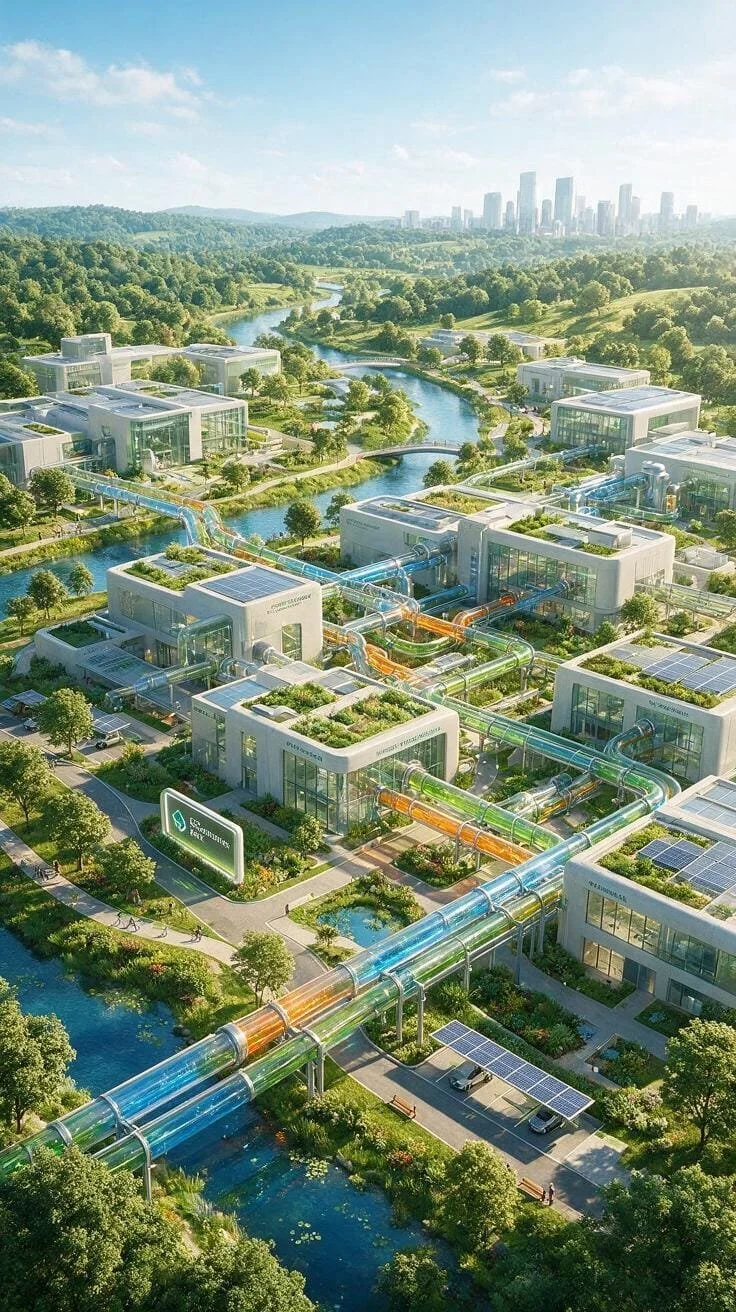
The 2026 Industrial Eco-Park is built on the principle of cascading resources.
Thermal Cascading: High-grade steam from heavy manufacturing is used to spin turbines. The resulting medium-grade heat is piped to warm a neighboring indoor aeroponic farm. The final, low-grade heat is used to maintain the temperature of localized biological digesters.
Material Swaps: The gypsum byproduct from a power plant’s emission scrubbers is routed directly to a drywall manufacturer. The highly alkaline wastewater from a textile dye house is routed to neutralize the highly acidic runoff from a metal plating facility before it ever hits the municipal sewer.
3. The Lifecycle Standard: Algorithmic Brokerage and Membrane Filtration
The historical barrier to Industrial Symbiosis is purity. Factory B cannot use Factory A's waste water if the chemical composition fluctuates by even 2%; it will destroy their machinery.
Under the PCU Lifecycle Standard, we solve this with Algorithmic Brokerage and Active Membrane Routing.
Instead of a dumb pipe connecting two buildings, the connection is governed by real-time IoT chemical sensors and smart filtration membranes (like the aquaporins we scaled in Issue 57). The algorithm monitors Factory A’s output. If the waste stream meets Factory B’s strict specifications, the membrane allows it through. If a sudden spike in impurities is detected, the smart membrane instantly isolates the batch, routing it to a Nexus reactor to be polished back into spec.
This creates absolute trust between industries. They are no longer buying "waste"; they are buying a guaranteed, hyper-local, precision-engineered raw material at a fraction of the cost of global imports.
The 2026 Vision: The Industrial Organism
At Project Clean Up (PCU), we are looking at the skyline of the industrial sector and erasing the smokestacks. An Eco-Park in 2026 operates with a net-zero footprint. It draws minimal fresh water, outputs zero toxic effluent, and vents no waste heat. The industries within it survive and thrive precisely because they are feeding off one another in a perfectly balanced, algorithmically managed chemical ballet.