DNA Origami & Copolymers – The "Guerilla" Factory
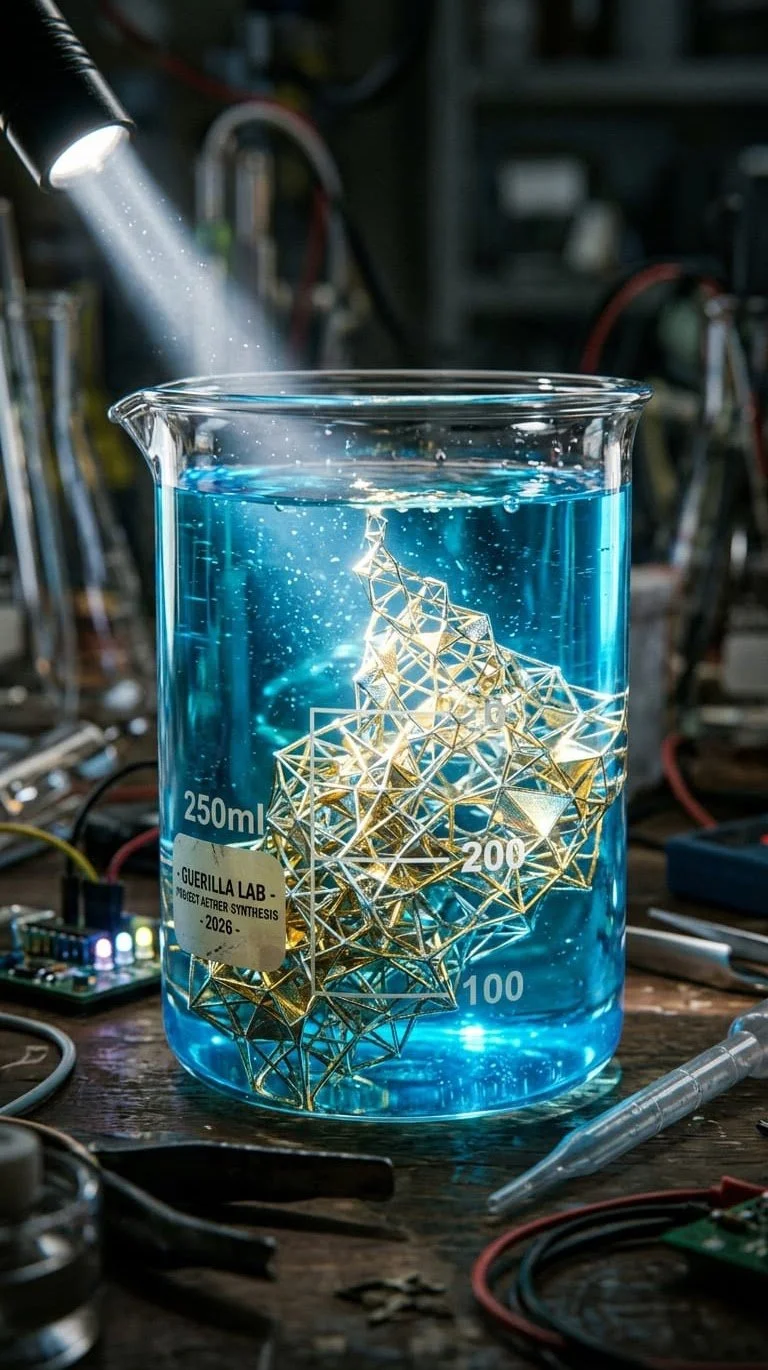
From the Laboratories of Project Clean Up (03/13/2026)
As we move into mid-March 2026, researchers at MIT and Caltech have successfully scaled Directed Self-Assembly (DSA) for semiconductor patterns. It is vital to note: while self-assembling materials are perfect for creating the high-precision 2D patterns needed for our transient suite, they are not yet able to build 3D macroscopic structures like a smartphone casing or a car chassis.
Why Self-Assembly? Efficiency by Design
The "top-down" approach (lithography) is reaching its physical limit. Self-assembly is "bottom-up." By engineering Block Copolymers—long-chain molecules with two different "ends" that hate each other—we can force them to arrange into perfect lines, circles, or lattices just by letting them sit on a surface. Even more advanced is DNA Origami, where we use the natural base-pairing of DNA to fold "scaffolds" that can carry the MXene shielding or Liquid Metal traces we developed in February.
The Lifecycle Standard: Programmed Reversibility
Under the PCU Lifecycle Standard, we have verified the "Triggered Collapse" pathway for self-assembled hardware:
The Challenge: Traditional chips are "frozen" in their state; they can only be destroyed.
The PCU Solution: Thermodynamic Reversal. Because self-assembled structures are held together by specific, programmed intermolecular forces, we can "turn off" those forces.
By introducing a specific chemical "key" or a thermal pulse, the "locks" holding the molecules together release. The device literally melts back into a "primordial soup" of its base components. These components can then be filtered and reused to "grow" the next device. This isn't just recycling; it's Molecular Reincarnation.
The 2026 Vision: The Desktop Foundry
At Project Clean Up (PCU), we are finalizing the vision for the Desktop Foundry. In 2026, a scientist in a "Guerilla Lab" doesn't need a billion-dollar supply chain. They need a library of programmed molecules and the right light triggers. We can grow a sensor, use it to track PFAS, and then dissolve it back into the same beaker to grow another one tomorrow. We have removed the "Permanence Penalty" from the act of creation. Learn more about "Beaker-to-Beaker" manufacturing at projectcleanup.com.