Organic OECTs – The Brains of the Transient Age
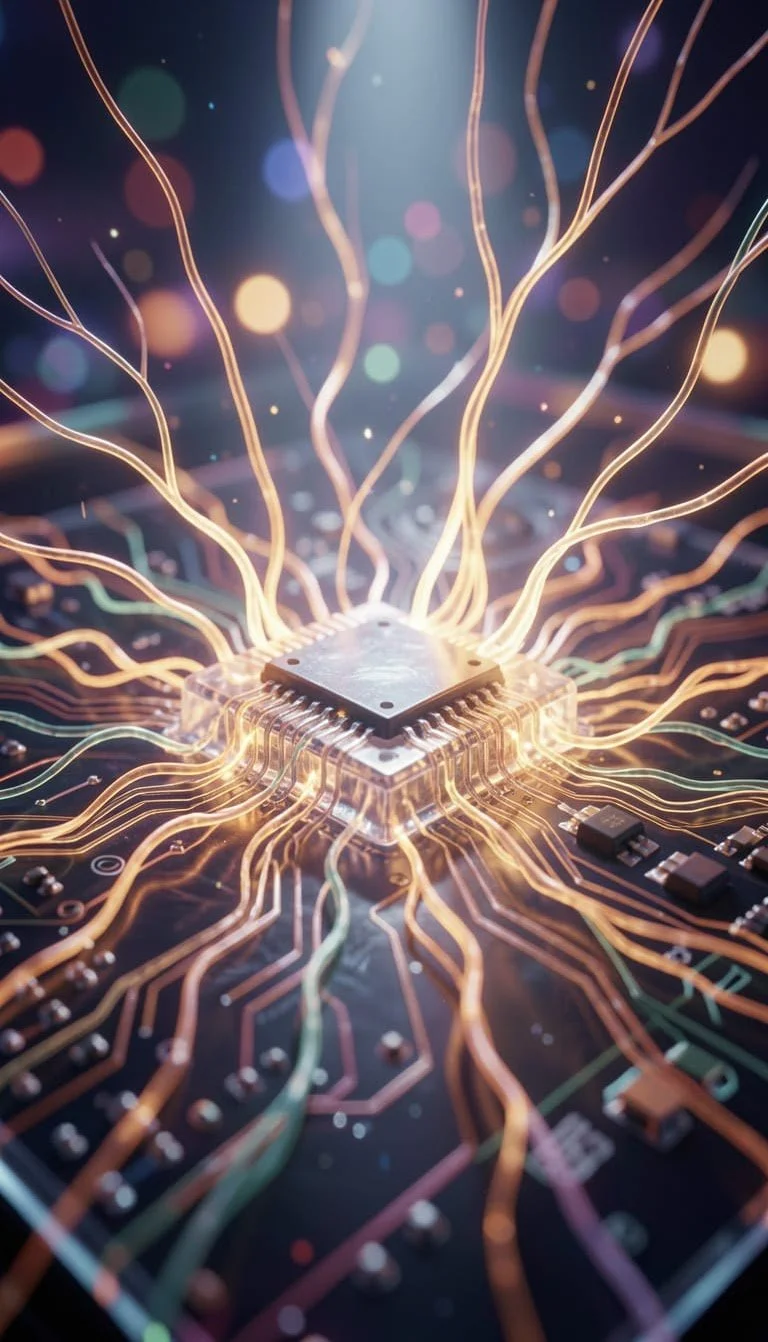
From the Laboratories of Project Clean Up (03/06/2026)
As we move into March 2026, researchers at Northwestern University and Linköping University have achieved a breakthrough in scaling Organic Electrolytic Transistors. It is vital to note: while these organic neuromorphic chips are superior for pattern recognition and "edge" sensing, they are not yet capable of the raw processing power required for complex desktop computing or high-end graphics rendering.
Why Neuromorphic? Efficiency Through Biology
Traditional chips separate memory and processing, wasting energy moving data back and forth. Neuromorphic chips combine them, mimicking the synapse. By using polymers like PEDOT:PSS, these chips can store "weight" (memory) by changing their conductivity based on ion flow. This allows a 2026 "Smart Sensor" to "learn" its environment—distinguishing between harmless minerals and toxic PFAS—without needing to send data back to a central server. This "intelligence at the edge" is powered by the same sugar-based biobatteries we discussed last week.
The Lifecycle Standard: Molecular Dissociation
Under the PCU Lifecycle Standard, we have verified the "Unzipping" pathway for these processors:
The Challenge: Silicon chips require 1,000°C smelting to recover trace elements.
The PCU Solution: Enzymatic Depolymerization. Because OECTs are built from polymer chains, we can introduce a specific enzyme (like laccase) into the recycling bath.
As the board dissolves and the liquid metal is recovered, the enzyme targets the OECT's "brain." It breaks the long polymer chains back into their base monomers—simple organic molecules that are naturally biodegradable. This is Molecular Dissociation: the chip doesn't just break; it reverts to its pre-manufactured state.
The 2026 Vision: The Sentient Environment
At Project Clean Up (PCU), we are finalizing the Total Transient Suite. Imagine millions of these "sentient" sensors scattered in the ocean. They "think" locally, powered by the water's movement or simple glucose, detecting contaminants with neuromorphic precision. Once their job is done, they receive a "shutdown" signal that triggers their internal aqueous reset. Within days, the intelligence and the hardware have both returned to the earth. We have achieved Zero-Legacy Technology. Learn more about "Synaptic Sensors" at projectcleanup.com.