

Forged Memory – The Physics of Nitinol
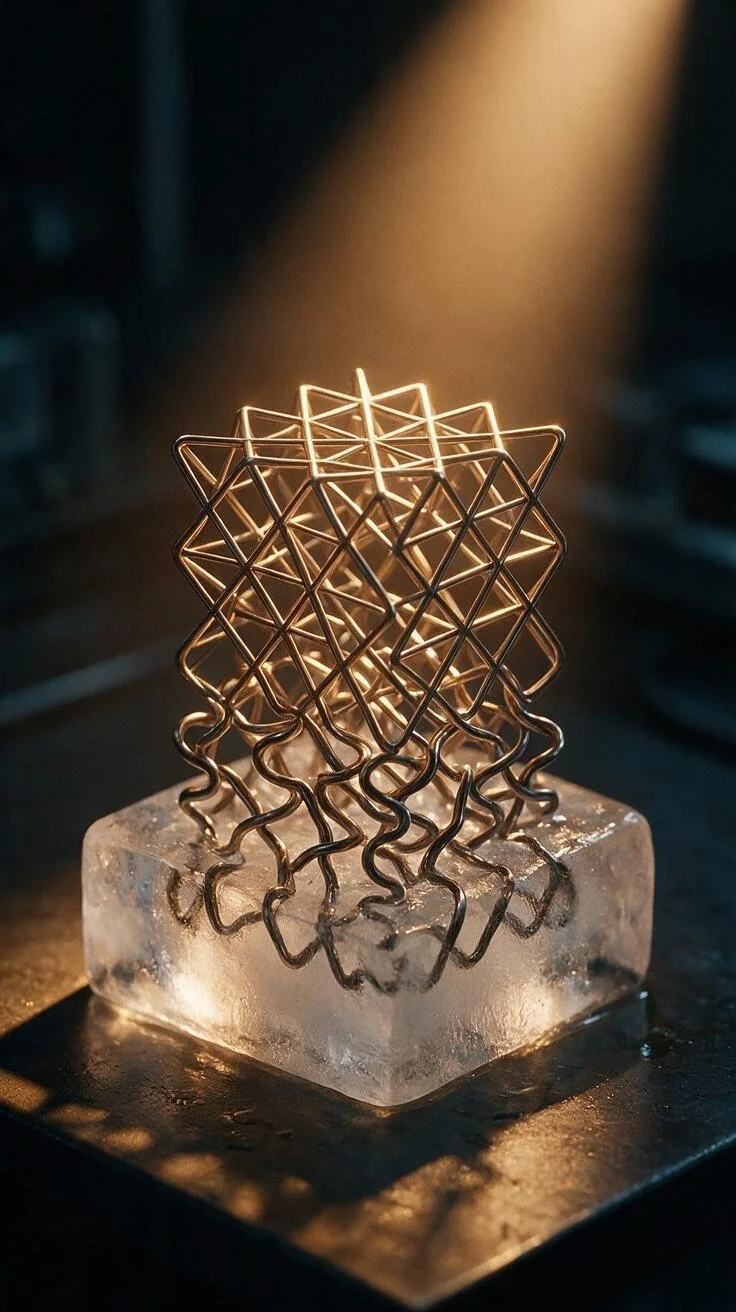
From the Laboratories of Project Clean Up (10/09/2026)
The most famous Shape Memory Alloy is Nitinol (Nickel-Titanium). Discovered serendipitously in a naval laboratory in 1959, it has spent decades primarily in the medical field. If you or someone you know has a cardiovascular stent, it is likely made of Nitinol. It is compressed to fit inside a tiny catheter, but once released into the warm bloodstream, the metal "remembers" its expanded tubular shape and props the artery open.
In 2026, we are scaling this technology out of the human body and into heavy industry and aerospace.
1. The Austenite-Martensite Flip
To understand how a solid piece of metal can remember its shape, we have to look at its atomic crystal lattice. Nitinol doesn't "melt" to change shape; it undergoes a solid-state phase transformation.
At cooler temperatures, the metal is in a phase called Martensite. In this state, the crystal structure is like an accordion. It can be easily bent, crushed, and stretched. To the naked eye, it feels like a piece of soft wire.
However, when heated above its specific "transformation temperature," the atoms violently rearrange themselves into a rigid, highly structured phase called Austenite. The metal refuses to stay deformed. It snaps back to the exact shape it was originally forged in, pulling with incredible mechanical force as it does so. When it cools back down, it returns to the soft Martensite state, ready to be deformed again.
2. The Death of Hydraulics
By 2026, the integration of heavy-duty SMA actuators is transforming robotics and aviation.
Consider an airplane wing. To deploy the flaps for landing, aircraft rely on hundreds of pounds of hydraulic fluid, massive pressurized pumps, and heavy metal pistons. A failure in the hydraulic line means the flap gets stuck.
By replacing hydraulic pistons with thick Nitinol cables, engineers have created solid-state aviation. To move the wing flap, a small electrical current is sent through the cable. The electrical resistance heats the metal, causing the Nitinol to instantly shrink and pull the flap down with thousands of pounds of force. It is lighter, silent, and immune to fluid leaks.
3. The Lifecycle Standard: The Nickel Dilemma
Under the PCU Lifecycle Standard, the widespread deployment of Nickel-Titanium alloys presents a severe end-of-life challenge that we must solve before scaling.
The Legacy Flaw: Nickel is a heavy metal, a known allergen, and highly toxic if it leaches into groundwater. Furthermore, the shape memory effect only works if the ratio of Nickel to Titanium is mathematically perfect (roughly 50/50). If you toss a broken Nitinol actuator into a standard metal recycling smelter, the ratio is destroyed, and the resulting slag is useless for future memory alloys.
The PCU Solution: Ion-Selective Electro-Winning.
We do not melt down old Nitinol. When a shape-memory component reaches the end of its life, it is routed to a PCU recovery facility and dissolved in an advanced deep-eutectic solvent.
We then apply a highly calibrated, pulsating electrical current to the liquid bath. Because Nickel and Titanium have different electrochemical potentials, we can selectively plate them out of the solution one at a time. The Titanium binds to the cathode first, followed by the Nickel.
We successfully recover 99.8% of the raw, purified elements at room temperature. This allows us to re-weigh the metals perfectly and forge a brand-new, flawlessly tuned memory alloy without relying on destructive new mining.
The 2026 Vision: The Material Brain
At Project Clean Up (PCU), we are witnessing the blurring of the line between a structural material and a computer. By engineering the crystalline structure of metals, we are creating infrastructure that can sense its environment, make a binary decision, and physically actuate—all without a single line of software code. We are building a world where the intelligence of the machine is forged directly into its bones.
