

The Soft Machine – The Physics of Artificial Muscles
From the Laboratories of Project Clean Up (10/02/2026)
To understand why a material like a Liquid Crystal Elastomer is so revolutionary in 2026, we have to look at the intersection of two very different everyday items: a rubber band and a flat-screen television.
1. The Molecular Accordion
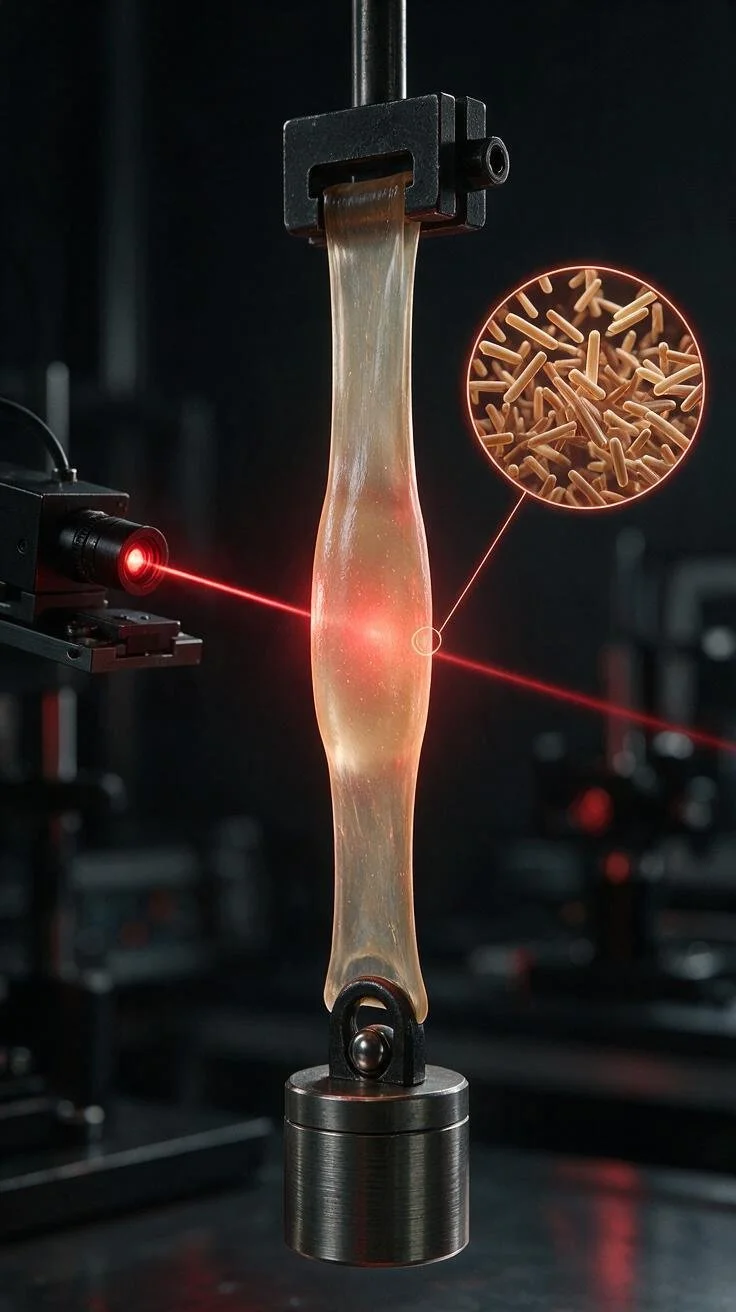
An elastomer is simply a rubbery polymer—it can stretch and return to its original shape. Liquid crystals (the 'LC' in LCD screens) are rigid, rod-like molecules that naturally want to align themselves in the same direction, much like matches in a box.
Chemists created LCEs by permanently grafting these rod-like liquid crystals directly onto the flexible chains of a rubbery polymer.
When the material is at rest, the liquid crystals are perfectly aligned, holding the rubber in a stretched, rigid state. But when a specific trigger is introduced—such as a flash of LED light or a small pulse of heat—the liquid crystals instantly scramble and lose their alignment. Without the crystals holding them straight, the rubber polymer chains violently coil up like a released spring.
The macroscopic result is staggering: the physical strip of material instantly and forcefully contracts by up to 400% of its length, pulling with immense strength. When the heat or light is removed, the crystals realign, and the "muscle" relaxes.
2. The Death of the Servo
The integration of LCEs is rapidly transforming robotics, aerospace, and consumer electronics.
If you are building a soft robotic hand to harvest delicate fruit, or a micro-bot to navigate a collapsed building, you can no longer afford the weight and bulk of traditional metal servos and copper wiring. By using LCE threads, engineers can weave actuation directly into the fabric of the machine. The robot moves silently, fluidly, and continuously, triggered simply by shining a light on specific joints or applying ambient thermal energy.
3. The Lifecycle Standard: Vitrimeric Unzipping
Under the PCU Lifecycle Standard, the widespread deployment of synthetic rubbers triggers a massive red flag.
The Legacy Flaw: Traditional elastomers (like car tires or vulcanized rubber) are "thermosets." Their chemical bonds are permanently locked. You cannot melt a car tire down to pour a new one; it simply burns. If millions of devices transition to LCE muscles, we risk creating an unrecyclable mountain of synthetic rubber.
The PCU Solution: Dynamic Covalent Bonds (Vitrimers).
The 2026 generation of PCU-approved LCEs are synthesized as Vitrimers. Instead of permanent, static cross-links holding the rubber network together, vitrimers use dynamic, "shape-shifting" bonds.
Under normal operating temperatures, the artificial muscle is strong, durable, and functions exactly like a permanent thermoset. However, when the machine reaches the end of its life, the LCE is exposed to a highly specific, elevated temperature combined with a green chemical catalyst. The dynamic bonds temporarily "unzip." The solid rubber melts into a viscous liquid, allowing the entire material to be easily separated, filtered, and seamlessly re-cast into brand-new artificial muscles with absolutely zero loss in performance.
The 2026 Vision: The Biomechanical Urban Mesh
At Project Clean Up (PCU), we are witnessing the obsolescence of the mechanical gear. By harnessing the molecular organization of liquid crystals, we are decoupling movement from heavy metals, toxic lubricants, and rare-earth mining. The machines, medical devices, and transit infrastructure of the future will not hum, grind, or whine. They will expand, contract, and breathe, operating with the silent, fluid efficiency of a living organism.
