

The Passive Thermostat – The Physics of PCM Textiles
From the Laboratories of Project Clean Up (09/25/2026)
The human body is an engine that constantly produces heat. When we get too hot, we sweat to cool down. When we get too cold, we shiver to generate warmth. Our clothing has historically been "dumb"—it traps heat (like a winter coat) or breathes (like a linen shirt), but it cannot actively respond to changing conditions.
In 2026, materials science has given fabrics a brain, utilizing a concept known as Latent Heat.
1. The Microcapsule Mechanism
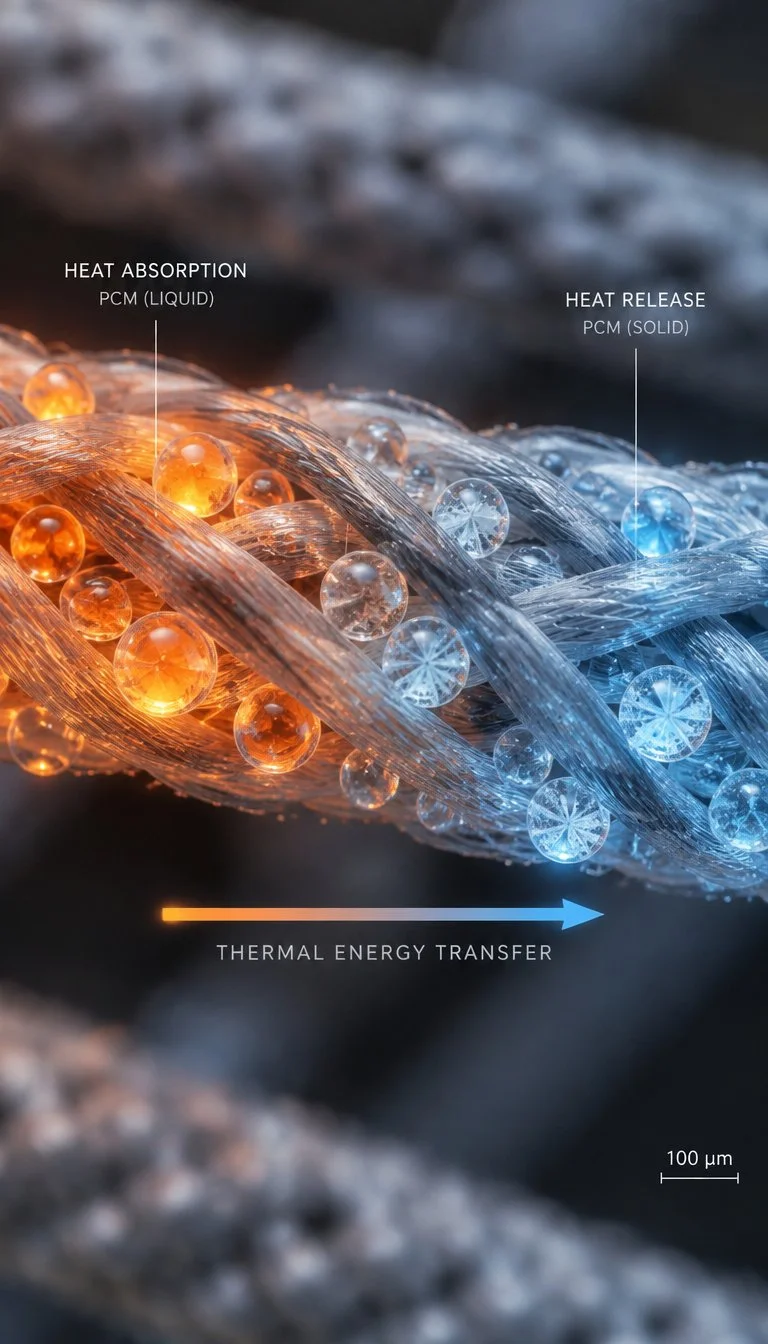
Phase Change Materials (PCMs) are substances that absorb and release thermal energy during the process of melting and freezing (changing phase).
In advanced textiles, microscopic spheres of PCM are permanently embedded directly into the fibers of a shirt or a jacket. These PCMs are chemically engineered to have a melting point right around human skin temperature (typically 82°F to 86°F).
If you walk into a hot room or start to exercise, your skin temperature rises. The moment it hits the threshold, the microscopic PCM spheres melt into a liquid. The act of melting absorbs massive amounts of heat from your body, creating an instant, sustained cooling effect. Conversely, if you walk out into the cold, the liquid PCM solidifies. As it turns back into a solid, it releases all of that stored latent heat directly back into your skin, keeping you warm.
2. The Macro-Energy Impact: Widening the Deadband
The true value of PCM clothing is not just extreme sports or outdoor survival; it is urban energy consumption.
In HVAC engineering, there is a concept called the "deadband"—the temperature range where neither heating nor cooling is required. By equipping the urban workforce with subtle, everyday PCM baselayers or office wear, we create a Personal Microclimate. Because the individuals are kept in a state of continuous thermal equilibrium by their clothing, building managers can drastically widen the thermostat deadband.
Allowing an office building to naturally fluctuate between 65°F and 78°F, rather than locking it at a rigid 72°F, saves millions of megawatts of grid power annually.
3. The Lifecycle Standard: The Microplastic Threat
Under the PCU Lifecycle Standard, embedding microscopic spheres into clothing sets off massive ecological alarm bells. We cannot deploy this technology if washing a PCM shirt flushes billions of acrylic microplastics into the ocean.
The Legacy Flaw: Early 2000s PCMs relied on petroleum-based paraffin waxes encapsulated inside synthetic, non-biodegradable plastic shells. As the garments wore down, they shed micro-pollutants.
The PCU Solution: Bio-Lipids and Cross-Linked Cellulose.
The 2026 generation of PCMs has entirely abandoned petroleum. The "wax" inside the capsule is now synthesized from advanced plant-derived lipids (fats and oils) that are fully biodegradable. More importantly, the microcapsule shell itself is constructed from cross-linked cellulose.
When a PCM garment reaches the end of its life under the PCU framework, it does not become toxic waste. When exposed to the high-microbial environment of an industrial composter, soil bacteria easily break the cellulosic bonds of the micro-shells. The bio-lipids are released and immediately metabolized by the microbes as high-energy food. The technology that controls the climate of the human seamlessly returns to the biology of the earth.
The 2026 Vision: The Autonomous Wardrobe
At Project Clean Up (PCU), we are proving that the most powerful infrastructure is often invisible. By integrating the physics of latent heat into the very threads we wear, we are decoupling human comfort from heavy industrial HVAC units. The wardrobe of the future does not just cover us; it responds, breathes, and actively balances our relationship with the environment around us.
