

The Seebeck Revolution – Advanced Thermoelectric Alloys
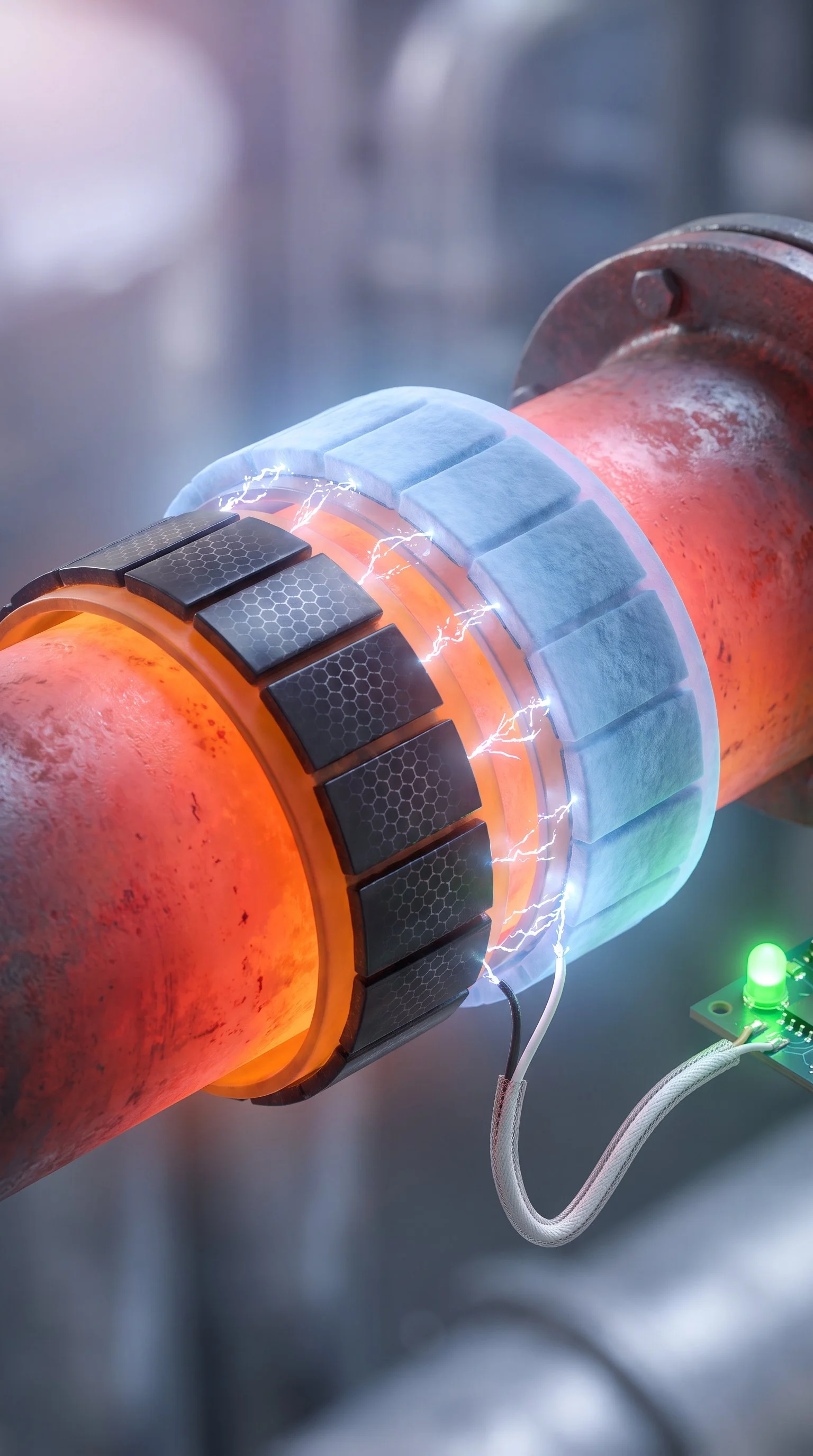
From the Laboratories of Project Clean Up (09/18/2026)
The concept of turning heat into electricity is not new. In 1821, physicist Thomas Johann Seebeck discovered that if you take two different metals, join them together, and make one side hot while the other stays cold, an electrical current flows between them.
For decades, this "Seebeck Effect" was used primarily in deep-space probes (like the Voyager spacecraft) where conventional solar panels were useless. But the materials were too expensive, toxic, and rigid for everyday commercial use. In 2026, materials science has finally broken the bottleneck.
1. Bismuth-Telluride to Half-Heusler Alloys
Historically, the best thermoelectric material was Bismuth-Telluride (Bi2Te3). It was heavy, brittle, and Tellurium is as rare as gold. It violated the PCU mandate for abundance.
The modern breakthrough lies in Half-Heusler Alloys and Conductive Polymers. By engineering specific lattice structures using vastly more abundant elements (like Titanium, Nickel, and Tin), chemists have created thermoelectric materials that can withstand searing industrial temperatures without breaking down. Furthermore, by embedding these thermoelectric nanoparticles into flexible polymer matrices, we can now "print" TEGs as flexible strips, allowing them to wrap seamlessly around curved industrial pipes or automotive exhaust systems.
2. The Data Center Savior
One of the largest deployments of flexible TEGs in 2026 is inside massive AI data centers. The servers required to run advanced AI models generate immense localized heat.
Instead of just using massive air conditioners to fight this heat, the server racks themselves are now lined with TEG strips. The temperature difference between the hot processors and the liquid-cooling lines creates a continuous electrical current. This current is fed directly back into the data center’s cooling fans. The hotter the servers get, the faster the TEG-powered cooling fans spin, creating a perfectly autonomous, self-balancing thermal loop that slashes the facility's total grid draw.
3. The Lifecycle Standard: Hydrometallurgical Delamination
Under the PCU Lifecycle Standard, the deployment of millions of thermoelectric strips cannot result in a new e-waste crisis when the semiconductors eventually degrade.
The Lead/Tellurium Problem: Old TEGs were soldered with lead and contained toxic heavy metals. Shredding them for standard recycling risked environmental contamination.
The PCU Solution: Hydrometallurgical Delamination. When a 2026 flexible TEG skin reaches the end of its life, it is submerged in a highly specific, green deep-eutectic solvent. Instead of smelting the material at 1,000 degrees, the solvent operates at room temperature. It systematically delaminates the flexible polymer backing, leaving the raw Half-Heusler alloy nanoparticles intact. A secondary mild acid wash isolates the titanium, nickel, and tin into distinct, high-purity streams.
Because we use chemical precision rather than brute-force heat, we recover 99% of the active semiconductor materials, ready to be immediately re-cast into the next generation of thermal scavengers.
The 2026 Vision: The Silent Harvesters
At Project Clean Up (PCU), we are ending the era of the thermal exhaust pipe. In the city of the future, nothing is vented into the sky without being harvested first. The heat from your apartment building's boiler powers the hallway lighting. The friction of the subway train powers its own diagnostic sensors. By applying advanced thermoelectric alloys to our most energy-intensive industries, we are weaving an invisible web of silent harvesters, turning humanity's lost energy into its most reliable power source.
