

Perovskite Photovoltaics – The Efficiency Ceiling Shatters
From the Laboratories of Project Clean Up (09/11/2026)
The year 2026 is rapidly becoming known as the turning point for Perovskite technology. After a decade of academic promise, the technology is officially making the leap from the lab to the commercial grid.
1. The Tandem Breakthrough: Breaking the 35% Limit
Silicon solar cells have a theoretical efficiency limit (the Shockley-Queisser limit) of around 32%, meaning they can only convert about a third of the sunlight that hits them into electricity. Standard commercial panels usually sit around 20-22%.
Perovskites possess a unique "tunable bandgap," meaning chemists can alter their crystalline structure to absorb specific colors of light. By "printing" a thin layer of perovskite directly on top of a standard silicon cell, we create a Tandem Solar Cell. The perovskite absorbs the high-energy blue light, and the silicon absorbs the lower-energy red light. Earlier this year, certified tandem cells officially shattered the silicon ceiling, achieving over 35% efficiency. We are extracting significantly more power from the exact same surface area.
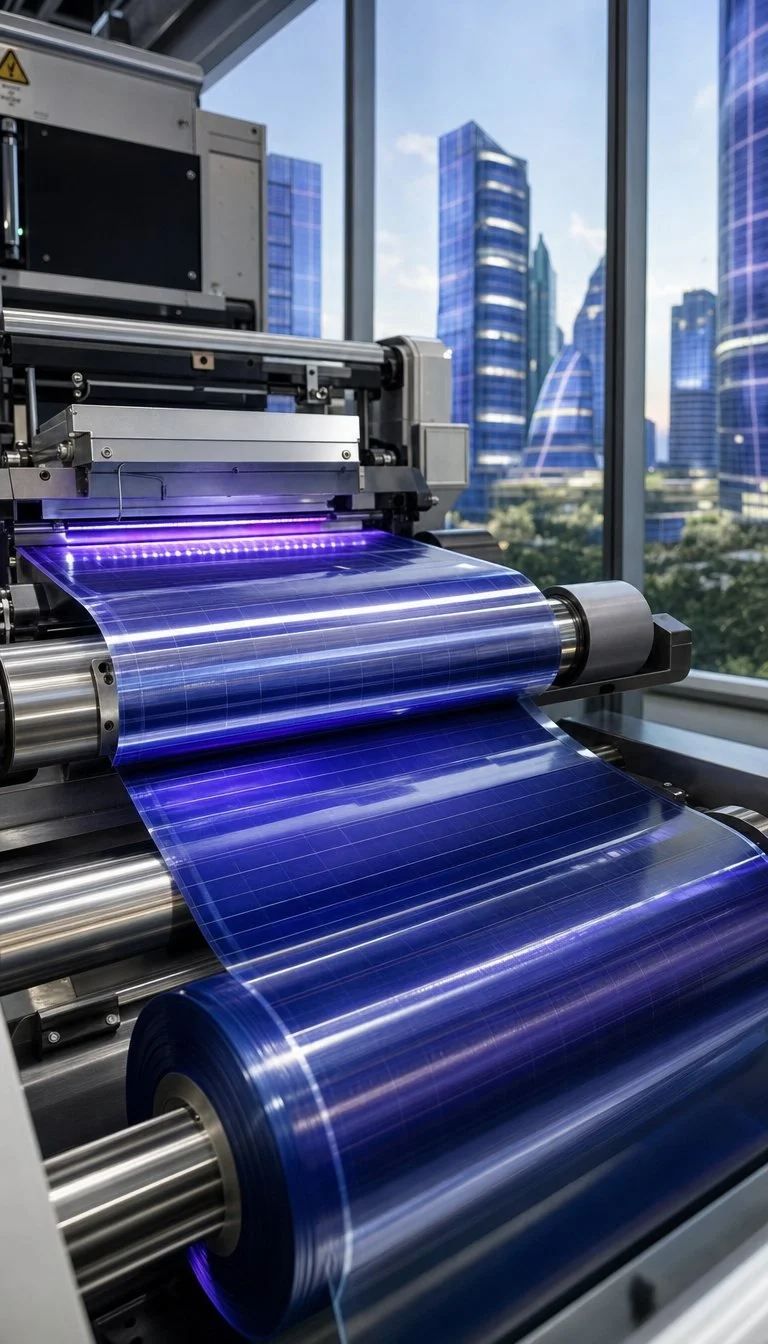
2. Roll-to-Roll Printing: The Desktop Factory
The true revolution of perovskites lies in how they are made. Unlike silicon, perovskites can be dissolved into liquid "inks."
This allows manufacturers to use Roll-to-Roll (R2R) Printing—the same technology used to print newspapers. This solvent-based, low-temperature process allows us to rapidly print flexible, ultra-lightweight solar cells onto plastic films or curved surfaces. In early 2026, Japan committed $1.5 billion to establish domestic supply chains for these flexible modules, aiming to turn building facades, windows, and urban infrastructure into power generators without the need for heavy structural reinforcement.
3. The Lifecycle Standard: Navigating the Lead Hurdle
Under the PCU Lifecycle Standard, the extraordinary efficiency of perovskites must be balanced against their chemical composition.
The Lead Challenge: The most efficient perovskite cells currently rely on lead. If a module breaks in a rainstorm, that lead can leach into the soil.
The PCU Solution: Parallel Pathways (Lead-Free and Holistic Recycling).
To mitigate the toxicity risk, the industry is pursuing two aggressive strategies:
Tin-Based Lead-Free Cells: Replacing lead with tin eliminates the toxicity, but tin rapidly oxidizes in the air, killing the cell's efficiency. However, a major September 2026 breakthrough utilizing chlorinated organic components has provided tin perovskites with a "built-in raincoat," protecting them from moisture and allowing them to retain 95% efficiency after thousands of hours of testing.
The Circular Decommissioning: For the highly efficient lead-based modules already entering the market, we deploy the Nexus solvent-extraction protocol. By treating the cells with specialized green solvents at the end of their life, we selectively precipitate the lead out of the solution as a stable salt, recovering the active materials and the substrate for 100% closed-loop remanufacturing.
The 2026 Vision: The Photovoltaic Skin
At Project Clean Up (PCU), we are witnessing the decoupling of solar power from heavy, rigid infrastructure. The energy grid of the future will not be confined to massive fields of glass and steel; it will be printed, flexible, and seamlessly integrated into the skin of our cities. By pairing these highly efficient printed cells with rigorous, closed-loop chemical recycling, we are ensuring that the pursuit of limitless energy does not come at the cost of our local ecosystems.
