

Solid-State Frost – The Physics of Magnetocaloric Alloys
From the Laboratories of Project Clean Up (09/04/2026)
The concept of the vapor-compression refrigerator is outdated. It relies on toxic gases, loud mechanical compressors, and highly pressurized pipes that are prone to leaking. To truly modernize thermal management, we need a solution built directly into the atomic structure of a solid metal.
Enter the Magnetocaloric Effect (MCE).
1. The Atomic Alignment
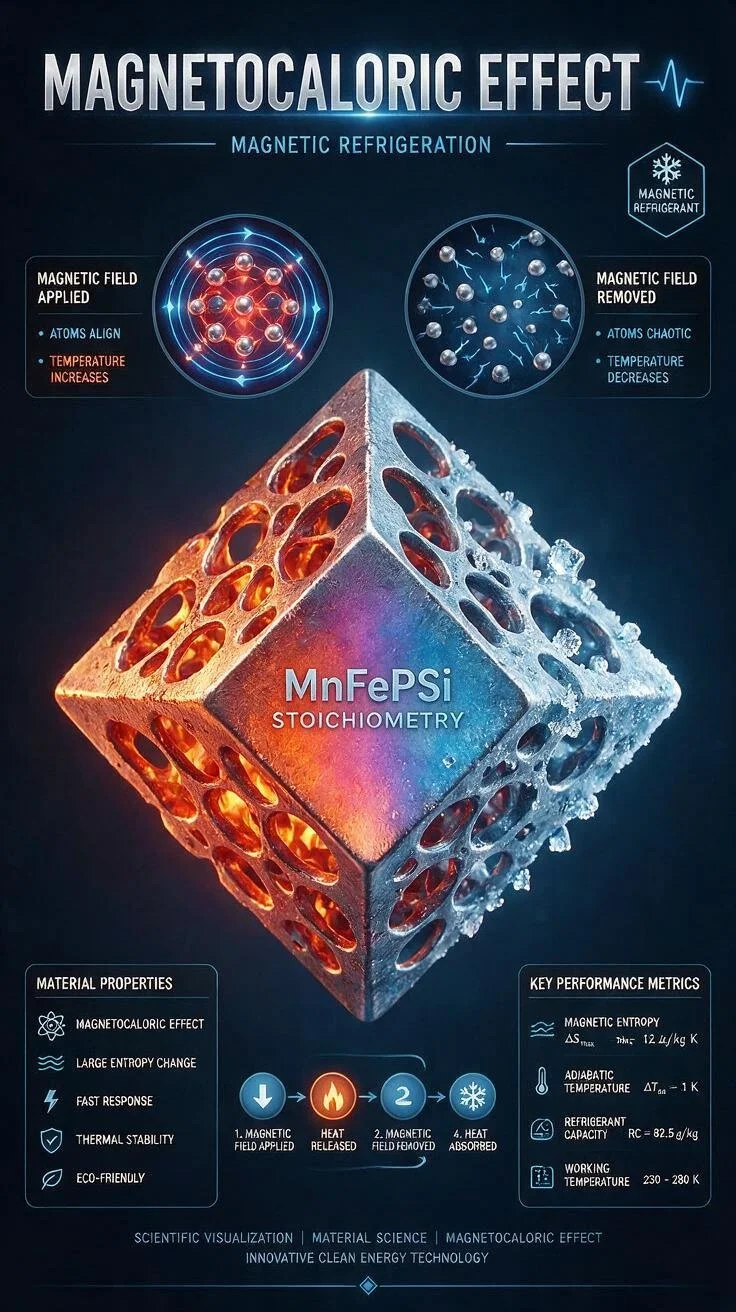
Certain advanced metallic alloys possess a unique thermodynamic property: they heat up when exposed to a magnetic field and cool down when removed from it.
When a magnet is introduced to these materials, the chaotic magnetic spins of their atoms are forced into perfect, rigid alignment. This sudden drop in atomic chaos (entropy) forces the material to release its thermal energy, heating up the metal. If we run water over the metal at this moment, the water absorbs that heat and carries it away.
Then, when the magnet is removed, the atoms violently snap back into their chaotic, randomized state. To do this, they must absorb thermal energy from their surroundings, causing the metal to instantly become freezing cold. If we run a second loop of water over the metal now, the water is chilled and can be pumped into a refrigerator or an air conditioning vent.
2. Moving Past Rare Earths: The MnFePSi Breakthrough
Early magnetocaloric prototypes relied heavily on Gadolinium—a highly expensive, difficult-to-mine rare earth metal. This violated the PCU mandate for abundant, accessible materials.
In 2026, the industry has successfully scaled a vastly superior alternative: Manganese-Iron-Phosphorus-Silicon (MnFePSi) alloys. By tuning the exact ratio of these highly abundant elements, we can create a material that exhibits a massive magnetocaloric effect precisely at room temperature. These solid blocks of metal are cheap to produce, highly durable, and entirely eliminate the need for global rare-earth mining.
3. The Lifecycle Standard: The Electrochemical Unzipping
Under the PCU Lifecycle Standard, a solid-state refrigerator completely solves the end-of-life refrigerant crisis, but we must still plan for the recycling of the alloy itself.
The Legacy Flaw: When an old refrigerator is scrapped, the toxic freon or HFC gas must be carefully siphoned and incinerated—a process that is frequently skipped, leading to massive atmospheric venting.
The PCU Solution: Electrochemical Ion-Recovery. A magnetocaloric refrigerator contains no gas to leak. When the unit reaches the end of its life, the solid MnFePSi alloy block is simply removed.
To prevent this specialized alloy from becoming mixed-metal waste, we employ a targeted electrochemical bath. By applying specific voltage gradients in an engineered solvent, we selectively dissolve the alloy. The iron and manganese are electroplated out of the solution in their pure states, while the phosphorus and silicon are precipitated as stable salts. 100% of the material is recovered and ready to be forged into the next generation of cooling arrays.
The 2026 Vision: The Silent Kitchen
