Teflon (PTFE) – The Non-Stick Revolution and Its End-of-Life Challenge
From the Laboratories of Project Clean Up (09/26/2025)
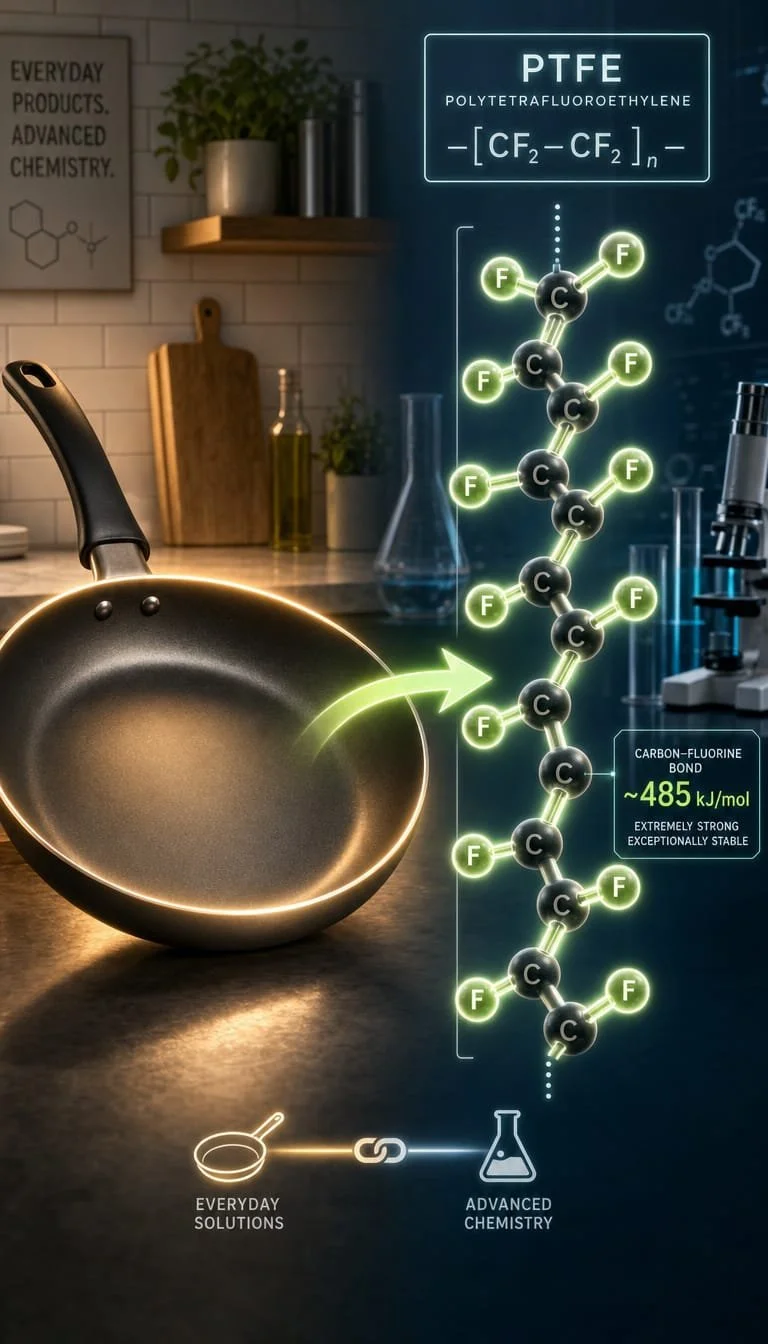
When we think of a "forever chemical," we often picture something insidious and invisible. But Polytetrafluoroethylene (PTFE), most famously known as Teflon, is a tangible example of a fluoropolymer that has been a part of our daily lives for decades. Discovered by accident, PTFE's unique properties—its extremely low friction coefficient, exceptional chemical inertness, and high heat resistance—made it a revolutionary material. It is a polymer of repeating tetrafluoroethylene units, forming a highly durable, non-stick, and waterproof surface. This innovation transformed industries, from the simple convenience of non-stick cookware to critical applications in aerospace, medical devices, and industrial machinery where a low-friction, non-reactive surface is essential.
The Persistence Problem: A Solid, Enduring Burden
Teflon's remarkable performance is a direct result of its incredibly stable carbon-fluorine (C-F) bonds, which are so strong that they resist almost all forms of degradation. While this makes PTFE a fantastic material for long-term use, it also makes it a significant waste management challenge. Unlike liquid or gaseous "forever chemicals" that can contaminate water or spread through the atmosphere, a Teflon-coated pan or a piece of industrial tubing is a solid object that will simply persist in a landfill for centuries. Conventional recycling methods cannot break down the PTFE coating, and it is not biodegradable. The sheer volume of this durable, undecomposable waste stream presents a looming environmental problem that demands a proactive scientific solution.
Degrading Teflon: PCU’s Approach to Polymeric Fluorocarbons
At Project Clean Up (PCU), our mission extends beyond the liquid and soluble "forever chemicals" to encompass robust, solid fluoropolymers like Teflon. Breaking down this highly stable, non-reactive polymer requires a specialized approach. Our laboratories are actively researching and developing advanced methods to cleave the tenacious C-F bonds within the PTFE polymer chain. This involves exploring powerful catalytic systems that can attack the very backbone of the polymer, as well as innovative methods to safely recover the valuable fluorine atoms. Our goal is to develop a scalable, effective solution for the complete deconstruction of Teflon, ensuring that this incredibly useful material can have a responsible and scientifically sound end-of-life pathway. We are committed to proving that even the most durable materials can be safely managed.
A Holistic Solution: From Creation to Deconstruction
The case of Teflon highlights the critical need for a new paradigm in material science—one that considers the full lifecycle, from creation to deconstruction. Our dedication at PCU is to provide the scientific tools for degradation, but our effectiveness relies on proper waste management strategies. Ensuring that Teflon-coated products and other persistent materials are properly collected and directed to the right treatment facilities is the first and most crucial step in the process. This proactive measure prevents environmental accumulation and empowers our science to safeguard our planet. Learn more about our vision for a sustainable future and how you can contribute at projectcleanup.com.