The Salt of the Earth – Why Sodium-Ion is Powering the Microgrid
From the Laboratories of Project Clean Up (06/19/2026)
When people think of the "battery revolution," they immediately think of Lithium-Ion. Lithium is the lightest metal on earth, making it the absolute gold standard for smartphones and electric vehicles, where every extra ounce drains efficiency.
But buildings do not move. If you are installing a massive battery bank in the basement of an apartment complex or a neighborhood sub-station to store solar energy, weight is entirely irrelevant. The criteria for stationary storage are cost, abundance, and absolute safety. This is where Sodium-Ion (Na-ion) batteries have taken over the market in 2026.
1. The Supply Chain Equation
Lithium, cobalt, and nickel require intense, ecologically destructive mining, and their supply chains are heavily constrained by geopolitics. Sodium, on the other hand, is the sixth most abundant element on the planet. It can be extracted from seawater or standard rock salt. By swapping the lithium ions for sodium ions, we bypass the global resource bottleneck entirely. We are building the energy infrastructure of the future using materials that are virtually infinite.
2. The Safety Mandate
The most critical barrier to neighborhood-level energy storage has always been fire risk. Traditional lithium-ion batteries are prone to "thermal runaway"—if one cell overheats, it can trigger a catastrophic, self-sustaining chemical fire that is notoriously difficult to extinguish.
Sodium-ion batteries are chemically far more stable. They do not utilize the same volatile liquid electrolytes, and they can be completely discharged to zero volts without damaging the cell (unlike lithium, which degrades if fully drained). This means a sodium-ion bank can be safely installed in the basement of a high-density urban apartment building without turning the building into a fire hazard.
3. The Neighborhood Node
The integration of cheap, safe sodium-ion storage is the catalyst for the Microgrid.
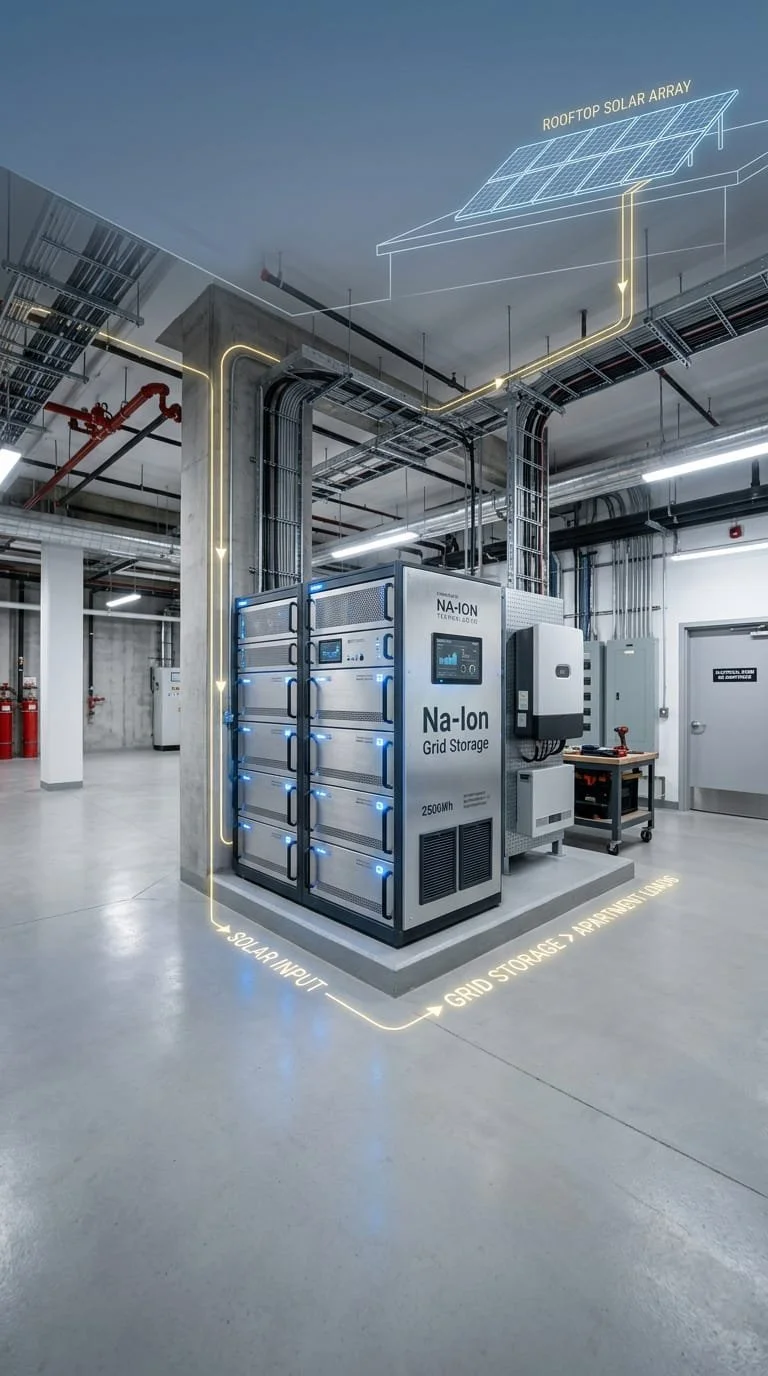
Imagine an apartment complex in 2026. The roof is lined with solar panels, and the basement houses a large sodium-ion battery bank. During the day, the building generates its own power and stores the excess in the basement. During peak evening hours, instead of pulling expensive, dirty energy from the municipal coal or gas plant, the building seamlessly switches to its own sodium reserves.
If the central city grid goes down during a summer blackout, this building becomes an "island." The lights stay on, the refrigerators stay cold, and the building can even share its excess power with the neighboring block through a localized mesh network.
By decentralizing our storage using abundant materials, we are not just going "green"—we are engineering absolute structural resilience. We are ensuring that the power to survive and operate remains firmly in the hands of the community.