The E-Waste Micro-Loop – Urban Mining at the Point of Origin
From the Laboratories of Project Clean Up (06/12/2026)
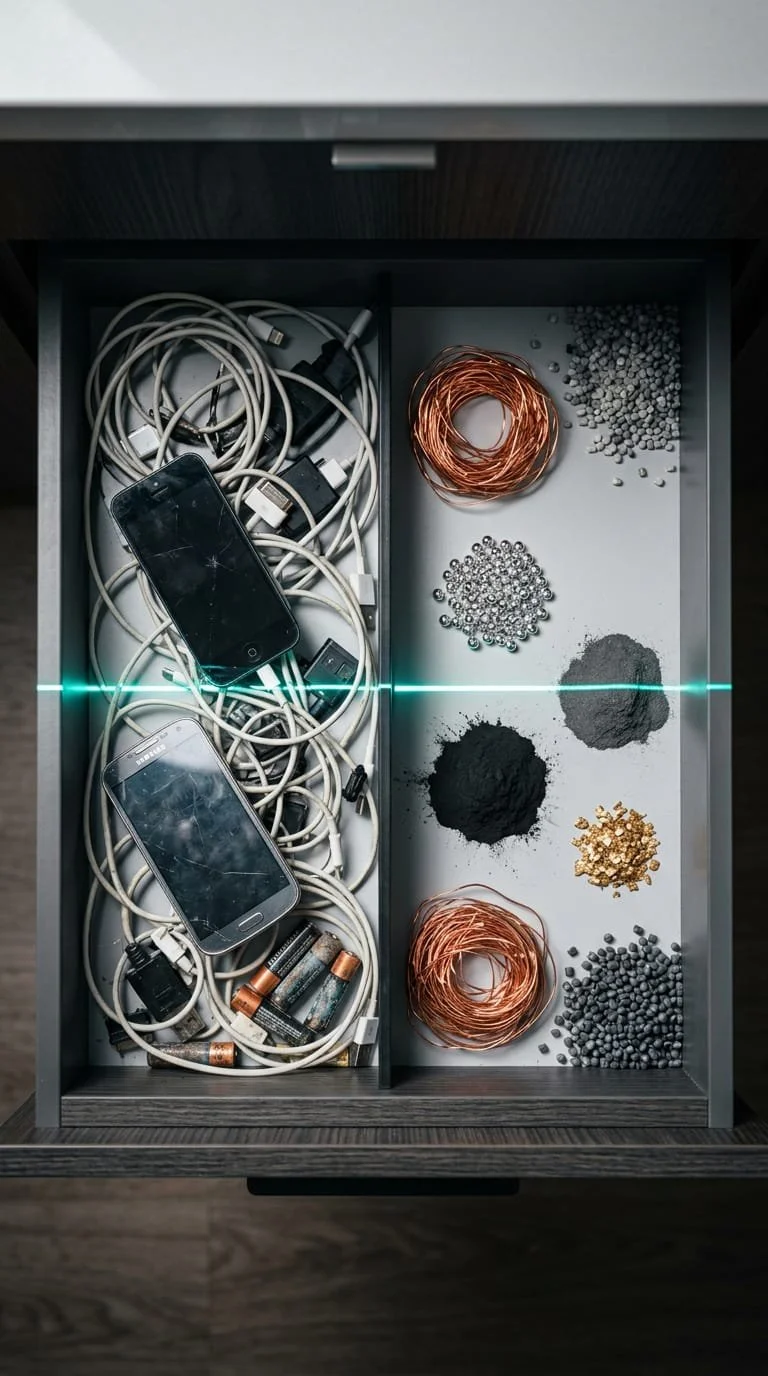
The fundamental flaw in modern electronics is that they are built for permanence but designed for obsolescence. A smartphone contains highly engineered, critical elements—cobalt, lithium, gold, silver, copper, and palladium—locked inside glass and glued-together aluminum. When the software stops updating or the battery degrades, the entire physical matrix becomes "useless" to the consumer, despite the elemental value remaining perfectly intact.
In the restricted space of an apartment, hoarding these devices is an invisible drain on square footage and a hoarding of critical global resources.
1. The Paralysis of the 'Special Trip'
The current infrastructure for e-waste relies entirely on consumer guilt and high-friction logistics. You are expected to stockpile your dead batteries and tangled cords until the city hosts an "E-Waste Drop-Off Day" at a distant stadium parking lot. For an apartment dweller without a car, or someone managing a tight schedule, this is a systemic failure. The friction is too high, so the drawer stays full.
2. Point-of-Origin Interception Networks
Just as we saw with textiles and organics, the solution is bypassing the municipal bottleneck through targeted logistics.
The Mail-Back Ecosystem: Companies and consortiums are finally eliminating the "special trip." Programs like Call2Recycle or manufacturer-direct mail-back programs allow you to request a prepaid, fire-safe box. You fill it with dead batteries and old phones, hand it to your standard postal carrier, and it routes directly to a processing facility.
The Retail Router: For larger items or mixed cables, taking advantage of mandated retail take-back programs transforms your weekly grocery or hardware store run into a recovery mission. Big-box electronics and hardware stores are increasingly required to serve as free collection points. The habit shift is simple: the dead tech leaves the apartment in the same bag as the reusable grocery sacks.
3. The Future: Modular Hardware and Dissolving Boards
Logistics are the bridge, but as we discussed in our "Transient Hardware" series earlier this spring, the ultimate goal is changing the hardware itself. The e-waste drawer only exists because we cannot easily separate the battery from the screen, or the gold from the board.
As the consumer market begins to demand Right-to-Repair modularity and the industry slowly adopts the transient biopolymer circuit boards and ultrasonic-recovery liquid metals we’ve championed, the "junk drawer" will cease to exist. A broken screen will be swapped, and an obsolete board will simply be dropped into an aqueous reset bath, returning its raw metals to the market.
Until then, we must act as our own urban miners.