The Wardrobe Micro-Loop – Managing Fabric in Restricted Spaces
From the Laboratories of Project Clean Up (06/05/2026)
The average consumer discards dozens of pounds of clothing every year. In an apartment environment, textile waste accumulates silently in the backs of closets until a sudden move or spring cleaning forces a decision. Because municipal curbside recycling programs completely reject clothing, the burden falls entirely on the individual to find a sustainable alternative.
To build a true Wardrobe Micro-Loop, we must understand why traditional downstream methods fail and how to intercept our garments at the point of origin.
1. The Myth of the Donation Bin
The standard response to a closet purge is dropping bags off at a local charity thrift store. While well-intentioned, global textile logistics reveal a harsher reality: the vast majority of donated clothing is not resold locally. Due to the sheer volume of low-quality, fast-fashion garments entering the system, sorting facilities are overwhelmed.
Unsold clothing is frequently baled and exported to developing countries, where it floods local markets or ends up in massive, unregulated coastal landfills. True point-of-origin responsibility means acknowledging that passing the material down the line rarely solves the underlying waste equation.
2. Identifying the Blend
Before a garment can be diverted, its composition must be evaluated. Modern textiles generally fall into three categories, each requiring a different strategy for a domestic micro-loop:
Pure Natural Fibers (100% Cotton, Linen, Wool): These materials are entirely bio-based. When a 100% cotton shirt reaches the end of its wearable life, it can be mechanically downcycled into highly absorbent cleaning rags for apartment maintenance, entirely bypassing the purchase of single-use paper products. Once completely degraded, these pure fibers can theoretically enter a controlled biological degradation system.
Pure Synthetics (100% Polyester, Nylon): These are technical polymers. Because they do not degrade biologically, they must remain in the technical loop. A growing network of take-back programs utilizes chemical depolymerization to turn old synthetic garments back into pristine raw material, but this requires the consumer to sort and route them specifically to brand-specific recycling drop-offs rather than the general bin.
The Poly-Blend Barrier: Garments containing mixed fibers (e.g., 60% cotton, 40% polyester) represent the ultimate recycling challenge. Because the synthetic and natural threads are woven tightly together at the microscopic level, they cannot be easily separated mechanically. For these items, longevity, repair, and conscious consumption are the primary defenses against the dumpster.
3. Implementing the Apartment Wardrobe Audit
Building a functioning micro-loop for clothing within a small floor plan requires a systematic approach to procurement and disposal:
The Procurement Filter: The most effective way to manage textile volume is to filter what enters the apartment. Prioritizing mono-materials (100% composition) over complex blends ensures that the garment can actually have a secondary lifecycle when it leaves your closet.
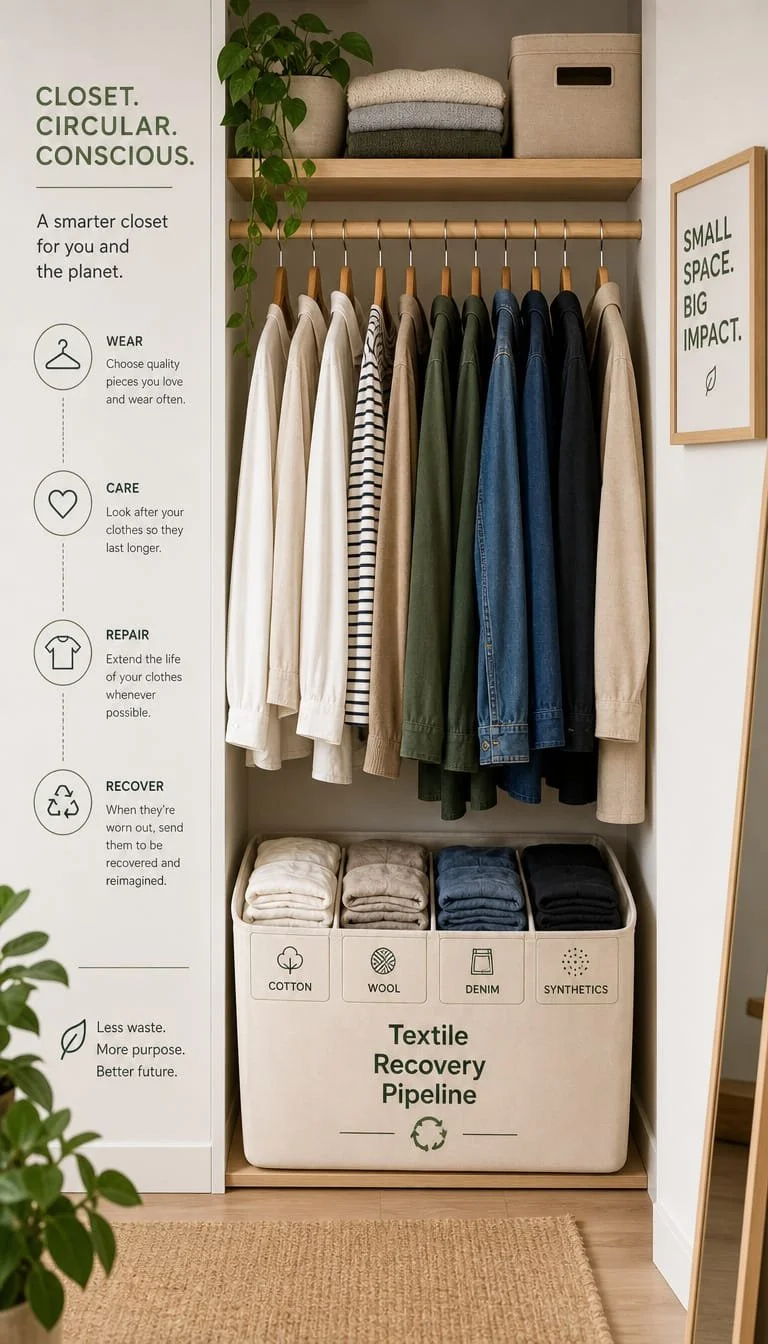
The Micro-Sorting Station: Dedicate a single, compact fabric bag in the closet specifically for textiles that are beyond repair. By separating worn-out socks, torn shirts, and fabric scraps from the daily trash, you prevent clean fibers from being contaminated by wet kitchen waste, preserving their value for dedicated textile recovery networks.
By taking control of our clothing habits and treating textiles as structured material assets rather than disposable goods, the modern apartment can successfully sever its connection to the global landfill pipeline.