The Apartment Ledger – Justifying the Premium and Storing the Peels
From the Desk of Project Clean Up (05/29/2026)
Let’s be entirely honest: the communal apartment dumpster is incredibly convenient. It demands nothing from you but a plastic bag and a walk down the hall. Municipalities handle it passively, wrapping the cost invisibly into your monthly expenses. To intentionally choose to pay an additional subscription fee, or to spend your Saturday morning driving food scraps to a community garden, requires more than good intentions. It requires a clear justification of value.
Here is how to audit the economics of your apartment and master the logistics of your kitchen.
1. The Spatial Valuation: Buying Back Your Square Footage
In a small apartment, space is a premium financial asset. If you pay $2,000 a month for 600 square feet, every single square foot costs you roughly $3.33 monthly.
When you rely entirely on a standard dumpster system, you have to store bulky cardboard, plastic milk jugs, and aluminum cans in your living space until the bag is completely full to justify the trip outside. You are effectively paying rent to house trash.
Premium doorstep recovery services change the equation from storage to logistics. By utilizing custom-fit, high-density sorting bins that stack vertically, you compress your waste footprint from several scattered bags down to less than one square foot. You are utilizing vertical space to buy back your highly valuable floor space.
2. The Cold-Trap: How to Store Biological Scraps Zero-Odor
The moment a banana peel or a coffee filter hits a standard room-temperature trash can, biological decay begins. In an apartment with no yard, no balcony, and sealed windows, volatile organic odors and fruit flies are unacceptable.
If you are participating in a local compost share network, you cannot leave these scraps exposed. The solution relies on temperature control, not chemical sprays:
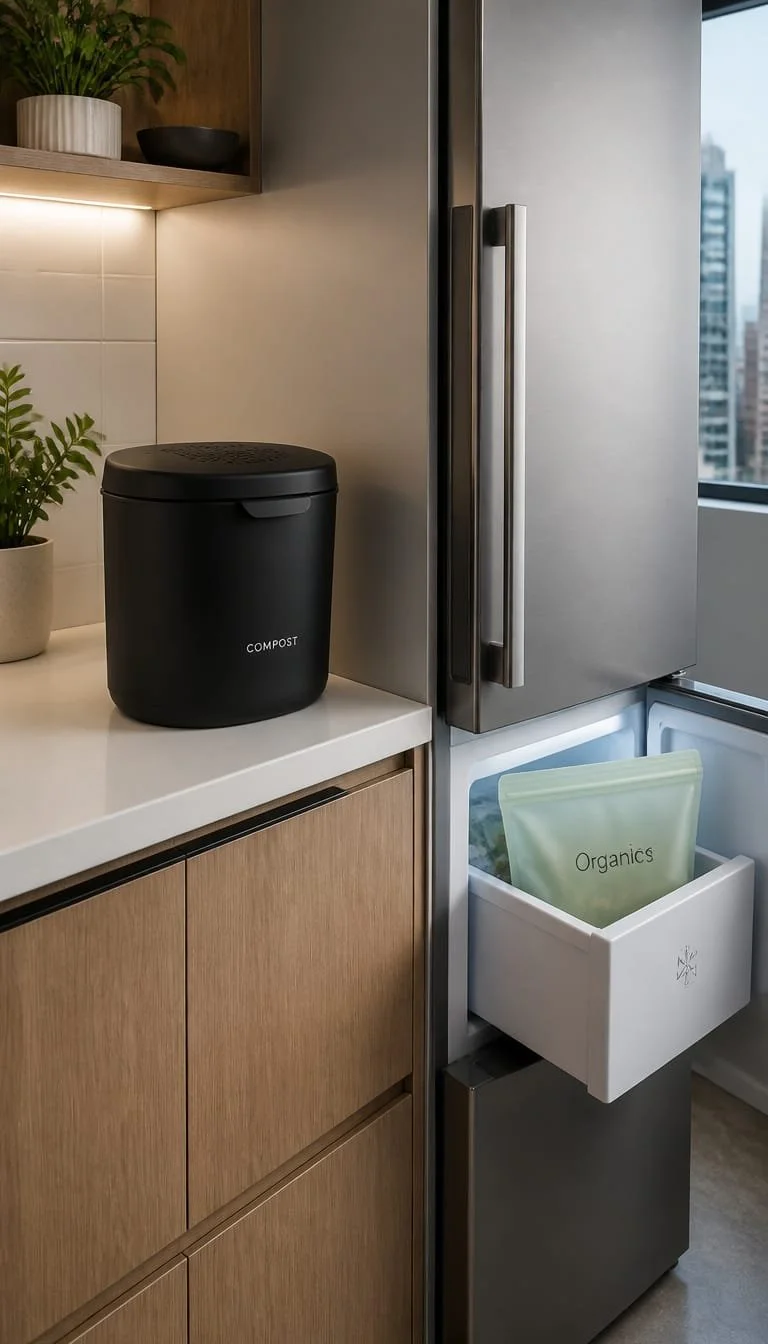
The Freezer Trap: The absolute gold standard for apartment organic storage is a designated, sealed silicone bag or stainless-steel bin kept directly in your freezer. Freezing completely arrests biological decay, locking in moisture and eliminating 100% of odor and pests. A banana peel frozen solid is entirely inert. On drop-off day, you simply empty the frozen blocks straight into the collection bin.
The Dry-Layer Method: If freezer space is unavailable, use a small countertop bin equipped with an activated carbon filter lid. The key rule of physics here is managing moisture. Every time you add a wet scrap (like fruit peels), cover it with a "dry layer" of spent coffee grounds, a handful of shredded unprinted brown cardboard, or a layer of baking soda. This drops the local water activity, slowing down the microbes that cause odor until your weekly drop-off.
3. The Micro-Investment Strategy
Think of a monthly recovery subscription not as a donation, but as a decentralized infrastructure utility. You are paying for a specialized router to handle materials that municipal systems are fundamentally too broken to process. It is an investment in guaranteed diversion—ensuring that your synthetic polymers actually become durable goods rather than permanent landfill mass.