

The Squinting Skyscraper – The Chemistry of Dynamic Glass
From the Laboratories of Project Clean Up (10/16/2026)
Dynamic glass allows a window to transition from perfectly clear to darkly tinted (and vice versa) without any mechanical blinds, shades, or moving parts. To understand how a solid piece of glass can change its color on demand, we have to look at the microscopic "sandwich" applied to its surface.
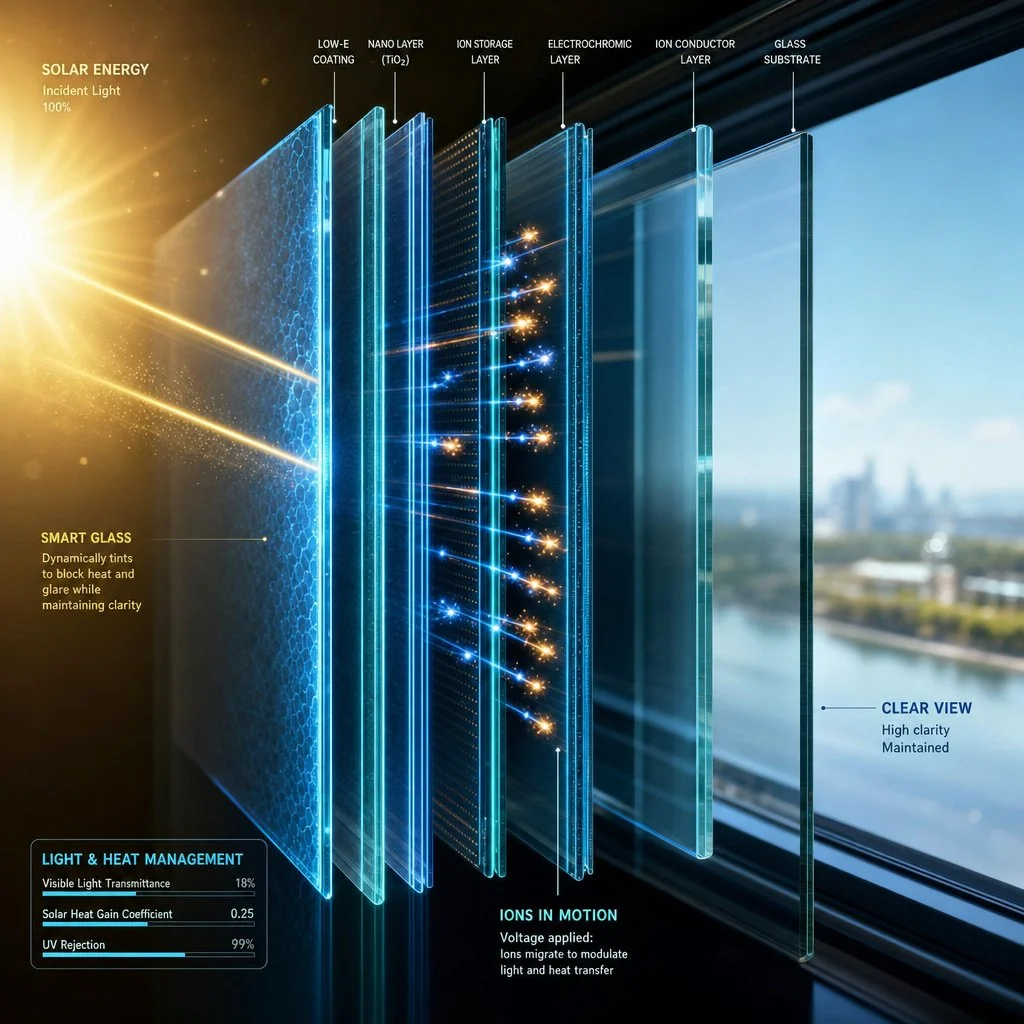
1. The Ion Migration Sandwich
An electrochromic window is not just a pane of glass; it is a complex, solid-state electrochemical cell, much like a transparent, flattened battery.
The glass is coated with several microscopic layers. The most important are the Ion Storage Layer and the Electrochromic Layer (typically composed of transition metal oxides like Tungsten Oxide). In its resting, clear state, lithium or hydrogen ions sit quietly in the storage layer.
When a tiny electrical voltage is applied to the window, these ions are pushed across a solid separator and into the Tungsten Oxide layer. When the ions enter the crystalline structure of the tungsten, they change its optical properties. The glass instantly absorbs light and heat, turning a deep, tinted blue. To clear the window, the electrical polarity is simply reversed, pulling the ions back into storage. It requires almost zero electricity to maintain the tint—only to trigger the change.
2. Slashing the Urban Heat Load
The deployment of electrochromic glass is fundamentally altering the energy dynamics of the 2026 city.
A skyscraper equipped with a smart facade doesn't rely on tenants pulling down plastic blinds. Connected to the building's Virtual Power Plant (VPP) and external weather sensors, the building tracks the path of the sun. As the morning sun hits the east facade, those specific windows gradually tint to block the infrared heat load, keeping the interior cool. By the afternoon, the east windows clear, and the west windows tint.
By actively rejecting the heat before it ever enters the building, smart glass can reduce a commercial skyscraper's peak HVAC energy load by up to 25%, drastically shrinking the size of the required air conditioning units.
3. The Lifecycle Standard: Delaminating the Sandwich
Under the PCU Lifecycle Standard, covering millions of square feet of urban real estate in electrochromic coatings presents a massive red flag for the recycling industry.
The Legacy Flaw: Early iterations of smart glass relied heavily on Indium Tin Oxide (ITO) and rare-earth metals. Furthermore, the active layers were baked into the glass so permanently that traditional glass recyclers couldn't process them. Tossing a smart window into a standard glass smelter ruined the purity of the silica melt.
The PCU Solution: Electrochemical Delamination.
The 2026 generation of PCU-approved smart glass entirely avoids Indium and rare earths, utilizing abundant Tungsten and Titanium oxides.
More importantly, the layers are designed for "programmed deconstruction." When a smart window reaches the end of its life, it is sent to a PCU recovery facility and submerged in a highly specific, room-temperature ionic liquid. By applying a reverse-frequency electrical pulse, the adhesive bonds holding the microscopic layers together fail. The metal oxides flake off into the liquid to be filtered and reused, leaving behind a perfectly pure, uncoated pane of silica glass ready to be melted and reformed.
The 2026 Vision: The Living Envelope
At Project Clean Up (PCU), we are watching the static building envelope become a thing of the past. By turning windows into active, electrochemical materials, we are giving architecture the ability to react to its environment, much like human skin reacts to the sun. The city of the future will not fight the elements with massive, noisy air conditioners; it will simply adapt, tint, and breathe in perfect harmony with the sky.
