Vertical Aeroponics – The Hyper-Local Urban Harvest
From the Laboratories of Project Clean Up (07/31/2026)
The traditional agricultural model is breaking under the strain of climate change and logistics. It requires massive acreage, consumes 70% of the world's freshwater, and demands a carbon-heavy fleet of trucks and planes to transport perishable goods to urban centers.
To achieve a true "Micro-Loop" at the neighborhood level, we must bring the farm into the building. The 2026 solution is not traditional soil farming, nor is it standard hydroponics (which requires heavy tanks of water). The solution is Aeroponics.
1. The Physics of the Mist
In an aeroponic system, plant roots are not buried in dirt or submerged in water. Instead, they hang suspended in an enclosed, dark chamber. A highly calibrated system intermittently sprays the roots with a microscopic mist of water and perfectly balanced nutrients.
Because the roots have 100% access to oxygen at all times, the plants grow up to three times faster than they would in soil. More importantly, because the mist is applied so precisely, aeroponics uses 95% less water than traditional agriculture.
2. Integration into the Biogenic Building
Aeroponics is lightweight and modular, making it the perfect architectural companion to the biogenic buildings we designed earlier this month.
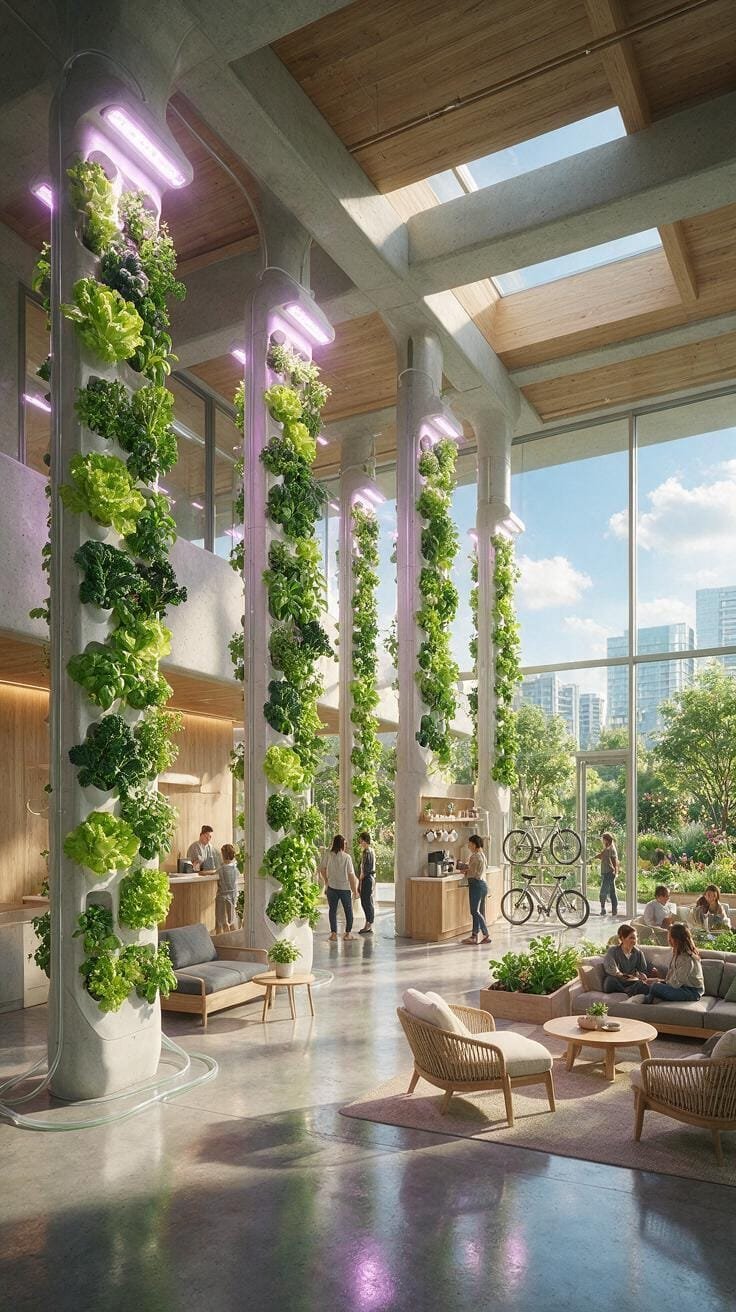
Imagine the common areas, the lobbies, or a dedicated, climate-controlled basement level of a 2026 apartment complex. These spaces are lined with vertical, glowing pillars of aeroponic growth. Because the building already has a Virtual Power Plant (VPP), the LED grow lights are powered by the building's own solar and sodium-ion reserves. Because the building has a Smart Water Grid, the aeroponic mist is supplied by the highly purified, recycled greywater generated by the tenants themselves.
3. The Lifecycle Standard: The Ultimate Point-of-Origin
Under the PCU Lifecycle Standard, vertical aeroponics eliminates the concept of agricultural waste and food miles.
Zero Transport Carbon: The distance from the farm to the table is measured in elevator floors, not highway miles.
Zero Packaging: Because the tenant simply harvests the leafy greens or vegetables directly from the building's communal growing wall, there is no need for the rigid plastic clamshells or metastable polymers we sought to eliminate in Issue 47.
The Nutrient Loop: Any inedible roots or stems are dropped into the apartment's Point-of-Origin biological processing drawer (Issue 46), where they are dehydrated and eventually routed to a Nexus facility (or a building-level micro-digester) to be turned right back into the liquid fertilizer that feeds the wall.
The 2026 Vision: The Producing City
At Project Clean Up (PCU), we are redefining what it means to be a city dweller. The tenant is no longer just a consumer waiting for a delivery truck. The building they live in traps its own carbon, filters its own water, stores its own energy, and grows its own food. We have transformed the urban apartment from an endpoint of consumption into an engine of creation.