The Circular Tap – Engineering the Smart Water Grid
From the Laboratories of Project Clean Up (07/24/2026)
The greatest inefficiency in modern architecture is the "single-use water fallacy." We spend massive amounts of municipal energy to purify water to rigorous potable (drinkable) standards, only to literally flush 30% of it down the toilet. To build a truly sustainable, biogenic city, we must sever this reliance on the centralized municipal pipe.
1. The Greywater Loop: Processing in the Basement
Water in an apartment building falls into two categories: Blackwater (sewage) and Greywater (drainage from showers, bathroom sinks, and washing machines). Greywater makes up over 60% of domestic water use, and it is relatively clean.
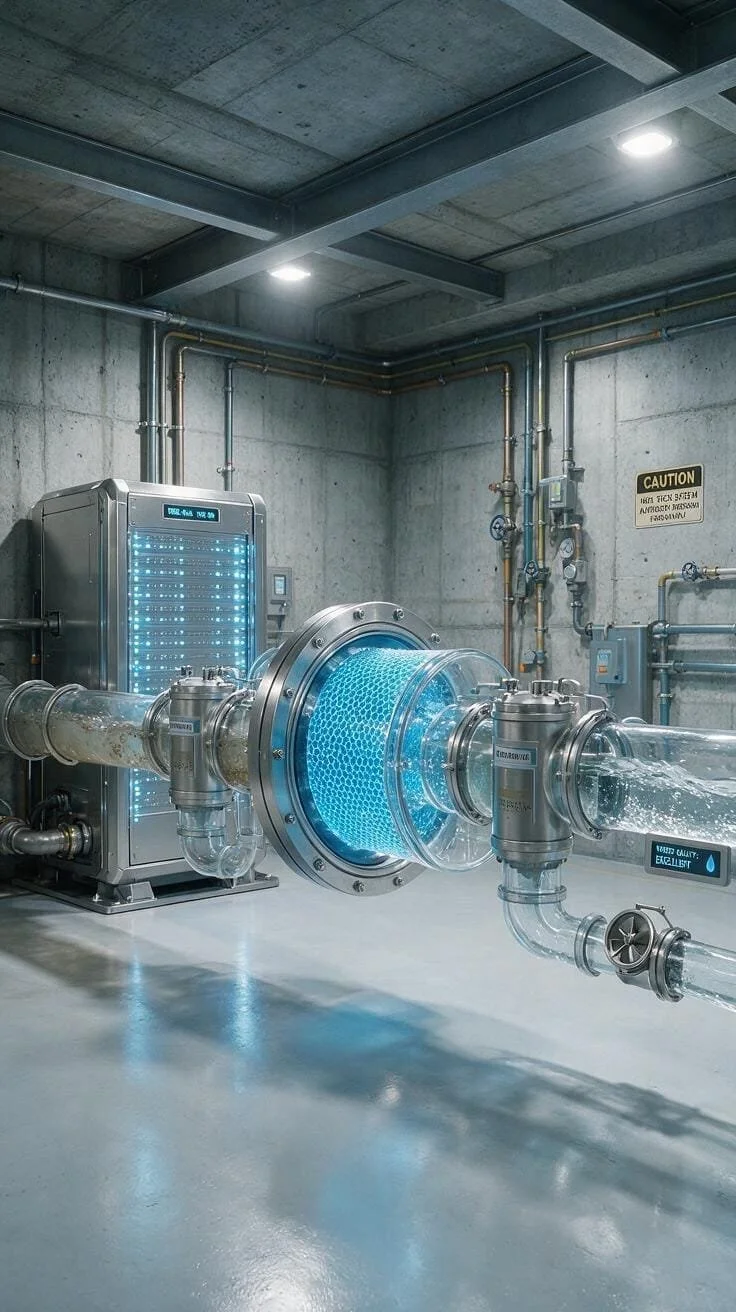
In our 2026 biogenic apartment building, the plumbing is bifurcated. Greywater does not leave the building. Instead, it is routed to a decentralized processing unit sitting right next to the sodium-ion battery bank in the basement. Using the low-energy aquaporin membranes developed by our Nexus team, the soapy shower water is passively filtered and immediately pumped back upstairs. This highly filtered, non-potable water is then used exclusively for toilet flushing, washing machines, and irrigating the building's green spaces.
By simply reusing the water once before it becomes blackwater, the building's draw on the municipal freshwater reservoir drops by half.
2. The Smart Grid: IoT and Hydrological Arbitrage
Just as the Virtual Power Plant (VPP) balances energy, the Smart Water Grid balances fluid.
Using localized IoT (Internet of Things) sensors integrated into the building's pipes, the system monitors water quality and flow rates in real-time. If the aquaporin membrane detects a sudden spike in chemical contaminants, it automatically diverts that specific batch of water to the municipal sewer line to protect the internal loop.
Furthermore, this smart grid connects to the neighborhood. If a heavy rainstorm hits, the building's smart cisterns capture the rainwater. If the neighboring block is experiencing a localized drought or high demand for irrigation, the Smart Water Grid can autonomously route excess captured water to where it is needed most, bypassing the municipal treatment plant entirely.
3. The Lifecycle Standard: Zero-Export Hydrology
Under the PCU Lifecycle Standard, water is treated with the exact same point-of-origin philosophy as physical waste.
We cannot continue to export our problems downstream. By processing greywater on-site, we drastically reduce the energy load on municipal wastewater plants, which are currently one of the largest consumers of electricity in any city. We also eliminate the risk of overwhelming city sewers during storm events, a common cause of catastrophic ecological runoff.
The 2026 Vision: The Autonomous Metabolism
At Project Clean Up (PCU), the vision of the Biogenic City is nearly complete. The building breathes through its walls, generates and stores its own power, and endlessly circulates its own water. It is no longer a static box drawing resources from the earth and pumping waste into the sea. It is a closed-loop system, functioning with the elegant, zero-waste efficiency of a living organism.