Bio-Cement and Mycelium – Turning Buildings into Carbon Sinks
From the Laboratories of Project Clean Up (07/10/2026)
The philosophy of Biogenic Construction is simple: we must mimic nature’s ability to build incredibly strong structures at ambient temperatures. A coral reef doesn't require a 1,500°C kiln to build its limestone skeleton, yet it withstands the force of the ocean. By harnessing biological processes, we are turning the construction industry from a massive carbon emitter into a global carbon sink.
1. Bio-Cement: The Cyanobacteria Foundation
Traditional concrete requires burning massive amounts of fossil fuels to heat limestone. In 2026, advanced construction firms are pivoting to Microbially Induced Calcite Precipitation (MICP).
Instead of heat, this process uses living bacteria (such as Sporosarcina pasteurii). When introduced to sand, water, and a calcium nutrient broth, these microbes rapidly precipitate calcium carbonate, gluing the sand particles together to form stone.
The result is a bio-cement that is grown at room temperature and physically absorbs CO2 during its creation. Even more impressively, it is self-healing. Because dormant bacterial spores remain trapped inside the concrete, if a micro-crack forms and water seeps in, the bacteria "wake up," produce more calcium carbonate, and organically seal the crack before it threatens the structural integrity of the building.
2. Mycelium Insulation: The Fungal Wall
The walls of a modern apartment are stuffed with toxic, itchy fiberglass or sprayed with polyurethane foam. These materials are hazardous to install and impossible to recycle.
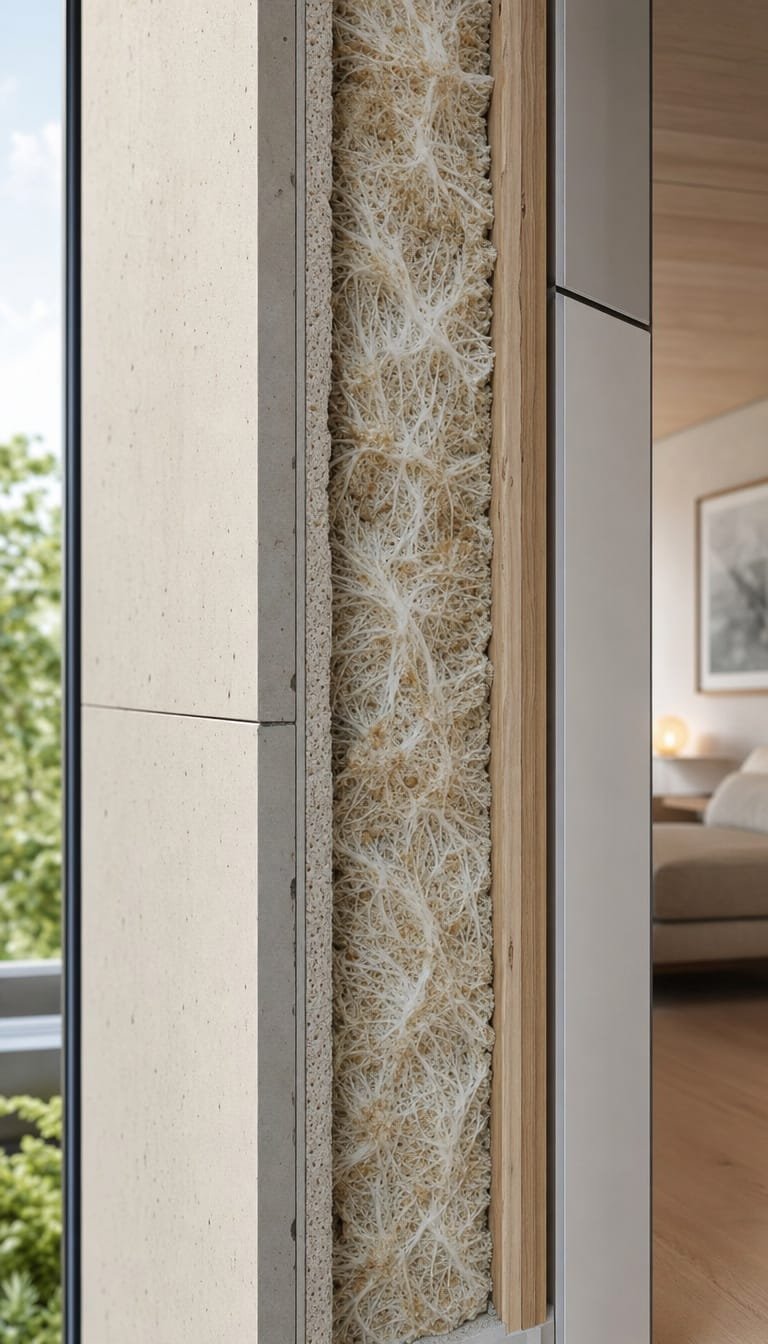
The biogenic replacement is Mycelium—the vegetative root structure of fungi. By taking agricultural waste (like hemp hurd or corn stalks) and inoculating it with mycelial spores, the fungus binds the loose waste into a solid, dense, interwoven mat.
Once baked to stop the growth, the resulting material is an architectural marvel. It is naturally fire-resistant, highly insulative, provides excellent acoustic dampening for shared apartment walls, and contains zero synthetic chemicals.
3. The Lifecycle Standard: The Compostable Building
Under the PCU Lifecycle Standard, biogenic materials fundamentally solve the demolition crisis.
When a traditional building is knocked down, it creates tons of hazardous, mixed-material rubble. When a biogenic building reaches the end of its lifecycle, the paradigm shifts. The bio-cement can be crushed and safely returned to the earth to neutralize soil acidity, without leaching forever chemicals. The mycelium insulation can be pulled from the walls and dropped directly into an industrial composter, turning back into nutrient-rich soil in a matter of weeks.
The 2026 Vision: The Breathing City
At Project Clean Up (PCU), we are looking at the city skyline not as a concrete jungle, but as a synthetic forest. The foundations are grown with bacteria, healing their own cracks. The walls are insulated with fungi, silencing the city noise. The energy is decentralized, and the waste is intercepted at the source. We are no longer extracting our living spaces from the earth; we are growing them in partnership with it.