Packaging from the Earth: Mycelium "Styrofoam"
(05/22/2026)
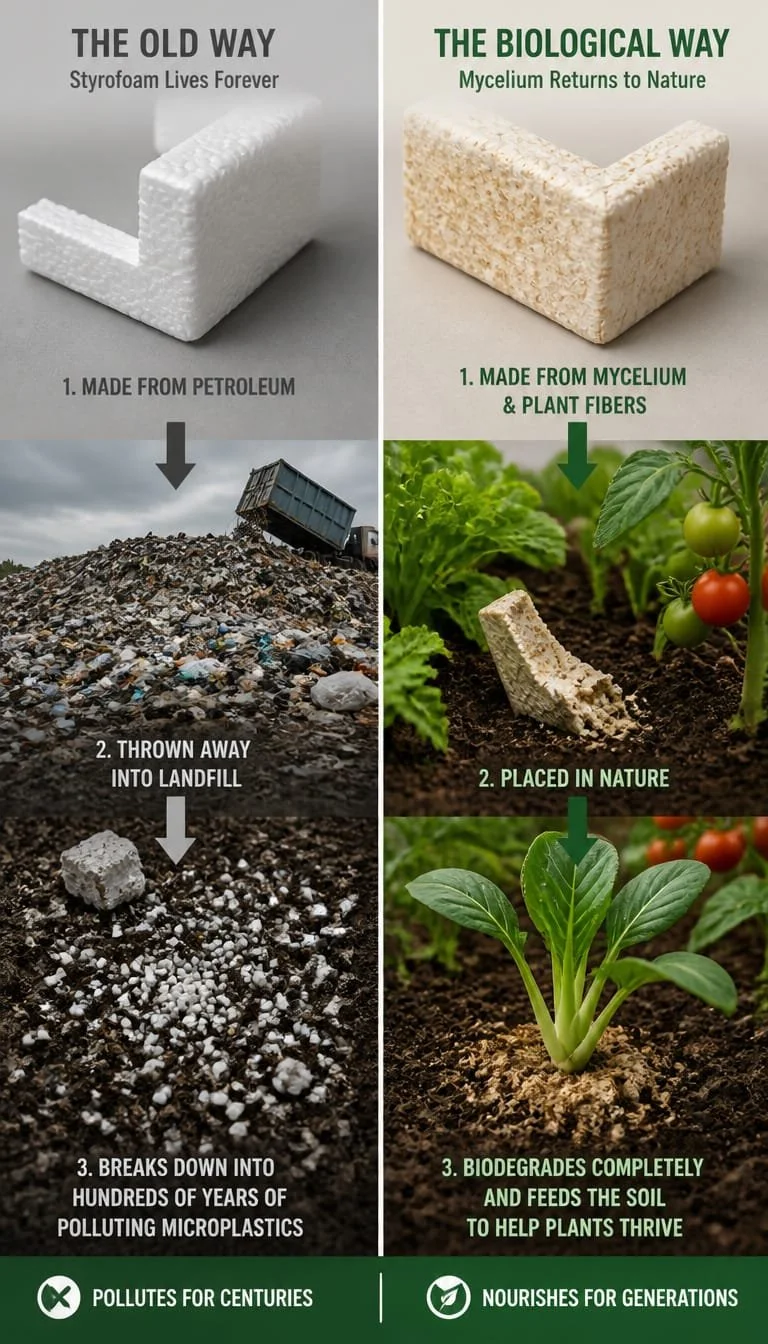
The Concept: Expanded Polystyrene (EPS), commonly known as Styrofoam, is an environmental nightmare. It is brilliant for its intended purpose—it is incredibly lightweight, shock-absorbent, and cheap. But because it is 95% air and 5% rigid synthetic plastic, it is virtually impossible to recycle economically. It ends up in landfills where it will sit for centuries, or worse, it breaks apart into millions of microplastic beads that choke terrestrial and marine ecosystems.
We need a material that protects our televisions and wine bottles during shipping, but completely disappears the moment we are done with it. To find it, we are once again turning to the fungal kingdom.
The Science: Nature's Ultimate Glue We already know that fungi are master decomposers. But before a fungus can decompose something, it has to grow through it. The vegetative part of a fungus is called mycelium—a microscopic, dense, incredibly strong web of white threads (hyphae).
Biotech companies realized that if you restrict where this mycelium can grow, it acts as a self-assembling biological glue.
The Protocol: Grow, Don't Blow Instead of blowing petroleum gases into plastic beads, we are now growing packaging in the dark.
The Substrate (The Food): The process starts with agricultural waste that would otherwise be burned or left to rot. Hemp hurds (the woody core of the hemp plant), corn stalks, or oat hulls are chopped into small, uniform pieces.
The Inoculation: This agricultural waste is sterilized and then inoculated with specific fungal spores (often from reishi or oyster mushrooms).
The Mold: The inoculated mixture is packed tightly into a custom 3D mold—for example, the exact shape of a protective corner block for a laptop.
The Growth Phase: The molds are placed in a dark, warm, humid room for about 5 to 7 days. As the fungus eats the hemp, the mycelium webs explode outward, stitching all the loose agricultural fibers together into a solid, impact-resistant block.
The Bake: Once the mold is completely filled by the white mycelial matrix, the block is removed and baked in an oven. This is a critical step: the heat kills the fungus, permanently stopping the growth and locking the material into a dry, rigid, inert state.
The Result: The final product looks, feels, and performs almost exactly like Styrofoam. It is water-resistant, flame-retardant, and highly shock-absorbent. But here is the massive paradigm shift: when you receive a package protected by mycelium, you don't have to throw it in the trash.
Because it is literally just baked hemp and dead mushrooms, it is 100% home-compostable. You can break it into pieces, throw it into the backyard compost pile we built in our DIY series, and it will return to rich, healthy soil in about 30 to 45 days. We are replacing permanent synthetic trash with temporary biological architecture.