The Living Pharmacy: Synthetic Biology in Medicine
(05/29/2026)
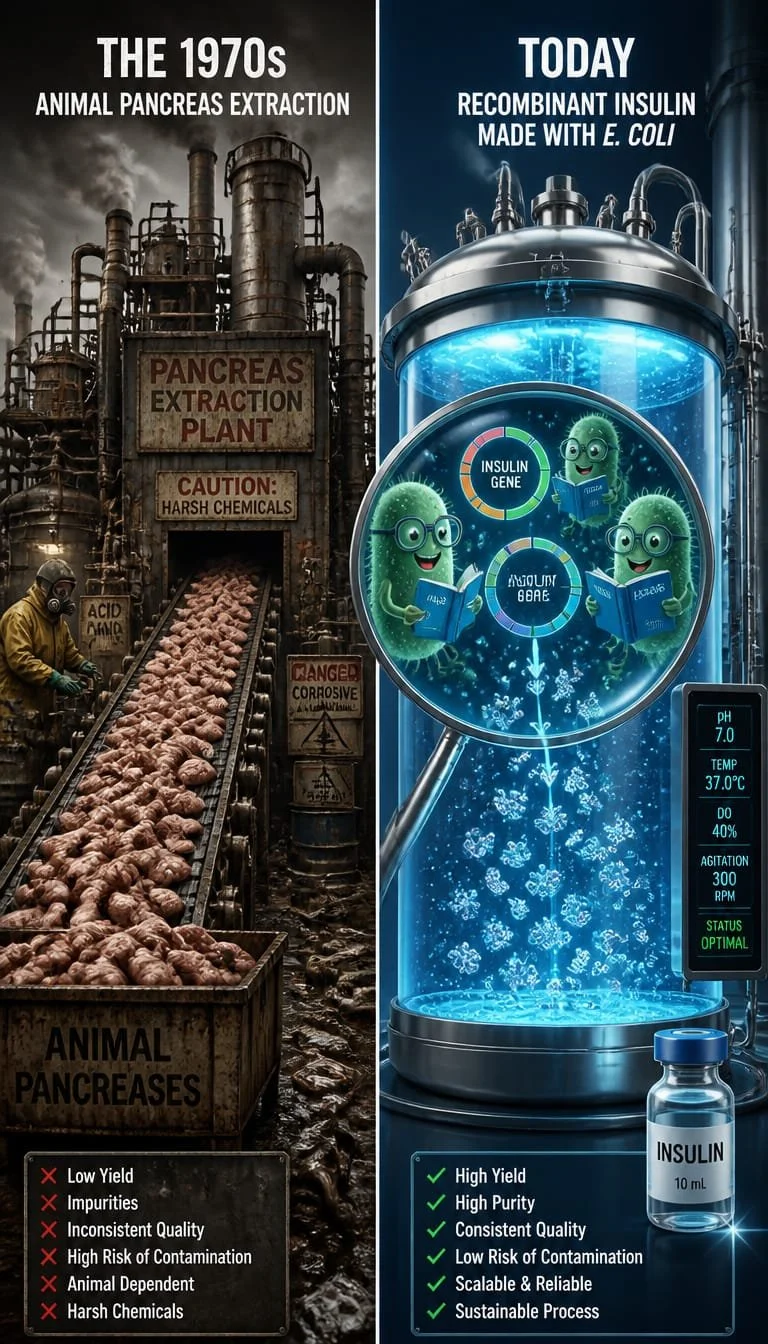
The Concept: If you went back to the 1970s and looked at how we treated diabetes, you would find a massive agricultural supply chain. To get the insulin necessary to keep a diabetic patient alive, pharmaceutical companies had to harvest and purify the pancreases of millions of slaughtered pigs and cows. It was expensive, inefficient, and because animal insulin isn't a perfect match for human insulin, it often caused allergic reactions.
Today, if you look at a vial of insulin, no animals are involved. It is 100% human insulin, pure and highly effective. But it isn't synthesized from scratch in a chemistry lab. It is brewed in a vat by Escherichia coli (E. coli) bacteria and baker's yeast. We turned single-celled organisms into microscopic pharmacies.
The Science: The Biological Software Patch To understand how we get a bacterium to produce a human hormone, we have to look at how bacteria store their genetic code.
In addition to their main chromosome, bacteria carry small, circular rings of DNA called plasmids. Think of a plasmid like a biological USB drive or a software patch. In nature, bacteria use plasmids to swap useful traits with each other, like antibiotic resistance.
Scientists realized that if plasmids are just software, we could write our own code. This birthed the field of Recombinant DNA technology.
The Protocol: Hacking the Microbe We treat the microbe exactly like a programmable factory machine.
The Source Code: Scientists isolate the exact sequence of human DNA that contains the instructions for making human insulin.
Cut and Paste: Using highly specific enzymes (acting as molecular scissors and glue), they cut open a bacterial plasmid and paste the human insulin gene directly into the circle.
The Reboot: This modified, "recombinant" plasmid is introduced back into a vat of standard E. coli or yeast cells. The bacteria absorb the plasmid and reboot their internal systems with the new software.
The Production Line: The bacteria do not know that the insulin gene isn't theirs. They just read the code and follow the instructions. As the bacteria are fed sugars in massive, warm fermentation tanks, they multiply by the billions, naturally secreting human insulin as a byproduct of their growth.
The Harvest: The bacteria are filtered out, and the pure, human-identical insulin is extracted, purified, and bottled.
The Result: This technology completely revolutionized medicine. We are no longer limited by what we can extract from nature; we can program nature to manufacture exactly what we need. Today, engineered biological factories produce our insulin, human growth hormones, blood clotting factors, and even the targeted antibodies used in cutting-edge cancer treatments. The future of manufacturing isn't just green; it is alive.