

Severing the Unbreakable Bond: Hunting Forever Chemicals
(09/11/2026)
The Concept: If you own a non-stick frying pan, a waterproof rain jacket, or stain-resistant carpeting, you benefit from PFAS (per- and polyfluoroalkyl substances). For decades, these chemicals were hailed as a miracle of modern manufacturing because they repelled both water and oil perfectly.
But that miracle came with a dark side. The very chemistry that makes PFAS so useful also makes them indestructible. They earned the nickname "Forever Chemicals" because they simply do not break down in the environment. They accumulate in our soil, our groundwater, and eventually, in our blood. Today, PFAS contamination is a global health crisis linked to cancer, liver damage, and immune system suppression.
Until recently, the only way to destroy PFAS was to pump contaminated water into a massive facility and incinerate it at insanely high temperatures. We needed a scalpel, not a flamethrower.
The Science: The Fortress of the Carbon-Fluorine Bond Why are PFAS so tough? It all comes down to a single molecular connection: the Carbon-Fluorine (C-F) bond.
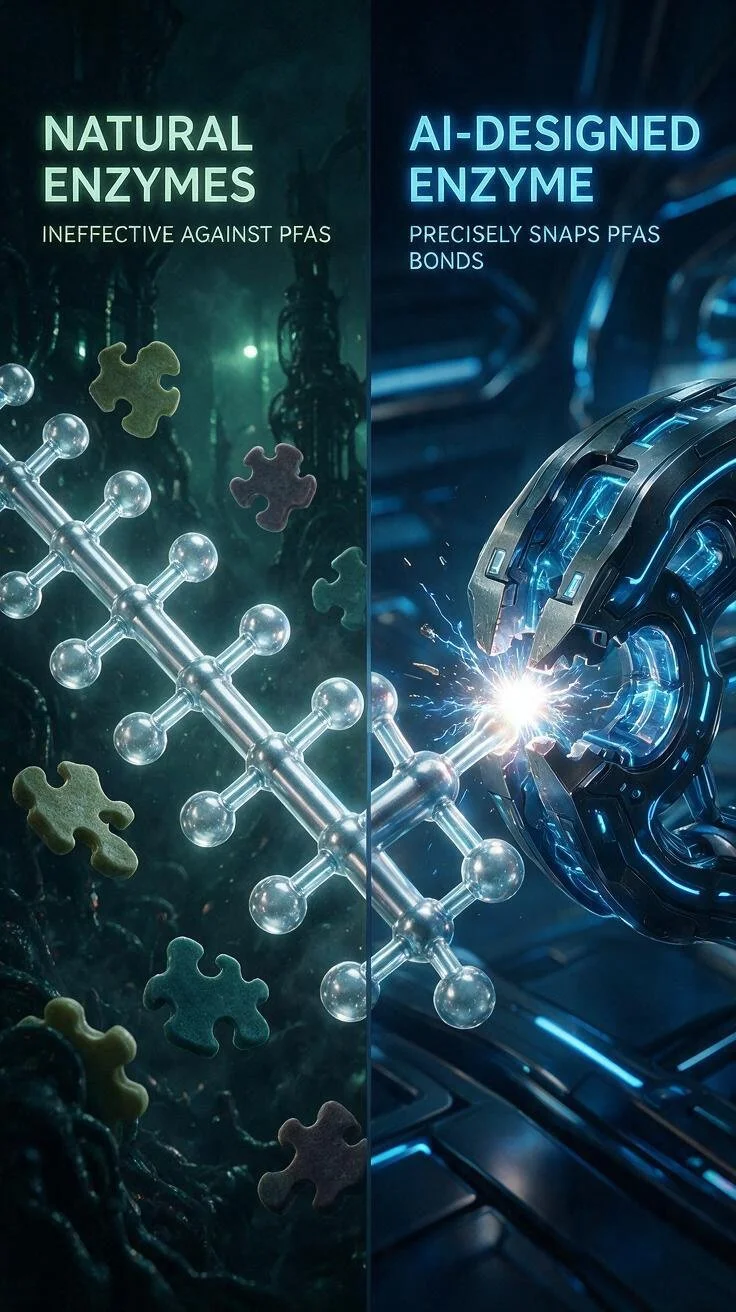
The C-F bond is the strongest single bond in organic chemistry. It is practically a microscopic fortress. Because this bond is almost entirely synthetic (it rarely occurs in nature), evolution never bothered to invent a biological tool to break it. If a PFAS molecule floats past a normal soil bacterium, the bacterium simply ignores it. It doesn't recognize it as food, and it doesn't have the chemical scissors to digest it anyway.
This is where the AI-driven "rational design" we discussed in Article 1 becomes our greatest weapon. We cannot wait a million years for nature to evolve a solution. We have to design the assassin ourselves.
The Protocol: Designing the Dehalogenase Biotech researchers are using AI to blueprint brand-new enzymes called defuoroaminases or engineered dehalogenases.
The Target Lock: The AI is tasked with designing a 3D protein pocket that perfectly matches the highly specific, unnatural shape of a PFAS molecule. The enzyme has to physically grab the chemical and hold it perfectly still.
The Molecular Crowbar: Once the PFAS is trapped in the active site, the enzyme exerts immense, highly targeted chemical pressure specifically on the Carbon-Fluorine bond.
The Snap: The enzyme destabilizes the bond just enough to snap it, popping the fluorine atoms off the carbon chain.
The Application: Water Treatment on a Microscopic Scale When you sever the C-F bonds, the "forever chemical" ceases to exist. It immediately falls apart into harmless, naturally occurring components: basic carbon molecules and free fluoride ions (the same safe mineral added to tap water and toothpaste).
The industrial application for this is staggering. Instead of hauling millions of gallons of contaminated groundwater to a fossil-fuel-burning incinerator, environmental engineers are preparing to deploy these designer enzymes directly into municipal water treatment plants. By pumping contaminated water through bio-filters packed with these molecular assassins, we can silently, efficiently, and cleanly dismantle one of the greatest chemical mistakes of the 20th century, operating entirely at room temperature.
