

The Plastic Eaters: Unzipping the Polymer
(09/04/2026)
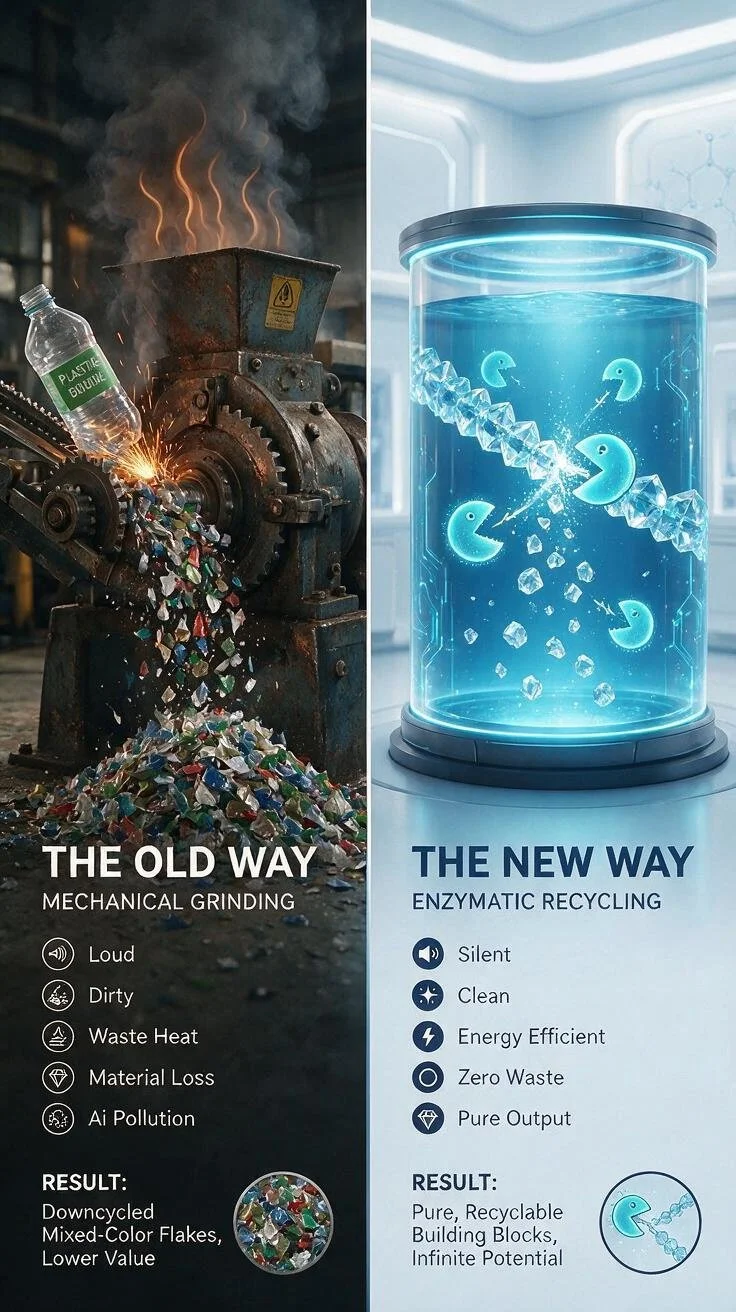
The Concept: We have a massive recycling lie to confront. When you throw a clear plastic clamshell or a water bottle into the blue bin, you assume it gets melted down and turned into a brand-new water bottle.
In reality, traditional mechanical recycling is highly inefficient. Heating and remolding plastic degrades its chemical structure. A clear water bottle usually gets "downcycled" into a lower-grade material, like polyester carpet fibers or park benches. Once that carpet wears out, it goes straight to the landfill. It is not a circle; it is just a delayed straight line to the dump.
Polyethylene terephthalate (PET) makes up roughly 12% of all global solid waste. It is highly stable and stubbornly resists breaking down in nature. But with designer enzymes, we are no longer trying to physically melt the plastic. We are chemically unzipping it.
The Science: The Molecular Scissor In 2016, scientists in Japan made a staggering discovery: a natural bacterium (Ideonella sakaiensis) living in a plastic recycling facility had evolved an enzyme—dubbed PETase—that could slowly eat PET plastic.
It was a miracle of evolution, but it had a fatal flaw: it was way too slow for industrial use, and it broke down if the temperature got too warm.
This is where the AI-driven "rational design" from our last article stepped in. Scientists took the 3D blueprint of the natural PETase enzyme and fed it into machine learning algorithms. They asked the AI to redesign the enzyme's amino acid string to make it faster, hungrier, and capable of surviving extreme temperature swings.
The result was an engineered super-enzyme (often referred to as FAST-PETase).
When you drop a piece of plastic into a vat of water mixed with these engineered enzymes, the molecular scissors go to work. Plastics are polymers—long, repetitive chains of smaller molecules linked together. The designer enzyme targets the exact chemical bonds holding that chain together, snapping them at lightning speed. Within hours, a solid plastic tray completely dissolves into a cloudy liquid.
The Application: True Circularity What is left in that vat isn't microplastics. The enzyme breaks the plastic all the way down into its two original, fundamental chemical building blocks (monomers): terephthalic acid (TPA) and ethylene glycol (EG).
This changes everything for the recycling industry:
Infinite Loops: We can extract those liquid building blocks, purify them, and use them to synthesize brand-new, virgin-quality plastic. The plastic never degrades. A bottle becomes a bottle, infinitely.
Eating the Rainbow: Traditional recycling requires intensive sorting because you cannot mix clear plastic with green or black plastic. Enzymatic recycling doesn't care about dyes or contaminants. The enzyme only cuts the PET bonds, leaving the dyes to just fall away.
The Textile Solution: Mixed fabrics—like a cotton/polyester blend shirt—are historically impossible to recycle. Now, we can toss the shirt in an enzyme bath. The enzyme dissolves the polyester back into a liquid, leaving the pure cotton threads perfectly intact to be spun again.
We are transforming plastic waste from a permanent environmental toxin into an infinite, renewable resource.
