The Protein Puzzle: AI and the Birth of Designer Enzymes
(08/28/2026)
The Concept: For the past few months, we have talked a lot about enzymes. We’ve seen enzymes that cut plastic, enzymes that dissolve cotton, and enzymes that bleach paper. In nature, enzymes are the ultimate chemical scissors, acting as catalysts to speed up reactions that would otherwise take centuries.
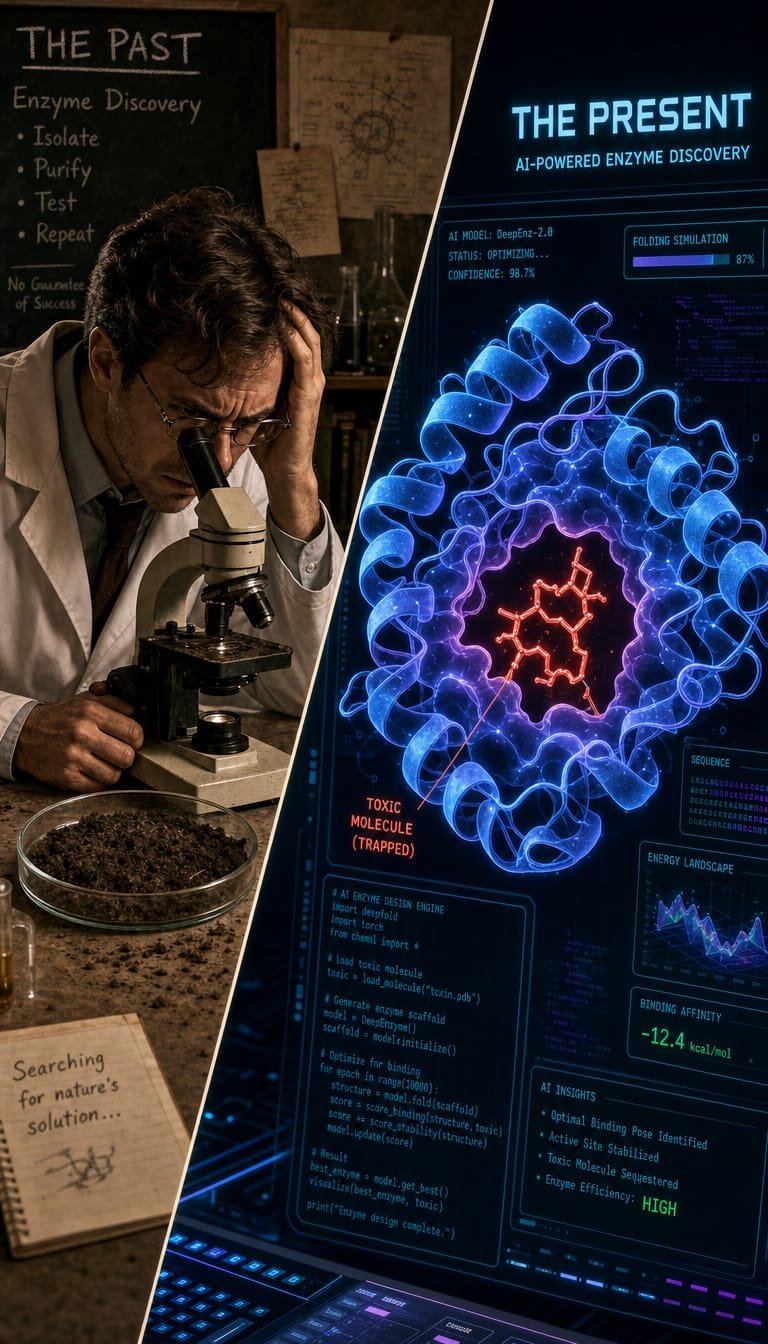
But historically, we had a major limitation: we could only use the scissors nature had already invented. If a human-made pollutant—like a synthetic "forever chemical" (PFAS) or a novel pesticide—was dumped into the environment, we just had to cross our fingers and hope that some random soil bacterium eventually evolved an enzyme to eat it. Evolution is a brilliant engineer, but it is incredibly slow.
Today, we are no longer waiting for evolution. We are stepping into the era of rational design. We are building custom molecular assassins from scratch.
The Science: The Lock and the Key To understand how we build an enzyme, you have to understand how they work. Every enzyme is a protein, which means it is essentially a long string of amino acids.
But a protein doesn't stay a floppy string; it folds up into a highly specific, incredibly complex 3D origami shape. This 3D shape is everything. An enzyme works like a lock and key. The 3D pocket of the enzyme (the active site) must perfectly match the 3D shape of the target pollutant molecule. If the shape is off by even a fraction of a nanometer, the enzyme won't bind, and the chemical won't be broken down.
For decades, the "Protein Folding Problem" was the holy grail of biology. Even if scientists knew the exact string of amino acids, predicting exactly how it would fold into a 3D shape was mathematically near-impossible for human brains and standard computers.
The Breakthrough: AI Enters the Lab Everything changed in the early 2020s with the advent of deep learning AI, most famously DeepMind's AlphaFold.
AlphaFold did what humans couldn't: it solved the protein folding problem. By analyzing the entire database of known biological structures, the AI learned to predict the 3D shape of practically any amino acid sequence with astonishing accuracy.
This flipped the script for bioremediation. Instead of finding an enzyme and figuring out what it does, scientists can now work backward:
The Target: We identify a toxic molecule we want to destroy (e.g., a specific microplastic or chemical weapon).
The Blueprint: We use AI software to digitally design a 3D enzyme pocket that perfectly grips that specific toxin and snaps its chemical bonds.
The Code: The AI then calculates the exact string of amino acids required to fold into that specific shape.
The Synthesis: We print that DNA sequence in a lab, insert it into a standard bacterium (like E. coli), and let the bacteria manufacture our brand-new, never-before-seen enzyme.
The Future: A Custom Arsenal We have transitioned from scavengers to architects. Over the next few weeks, we are going to look at exactly what these "designer enzymes" are being programmed to hunt. From devouring ocean plastics in hours to neutralizing toxic nerve agents on contact, biology has become a programmable weapon for environmental defense.