The Pearl and the Shell: Sculpting with Seawater
(08/21/2026)
The Concept: If you crack open an oyster shell or look at a pearl, you are immediately struck by its smooth, iridescent, glowing surface. This material is called nacre (commonly known as mother-of-pearl). It is beautiful, yes, but it hides a much more important secret: it is practically indestructible.
If you take a piece of pure chalk (calcium carbonate) and hit it with a hammer, it shatters instantly into dust. An oyster builds its shell out of that exact same chalk, pulling the calcium and carbonate directly from the seawater. Yet, if you hit an oyster shell or a pearl with a hammer, it doesn't shatter. It is up to 3,000 times more resistant to fracturing than the raw mineral it is made of.
How does a soft, fleshy, brainless mollusk transform fragile chalk into high-tech armor?
The Science: The Brick and Mortar The secret to nacre’s strength is a masterful lesson in microscopic composite engineering, achieved through a biological process called biomineralization.
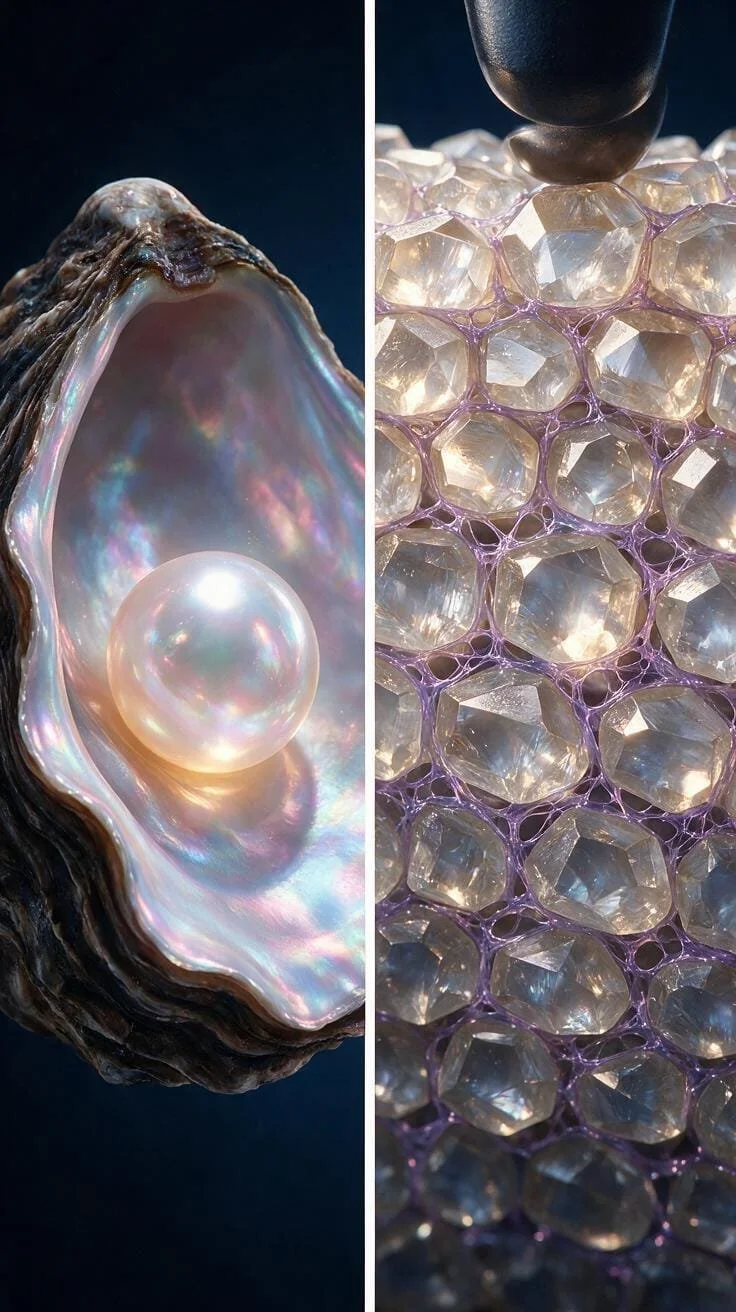
When the oyster builds its shell, it doesn't just excrete a solid block of mineral. Instead, it carefully constructs alternating layers of hard and soft materials, creating a microscopic "brick-and-mortar" wall.
The Bricks: The oyster pulls dissolved calcium and carbonate from the ocean and crystallizes it into microscopic, flat, hexagonal plates of a hard mineral called aragonite (the chalk). These are the bricks.
The Mortar: Between every single layer of aragonite plates, the oyster secretes a highly elastic, soft layer of biological proteins and chitin. This is the mortar.
When a physical impact (like the jaws of a predator or a hammer) hits the shell, the energy cannot travel in a straight line to crack the material. The soft, elastic protein layers absorb the shock, allowing the hard mineral "bricks" to slide over one another just a tiny bit instead of shattering. The microscopic friction between the bricks diffuses the force across the entire shell, neutralizing the blow.
The Application: Shatterproof Futures Human engineers are obsessed with nacre. Making materials that are both extremely hard and extremely tough (resistant to shattering) is one of the hardest challenges in materials science. Usually, hard things (like glass or ceramics) are brittle, and tough things (like rubber) are soft. Nacre is both.
Next-Generation Armor: Defense contractors and aerospace engineers are actively 3D-printing impact-resistant armor and vehicle plating that mimics the exact microscopic brick-and-mortar structure of the oyster shell, using advanced ceramics and synthetic polymers.
Shatterproof Glass: Materials scientists are developing clear, nacre-inspired glass for phone screens and windshields. By etching microscopic "brick" patterns into glass and filling the gaps with soft, elastic polymers, they are creating screens that can bend and absorb devastating impacts without sending a single spiderweb crack across the surface.
By studying a soft mollusk, we are learning how to build a tougher, safer world from the ground up.