Glass Houses: The Architecture of Diatoms
(08/14/2026)
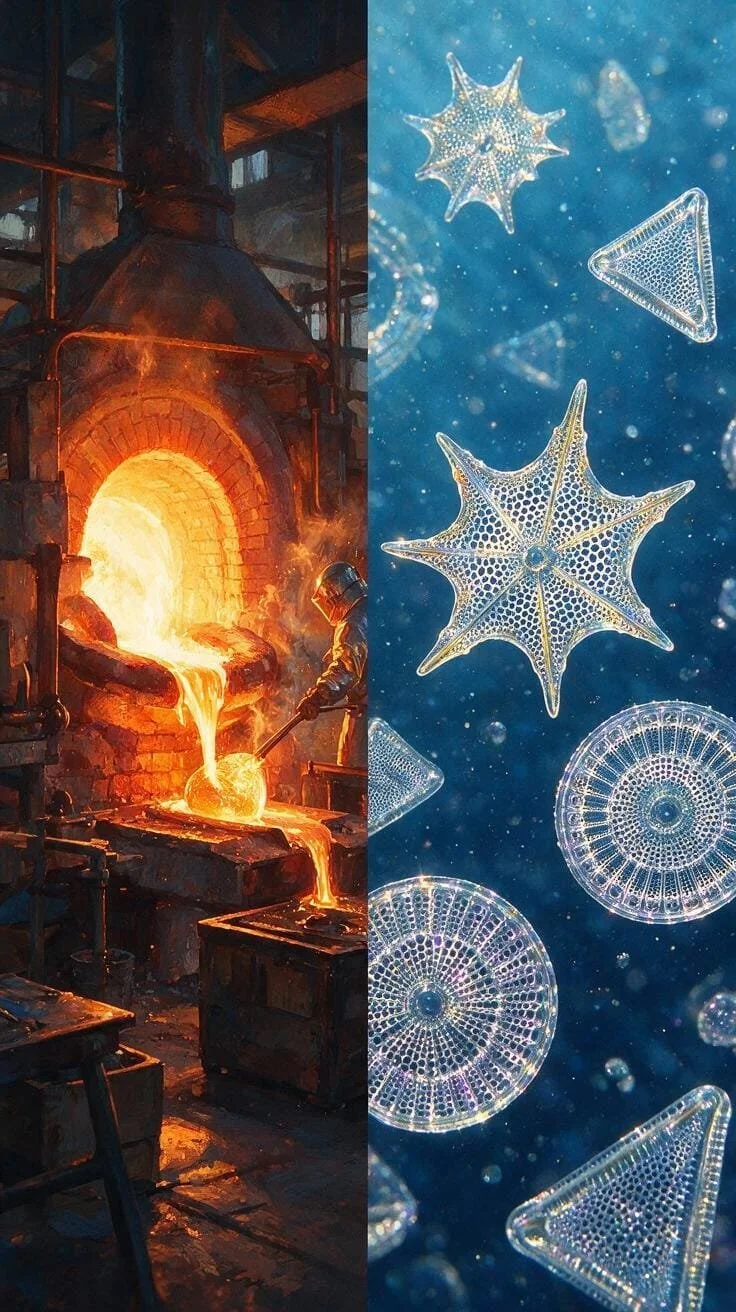
The Concept: Take a cup of seawater and hold it up to the light. To the naked eye, it looks like clear water. But under a microscope, that single cup contains thousands of microscopic, perfectly symmetrical "jewel boxes" floating in the current.
These are diatoms—a type of single-celled algae responsible for producing nearly 20% of the oxygen we breathe. But what makes diatoms truly staggering is not just their photosynthesis; it is their architecture. Every single diatom lives inside a custom-built, intricate shell made of pure, transparent glass.
The Science: Cold-Water Glassblowing If a human wants to make silica glass, it is a violent, energy-intensive process. We have to mine silica sand, dump it into a massive industrial furnace, and heat it to well over 2,000°F (about 1,200°C) just to melt it into a pliable state.
Diatoms, however, manufacture perfectly structured, highly complex glass shells (called frustules) in the freezing, dark waters of the ocean. How? Through a highly controlled biological process called biosilicification.
Instead of using extreme heat, the diatom relies on specialized proteins and long-chain polyamines. As ocean water flows over the cell, these biological tools actively extract dissolved silicic acid from the seawater. Operating entirely at ambient temperatures, the diatom then precipitates this acid, meticulously assembling nanoparticles of silica into a rigid, 3D structure.
The resulting glass shell isn't just a solid box; it is a masterpiece of hierarchical nanotechnology. It is covered in incredibly precise, repeating patterns of microscopic pores, ridges, and channels that look like perfectly cut crystal.
The Application: Harvesting Nature's Nanotechnology Human engineers struggle to manufacture nanoscale 3D structures with the exact precision that diatoms achieve naturally every single day. Instead of trying to build these structures from scratch, modern biotech companies are simply harvesting them.
Solar Energy: The intricate, porous structure of a diatom's glass shell is perfectly evolved to capture and funnel scattered sunlight directly into the algae's chloroplasts. Companies like Swedish Algae Factory are now cultivating specific diatoms, extracting their empty glass shells (called Algica), and coating commercial solar panels with them. The microscopic glass acts as a light-trapping layer, significantly boosting the panel's energy efficiency.
Targeted Drug Delivery: Because these shells are highly porous, non-toxic, and biocompatible, medical researchers are using them as microscopic cargo ships. By filling the porous glass frustules with targeted cancer drugs and capping the microscopic holes, they can deliver toxic chemotherapy agents safely through the bloodstream directly to a tumor, minimizing side effects.
Lithium-Ion Batteries: The unique, porous silica architecture of the diatom makes it an ideal template for next-generation battery anodes, buffering the physical expansion of silicon during charging cycles and drastically increasing battery life.
By studying a microscopic algae, we are learning how to replace roaring industrial furnaces with cold, biological precision.