The Lotus Effect: Self-Cleaning Biology
(08/07/2026)
The Concept: In many Eastern cultures, the lotus flower is a sacred symbol of purity and enlightenment. This symbolism is rooted in a striking biological paradox: the lotus naturally grows in the deepest, muddiest, most stagnant swamps on Earth, yet its broad green leaves and brilliant white and pink petals emerge completely immaculate. They never look dirty.
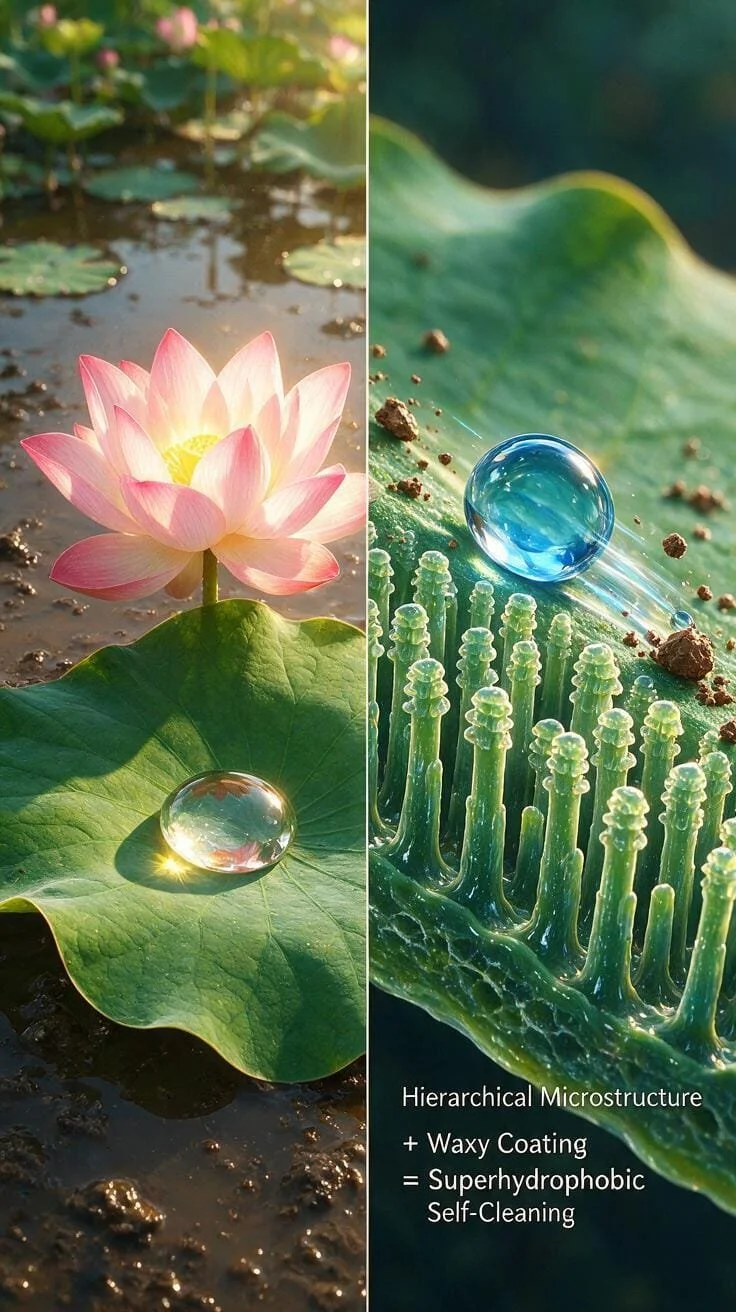
If you take a handful of thick swamp mud and throw it directly onto a lotus leaf, it won't stick. The mud simply rolls off, leaving the leaf perfectly clean and dry. For a long time, scientists assumed the leaf was just very smooth and waxy. But when they finally put it under an electron microscope, they discovered the exact opposite was true.
The Science: The Bed of Nails The lotus leaf achieves its extreme cleanliness through a physical property called superhydrophobicity (extreme water repulsion).
If you wax your car, water beads up on the hood. That is standard hydrophobicity. But on a lotus leaf, water doesn't just bead up; it forms a perfect, near-flawless sphere.
This happens because the surface of the lotus leaf is incredibly rough on a microscopic level. It is covered in a dense forest of tiny bumps called papillae (micro-pillars), which are further coated in jagged, hydrophobic wax crystals.
Think of it like a microscopic bed of nails. When a raindrop falls onto the leaf, it cannot flatten out or sink into the microscopic valleys. It is suspended purely on the microscopic tips of those wax pillars. Because the water has almost nothing to grip onto, its own internal surface tension pulls it into a tight, perfect sphere.
The Cleaning Mechanism: When the leaf tilts even slightly in the wind, that perfect sphere of water rolls across the "bed of nails."
As it rolls, the water acts like a microscopic vacuum cleaner. Any dirt, dust, or fungal spores sitting on the leaf are also resting lightly on the tips of those pillars. The physical adhesion between the dirt particle and the rolling water droplet is much stronger than the adhesion between the dirt and the tiny tip of the plant pillar. So, the water plucks the dirt right off the surface, sweeping it away.
The Application: Designing a Clean World Industrial engineers are obsessed with the Lotus Effect because our traditional methods of cleaning rely on harsh chemical solvents, massive amounts of water, and intense physical labor. By biomimicking the lotus, we can engineer surfaces that clean themselves with just a gentle mist of water.
Self-Cleaning Architecture: Glass manufacturers are now baking microscopic, silica-based nano-pillars directly into the surface of exterior windows for skyscrapers. When it rains, the water perfectly beads up and rolls off, taking city smog and dirt with it, eliminating the need for dangerous, chemical-heavy window washing.
Medical Implants: One of the greatest risks of medical implants (like catheters or stents) is that bacteria attach to them and form toxic biofilms. By stamping the surface of the plastic with the lotus's microscopic texture, bacteria physically cannot find enough flat surface area to anchor themselves, drastically reducing infection rates.
Textiles: Remember our series on PFAS ("Forever Chemicals")? Historically, we used those toxic chemicals to make waterproof, stain-resistant clothing. Today, material scientists are weaving fabrics with nano-scale roughness that mimics the lotus. Red wine or mud simply bounces off the fabric, creating stain-proof clothing without a single drop of toxic chemistry.