Living Light: The Chemistry of Bioluminescence
(07/31/2026)
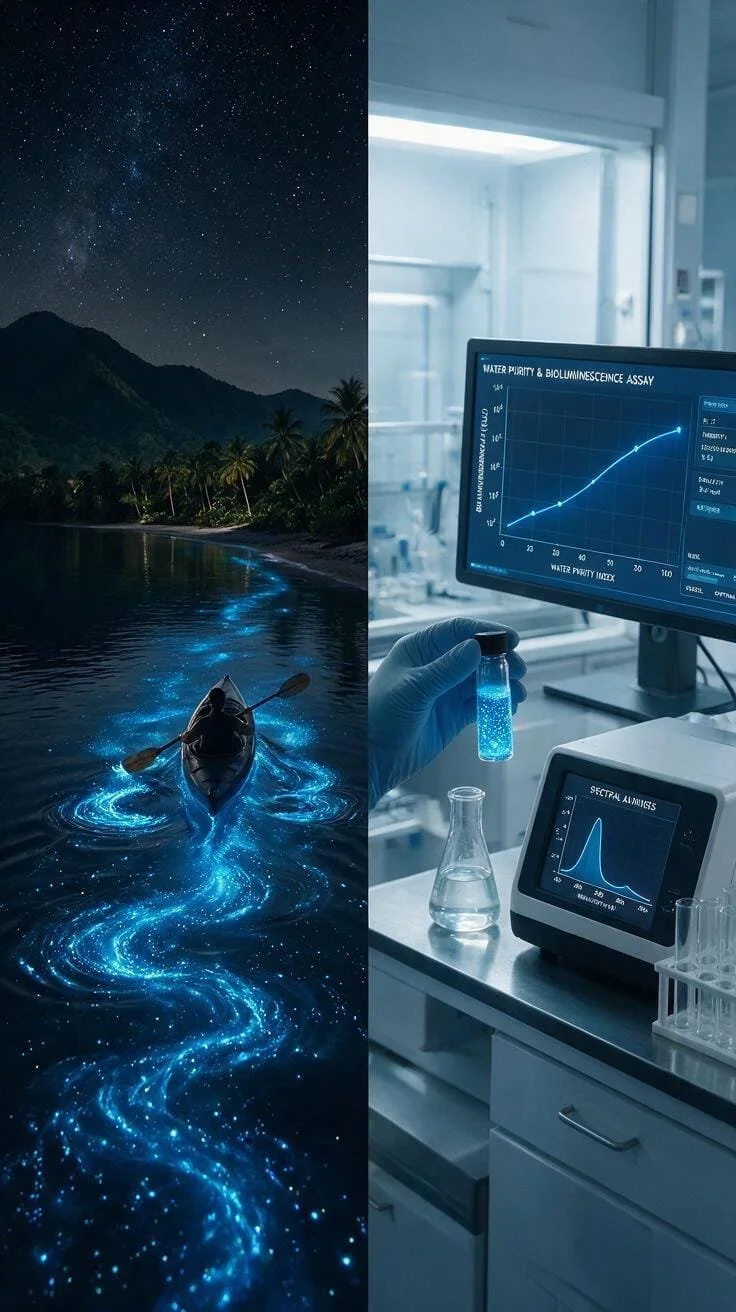
The Concept: If you have ever seen a firefly pulse in a dark forest, or paddled through a bioluminescent bay where the water glows neon blue with every stroke of your oar, you have witnessed one of nature's most enchanting magic tricks.
For centuries, this glowing water was steeped in folklore and mystery. How can a living creature produce light? Human-made light, historically, comes from fire. Whether it is a candle, a gas lantern, or a traditional incandescent lightbulb, we produce light by burning something or heating a filament until it glows.
But fire is hot, and if a firefly used heat to make light, it would incinerate itself. Nature had to invent a completely different mechanism: "cold light."
The Science: The Luciferin/Luciferase Reaction The secret to biological light is a highly efficient chemical reaction that takes place inside the cells of these organisms. It requires two main components with rather demonic-sounding names (derived from Lucifer, the Latin word for "light-bringer"):
Luciferin: This is the light-emitting molecule, the biological "fuel."
Luciferase: This is an enzyme, the biological "spark."
When the organism wants to glow, it introduces oxygen to the luciferin in the presence of the luciferase enzyme. The enzyme catalyzes a rapid oxidation reaction. This reaction pushes electrons in the luciferin molecule into a higher energy state. Because this state is unstable, the electrons immediately drop back down to their normal level, releasing the excess energy in the form of a photon—a particle of visible light.
The Miracle of Efficiency: The most staggering part of this chemistry is its thermodynamic efficiency. A traditional incandescent lightbulb is horribly inefficient; it converts only about 10% of its electrical energy into light, wasting the other 90% as heat.
Bioluminescence, however, is essentially 100% efficient. Almost zero energy is lost as heat. It is a perfectly cold, perfectly controlled chemical glow, engineered over millions of years of evolution.
The Application: The Living Canary While this light is beautiful, environmental engineers are using it for something highly practical: detecting pollution.
Certain marine bacteria, like Aliivibrio fischeri, naturally glow continuously when they are healthy. Scientists realized that if these bacteria are exposed to toxins—like heavy metals, pesticides, or industrial runoff—their metabolism slows down, and their light immediately dims.
Instead of waiting days for complex chemical assays in a lab, engineers can now use these glowing bacteria as living "biosensors." By dropping a standardized vial of bioluminescent bacteria into a water sample from a river or factory outflow, they can instantly measure the water's toxicity. If the water is clean, the bacteria shine bright. If the water is toxic, the light fades.
It is a modern, microscopic version of the canary in the coal mine—using the beautiful chemistry of nature to protect it.