The Blue Morpho: The End of Pigment
(04/24/2026)
The Concept: If you walk through the dense, shadowed understory of the Amazon rainforest, you might see a flash of electric, iridescent blue that is so bright it almost looks artificial. This is the Blue Morpho butterfly. Its wings are arguably the most vibrant blue found anywhere in nature.
Naturally, you would assume that the butterfly's wings are packed with a highly concentrated blue dye. But if you were to take that magnificent wing and grind it into a fine powder, the blue would vanish entirely. You would be left with a dull, translucent grey dust.
The Blue Morpho contains absolutely zero blue pigment. Its color is an optical illusion, created not by chemistry, but by microscopic architecture.
The Science: Sculpting Light Most of the colors we interact with daily (like the dye in your shirt or the paint on your walls) are pigment-based. Pigments are chemicals that absorb certain wavelengths of light and reflect others. A red shirt looks red because the chemical dye absorbs blue and green light, bouncing only the red light back to your eye. Over time, UV light breaks these chemical bonds, which is why pigments fade.
The Blue Morpho uses a completely different strategy called Structural Color.
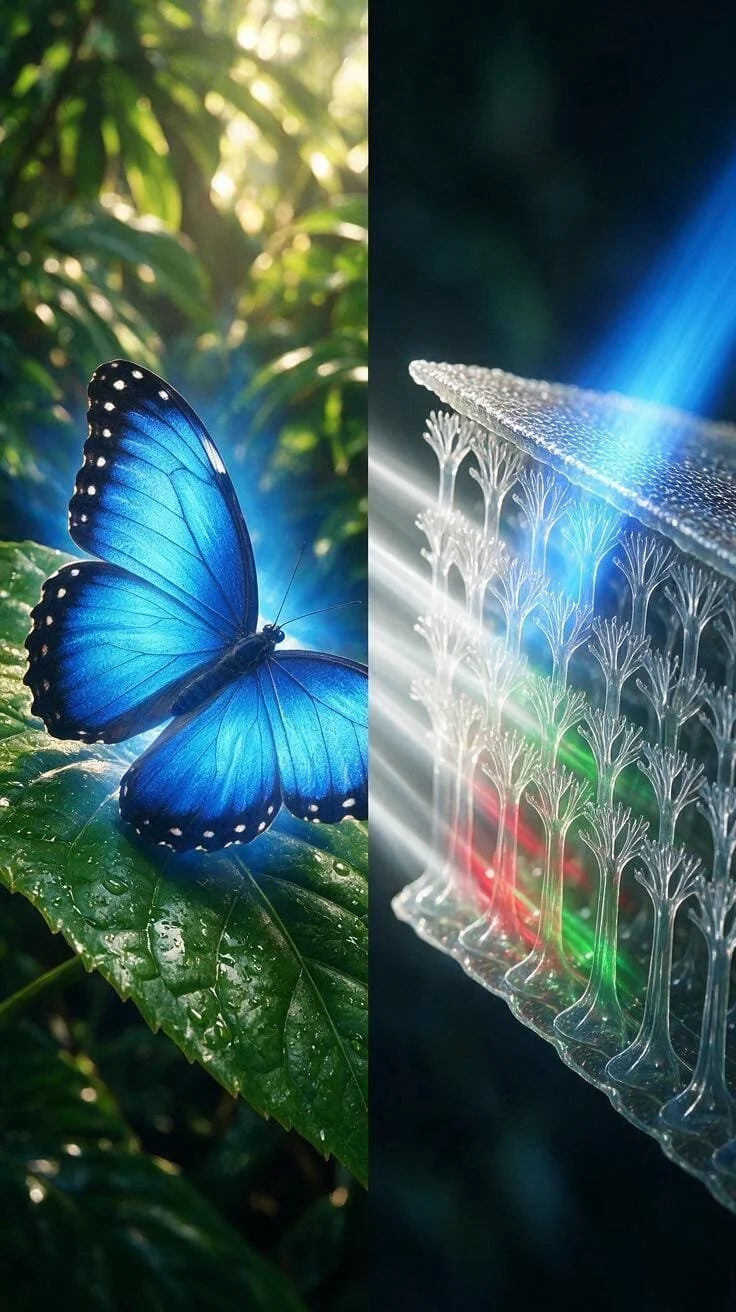
If you place a Morpho wing under an electron microscope, you won't see a flat surface. The wing is covered in millions of microscopic scales. Each scale is made of chitin (the same biological plastic that makes up crab shells) and is shaped remarkably like a microscopic pine tree, with a central trunk and perfectly spaced horizontal branches.
This specific "tree" shape is precisely engineered to manipulate the physics of light through a process called thin-film interference:
The Trap: As white light hits the wing, it enters the microscopic branches of these chitin trees.
Destructive Interference: The physical spacing of the branches forces the red and green wavelengths of light to bounce around and collide with each other out of sync, effectively canceling each other out.
Constructive Interference: The exact spacing perfectly aligns the blue wavelengths. As they bounce off the branches, they merge in perfect sync, amplifying each other.
The wing doesn't have blue color; it physically sculpts white light, destroying the red and green and firing a highly amplified, pure blue directly back at your eyes. Because there is no chemical pigment to break down, a Morpho wing will remain brilliantly blue for centuries after the butterfly dies, as long as the physical structure remains intact.
The Application: Painting Without Paint Why does this matter for industrial engineering? Because creating chemical pigments—especially bright, durable ones—is incredibly toxic. As we covered in our previous series on the textile industry, synthesizing and applying heavy-metal dyes pollutes billions of gallons of water globally.
Materials scientists are now using nanotechnology to biomimic the Blue Morpho.
Automotive Paint: Companies like Lexus have spent over a decade developing "Structural Blue" paint. Instead of blue dye, the paint is filled with transparent, microscopic nano-flakes engineered to mirror the butterfly's thin-film interference. It creates a blue so deep it appears to glow, and because it has no pigment, it will never fade in the sun.
Textiles: Textile engineers are developing threads woven with specific nano-structures to create fabrics that shimmer with color without a single drop of toxic dye.
By copying the architecture of an insect, we can eliminate one of the most toxic manufacturing processes on Earth, replacing chemical pollution with pure physics.