The Desert's Last Stand: Healing Toxic Lands with Extremophile Plants
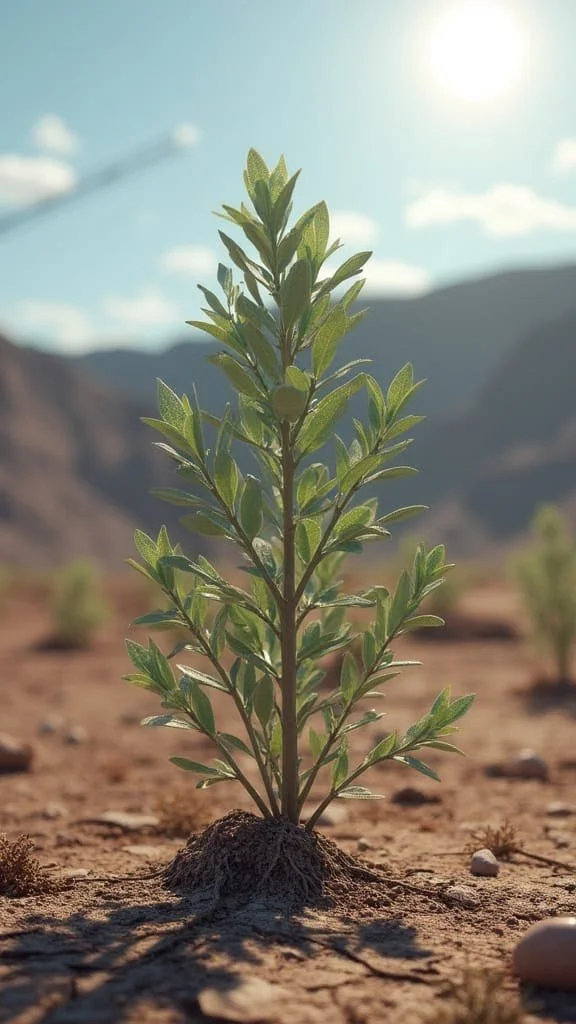
When we think of plants, we often picture them in rich, healthy soil. But what about the most damaged, poisoned landscapes on Earth, like the vast and barren lands left behind by mining operations? In these toxic deserts, a special class of plants, known as "extremophytes," are not just surviving—they are actively healing the soil in a process called phytoremediation. (07/04/2025)
The Problem: The Barren Legacy of Mining
Mining has provided critical resources for our world, but it often leaves behind a devastating environmental legacy. Mine tailings—the leftover materials from ore extraction—are frequently laden with high concentrations of heavy metals like lead, arsenic, zinc, and cadmium. This soil is also often highly saline (salty) and nutrient-poor. This toxic cocktail prevents most plants from growing, leaving the land barren, unstable, and prone to wind and water erosion, which can spread the contaminants into nearby ecosystems and water sources.
The Hero: The Unshakable Saltbush (Atriplex)
Meet the Saltbush, a member of the Atriplex genus. This is no delicate flower. It's an extremophyte, a plant naturally evolved to thrive in extreme conditions of high salinity and drought. While other plants perish, the Saltbush stands firm, making it a perfect candidate for remediating the harsh environment of mine tailings. It is a pioneer species, a first responder that prepares the way for ecological recovery.
The Advanced Technique: Phytostabilization
While some plants absorb and accumulate toxins (phytoextraction), the Saltbush performs a different, equally crucial role: phytostabilization. Instead of removing the heavy metals, it locks them in place. Here's how this advanced technique works:
Physical Anchoring: The Saltbush develops a dense, fibrous root system that physically binds the loose, contaminated soil particles. This immediately reduces erosion, preventing wind from blowing toxic dust and rain from washing contaminants into the groundwater.
Chemical Immobilization: This is the most critical step. The plant's roots actively change the chemistry of the soil around them. They can alter the pH or release specific chemical compounds that cause the dissolved, mobile heavy metals in the soil to precipitate, or "solidify." This process converts the metals into a stable, insoluble form, making them far less bioavailable and less likely to be absorbed by other organisms or to leach into the water supply.
The Saltbush doesn't just tolerate the toxins; it actively corrals them, effectively putting them in a state of "geochemical lockdown" and reducing the overall risk to the environment.
The Big Picture: A Foundation for Renewal
Phytostabilization with hardy, native plants like Saltbush is a game-changer for large-scale ecological restoration. It's a low-cost, low-maintenance, and visually effective first step in a long healing process. By stabilizing the soil and reducing toxicity, these pioneer plants create micro-environments where other, less tolerant species can begin to establish themselves.
Over time, what was once a barren, toxic wasteland can slowly be transformed back into a functioning ecosystem. It's a powerful reminder that for even our most damaged landscapes, nature, with a little help from its toughest inhabitants, holds the key to recovery.
We've journeyed from fungi and bio-electric bacteria to genetically engineered microbes and extremophile plants. The future of environmental cleanup is diverse, innovative, and full of natural power.