The "Lab Effect": Why Success in a Petri Dish Doesn't Always Work in the Field
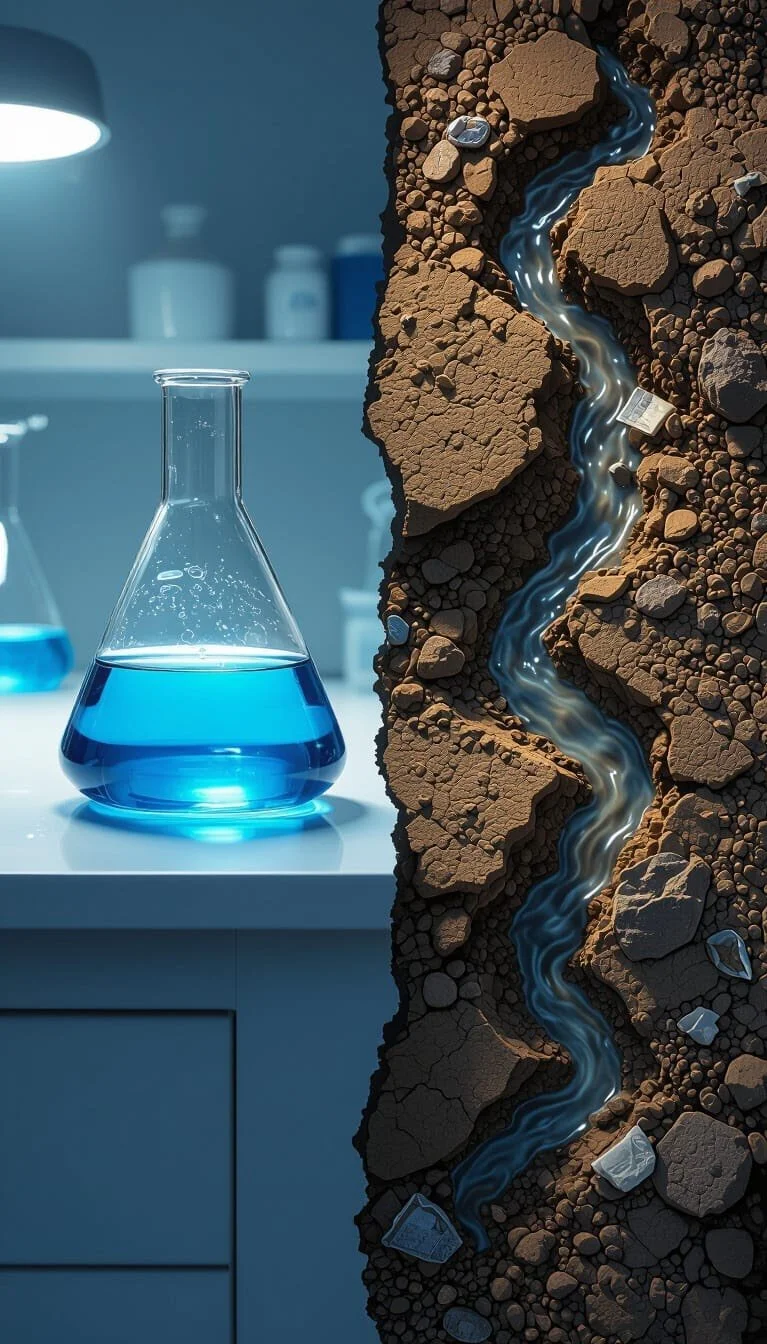
One of the most common heartbreaks in bioremediation happens when a strategy that worked perfectly in the laboratory fails completely when applied to a real contaminated site. This phenomenon highlights a fundamental challenge: Environmental Heterogeneity. (11/21/2025)
The Myth of the Perfect Mix
In a laboratory, scientists create an idealized world.
Homogeneity: When testing a microbe in a beaker, the soil is sifted, the contaminants are mixed evenly, and the temperature is constant.
Isolation: The "hero" microbe is often the only one in the jar, with no competition.
Access: Nutrients are stirred in, ensuring every single bacterium gets exactly what it needs.
The Chaos of the Real World
The real world, however, is messy and uncooperative.
The Delivery Problem: Real soil and aquifers are not uniform sponges; they are complex layers of clay, sand, and rock. Water (and the nutrients we inject) follows the path of least resistance, often flowing through cracks and completely bypassing the contaminated zones in the dense clay. You might inject food for the microbes, but if it flows around them rather than to them, the cleanup fails.
Microbial Warfare: In the field, your introduced "hero" microbes aren't alone. They are dropped into a jungle containing thousands of native species. They have to compete for food and space, and they might even be eaten by predatory protozoa before they can do their job.
Patchiness: Pollution isn't spread evenly. It sits in concentrated pools or thin veins. Finding these hotspots and targeting them with precision is an immense engineering challenge.
Bridging the Gap
This challenge means that bioremediation is rarely just about biology; it is heavily reliant on hydrogeology and engineering. Success depends on "pilot studies"—small-scale field tests that bridge the gap between the beaker and the full-scale cleanup—and advanced delivery systems like fracturing the soil to ensure nutrients reach their target. It reminds us that nature is rarely as tidy as science would like it to be.