

The Microplastic Hunters - Deployment in the Wild
(10/16/2026)
The Concept: A few weeks ago, we talked about a designer super-enzyme (FAST-PETase) capable of chemically unzipping solid plastic in a matter of hours. In a controlled, heated industrial recycling vat, this technology is revolutionary.
But out in the open ocean, the problem changes entirely. We are not dealing with whole plastic bottles neatly gathered in one place; we are dealing with a diffuse soup of microplastics spread across thousands of miles of cold, shifting currents. We cannot pump the entire ocean through a recycling facility. Instead, we have to send the factory into the ocean.
We need a biological cleanup crew that can actively hunt down the pollution.
The Science: Programming the Hunter-Seeker To achieve this, synthetic biologists are merging the designer enzymes we discussed previously with whole-cell engineering, creating a microscopic, autonomous drone.
The Marine Chassis: We cannot use standard laboratory E. coli in the ocean; the saltwater would kill it instantly. Instead, scientists start with rugged marine bacteria, such as Alcanivorax borkumensis—a species that naturally evolved to eat hydrocarbons and is famous for cleaning up oil spills.
The Weapon Payload: Using the plasmid software-patching techniques we covered in our medical series, scientists insert the genetic code for our designer plastic-eating enzymes into the marine bacterium.
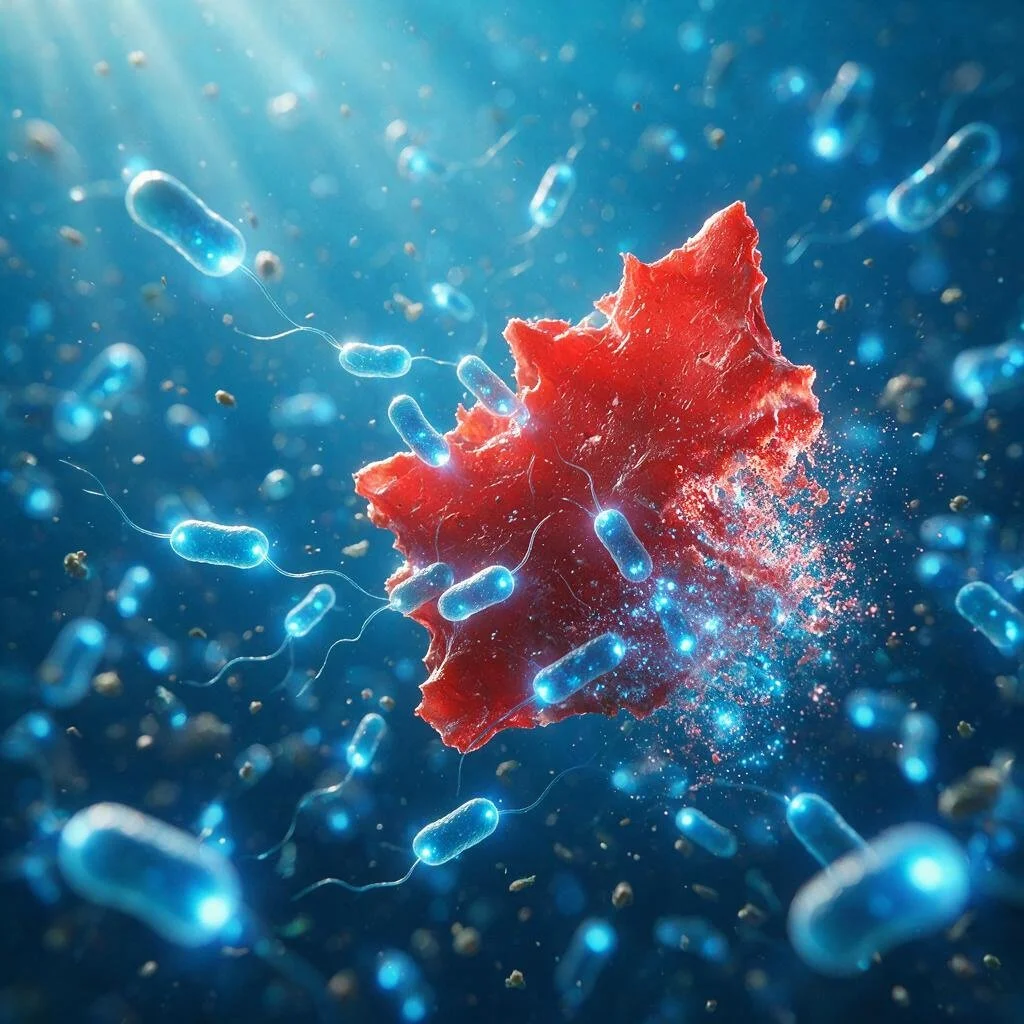
The Targeting System: This is the truly brilliant part. It is not enough for the bacteria to just float aimlessly; they have to find the microplastics. Biologists are enhancing the bacteria's natural "chemotaxis"—their ability to swim toward specific chemical gradients. As microplastics degrade in the sun, they leach specific chemical signatures into the water. The engineered microbes are programmed to smell this signature and actively swim toward the source.
The Application: Swarm Remediation When deployed into a polluted marine environment, these engineered micro-hunters go to work.
They swim through the water column, following the chemical trail until they collide with a jagged shard of microplastic. Upon contact, they form a biofilm—a sticky biological mat—over the surface of the plastic. They then deploy their engineered payload, secreting the designer enzymes directly onto the polymer.
The enzymes chemically unzip the microplastic, breaking it down into basic, harmless carbon monomers. The bacteria then consume those monomers as fuel, giving them the energy to detach, multiply, and swim off to hunt down the next piece of plastic.
We are transforming static designer enzymes into a dynamic, self-replicating, self-fueling swarm of ocean roombas.
