(10/30/2026)
The Concept: To feed eight billion people, humanity relies heavily on a single industrial miracle invented in the early 20th century: the Haber-Bosch process. This process pulls nitrogen gas out of the atmosphere and turns it into the liquid ammonia used in synthetic fertilizers.
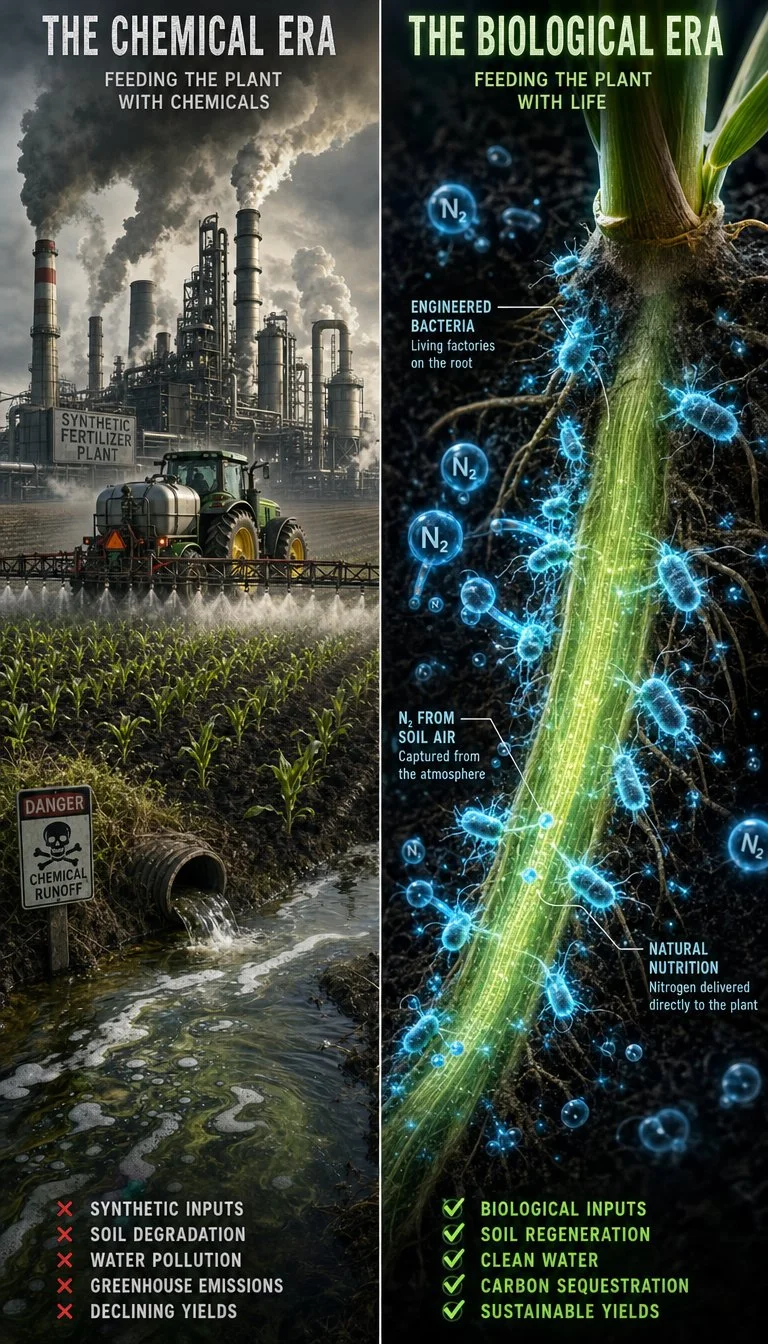
But this miracle has a devastating cost. The Haber-Bosch process requires insane amounts of heat and pressure, consuming roughly 1-2% of the world's entire energy supply and emitting massive amounts of carbon dioxide. Furthermore, when farmers spray this synthetic fertilizer onto their fields, the crops only absorb about half of it. The rest washes away in the rain, creating toxic chemical runoff that causes massive algae blooms and suffocates marine life in our rivers and oceans.
We need a way to fertilize our food without burning fossil fuels or poisoning our water. The solution is already in the soil; we just need to reprogram it.
The Science: The Biological Haber-Bosch Nature already knows how to pull fertilizer out of thin air. The air we breathe is 78% nitrogen, but plants cannot use it in its gaseous form. However, certain plants, like legumes (beans, peas, and clover), have a natural superpower: they form a symbiotic relationship with a type of soil bacteria called Rhizobia.
These bacteria attach to the plant's roots, pull nitrogen directly from the air, and convert it into ammonia for the plant to eat. In exchange, the plant feeds the bacteria sugars. It is a perfect, zero-waste system.
The problem? Our most vital staple crops—corn, wheat, and rice, which feed the vast majority of the planet—do not have this relationship. They cannot talk to the Rhizobia, which is why we have to spray them with synthetic chemicals.
Using whole-cell engineering, synthetic biologists are finally bridging this gap.
The Protocol: Engineering the Root Microbiome Instead of trying to genetically modify the corn itself (which is incredibly difficult), scientists are reprogramming the native bacteria that already live around the corn's roots.
The Host: Biologists isolate a common, rugged strain of bacteria that naturally thrives on the roots of corn or wheat.
The Software Patch: Using genetic circuits, they splice in the specific cluster of genes responsible for nitrogen fixation (the nif cluster)—the same biological machinery used by the legume bacteria.
The Sensor: They add a genetic sensor so the bacteria only produce fertilizer when the corn plant chemically signals that it is hungry, preventing any excess waste.
The Application: Brewing Fertilizer This technology fundamentally shifts how we grow food. Instead of buying thousands of gallons of petrochemical-based fertilizer, a farmer can simply coat their seeds in a liquid solution of these engineered, programmable microbes before planting.
As the corn grows, the microbes multiply and form a living, symbiotic fertilizer factory directly on the roots. They pull nitrogen gas seamlessly from the air and hand it straight to the plant. Because the fertilizer is created exactly where it is needed and only when it is needed, there is zero runoff into the water supply.
By upgrading the software of the soil microbiome, we are simultaneously decarbonizing global agriculture and saving our downstream ecosystems.