Blueprints From Reality: Learning from the ISS and Biosphere 2
(07/25/2025)
Welcome back to the Project Clean Up blog. Over the past several weeks, we have outlined the ambitious vision for a completely closed-loop city—a self-sustaining, regenerative model for humanity's future on Earth and beyond. We've explored its theoretical systems for water, waste, food, and energy.
Now, it is time to ground that vision in reality.
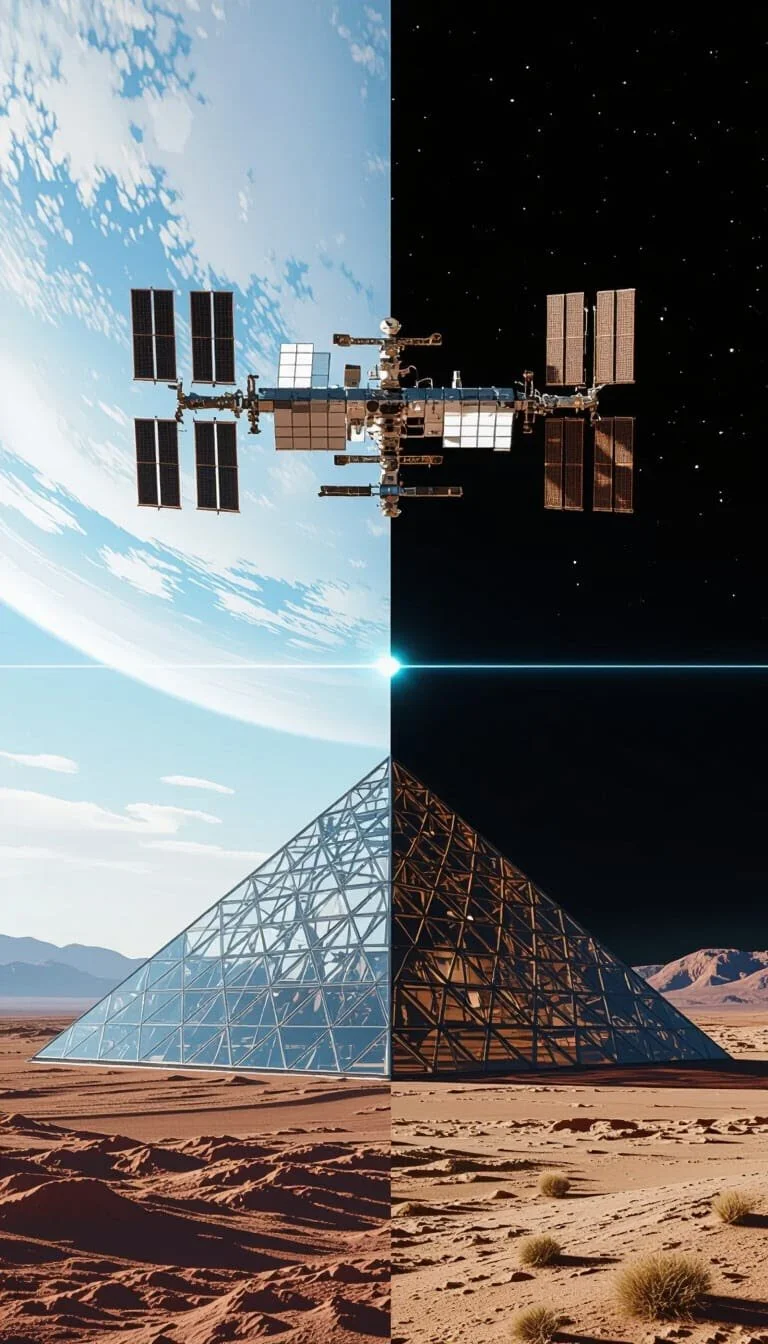
The dream of creating a self-sufficient human habitat is not new. We are fortunate to stand on the shoulders of giants—pioneering projects that have tested the limits of science and human endurance. For our next series of articles, we will be guided by two of the most significant experiments ever conducted in this field: the International Space Station (ISS) and Biosphere 2. They are our real-world blueprints, teaching us through their incredible successes and their invaluable failures.
Case Study 1: The International Space Station – The Pragmatic Survivor
Orbiting 250 miles above Earth, the ISS is a testament to engineering in the most hostile environment imaginable. Its primary goal is not complete ecological closure, but maximum resource efficiency. Every kilogram of water or oxygen launched from Earth costs thousands of dollars, so a key objective is to recycle as much as possible.
The Success: The ISS's Environmental Control and Life Support System (ECLSS) is a marvel of pragmatic engineering. Its Water Recovery System, for example, recycles an astonishing 98% of all water from crewmembers' breath, sweat, and urine back into pure drinking water. This represents the pinnacle of engineered life support—reliable, modular, and relentlessly optimized mechanical systems that sustain human life.
The Limitation: The ISS is a semi-closed loop. It is fundamentally a high-tech campsite that relies on a constant tether to Earth for food, new equipment, and the disposal of solid waste. It proves we can survive in a sealed environment, but not yet thrive independently.
Case Study 2: Biosphere 2 – The Ambitious Ecosystem
In the Arizona desert stands a monumental glass-and-steel pyramid: Biosphere 2. It was designed in the late 1980s with a breathtakingly ambitious goal: total material closure. The project sought to create a completely self-regulating, living ecosystem—with biomes including a rainforest, an ocean, and a farm—that could sustain a team of eight "biospherians" with no inputs other than energy.
The Success: Biosphere 2 was a priceless learning experience. For two years, its crew breathed air circulated by plants, drank water that had rained from its own "sky," and ate food grown in its own soil. It proved that complex ecological interactions could be modeled and provided invaluable data on the intricate dance of carbon, water, and nutrients. It represents the pinnacle of ecological life support—the attempt to work with nature's complexity.
The Limitation: The experiment famously struggled. Oxygen levels plummeted unexpectedly due to rampant microbial activity in the overly rich soil, forcing engineers to pump oxygen in from the outside. The crew battled hunger, and interpersonal conflicts arose under the intense pressure. Biosphere 2 taught us a humbling lesson: we do not yet fully understand Earth's complex web of life and cannot easily replicate it.
Our Path Forward: The Engineer and the Gardener
These two projects give us our guiding principles. The ISS is our Engineer, teaching us to build robust, redundant, and efficient mechanical systems. Biosphere 2 is our Gardener, teaching us about the power and complexity of integrating living ecosystems.
Our closed-loop city must be a hybrid of both. It needs the life-support reliability of the Engineer and the regenerative ambition of the Gardener.
In the coming weeks, we will revisit these two monumental projects as we re-examine each system of our city. We will start with the most critical resource of all—Air—and see what lessons the pragmatic survivor and the ambitious ecosystem can teach us.