The Human Element: Culture, Community, and Purpose in the Closed-Loop City
(07/18/2025)
Welcome, for one last time, to our foundational series on the Closed-Loop City. Together, we have architected its systems from the ground up. We have designed the living water cycles, the waste-to-wealth metabolism, the urban harvest, the regenerative energy grid, the ISRU-based construction, and the AI-human collaborative governance that holds it all together. We have built a machine for survival.
But the final, most important question remains: Why? What is it like to live inside this perfect loop? Today, we explore the ultimate purpose of our city: the human experience.
A New Consciousness: From Scarcity to Stewardship
Life within the loop fosters a profound psychological shift. The gnawing anxiety of resource scarcity, which has driven much of human history, is replaced by the calm confidence of managed abundance. Citizens are not consumers in competition; they are stewards in collaboration.
This isn't just an ideal; it's a tangible reality reflected in the "City Dashboard" visible in every public square and home. When you see in real-time how your community’s water reserves are full, how its air is pure, and how its energy is stable because of your collective actions, your relationship with your environment and your neighbors fundamentally changes. You are not a passenger; you are a vital crew member.
The Redefinition of Work and a Renaissance of Purpose
With basic needs like food, water, shelter, and energy met by a highly automated and efficient system, humanity is liberated from the traditional definition of "work." The drudgery required for mere survival is handled by machines. This does not lead to idleness, but to a renaissance of purpose. "Labor" is for machines; "Work" becomes the domain of human passion and contribution.
A citizen’s day is defined not by a monotonous job, but by a fluid pursuit of interest and mastery. A morning might be spent contributing to a quantum computing research project, an afternoon mentoring young people in a community culinary garden, and an evening composing music that is broadcast throughout the city's habitats. People are free to become what they were always meant to be: scientists, artists, explorers, teachers, and innovators.
The Fabric of Community: Tangible Interdependence
In our current world, our interdependence is often abstract. In the closed-loop city, it is visceral. The system's design makes it clear that every action has a consequence. An act of waste is a measurable debit from the community's shared resources. An act of innovation is a tangible credit that benefits everyone.
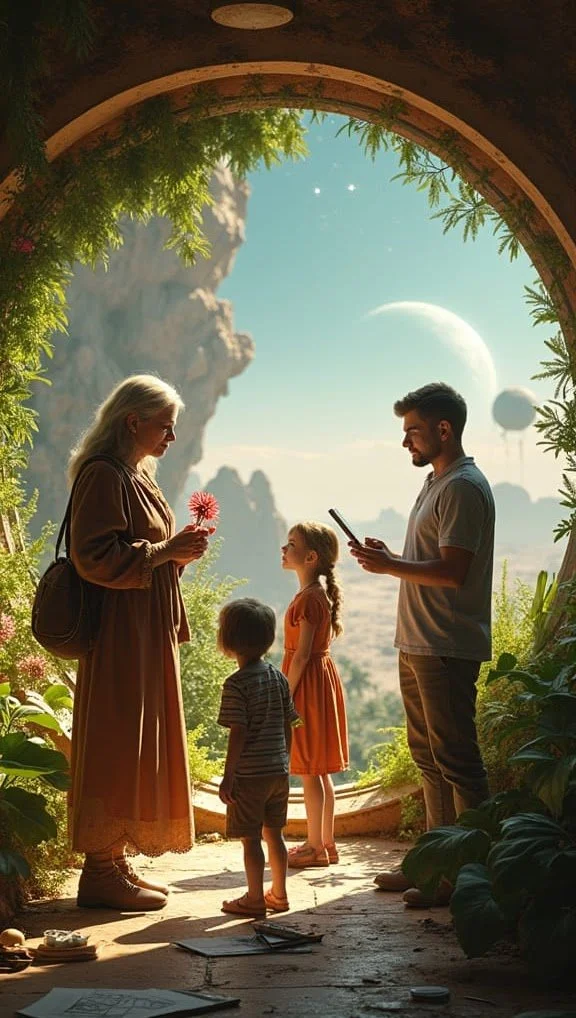
This reality, combined with urban design that prioritizes shared spaces—communal workshops, learning centers, collaborative kitchens, and sprawling parks—weaves an incredibly strong social fabric. The community is bound by a clear and noble shared project: maintaining the vibrant, delicate, and life-sustaining world they have built together. On Mars, this bond is even more profound, as every neighbor is a fellow astronaut on the fragile frontier of human existence.
A Resilient Hope: Not Utopia, but a Foundation
The closed-loop city is not a perfect, static utopia. It is a framework designed to absorb and adapt to the timeless complexities of the human condition. People will still face personal challenges, disagree, and strive. But the city removes the brutal pressures of survival, providing a stable, equitable, and inspiring foundation upon which to build a meaningful life.
This is the ultimate goal of Project Clean Up. It is not just about cleaning our air and water, but about clearing the path for humanity to reach its highest potential. The closed-loop city is our blueprint for a future where our systems are not at war with nature, but an extension of it; where our lives are not defined by what we consume, but by what we create and contribute. It is a foundation for a resilient and hopeful future, for our world and for any new worlds we may one day call home.