The Alchemical Loop: The Kitchen's Contribution to Soil and Power
(10/31/2025)
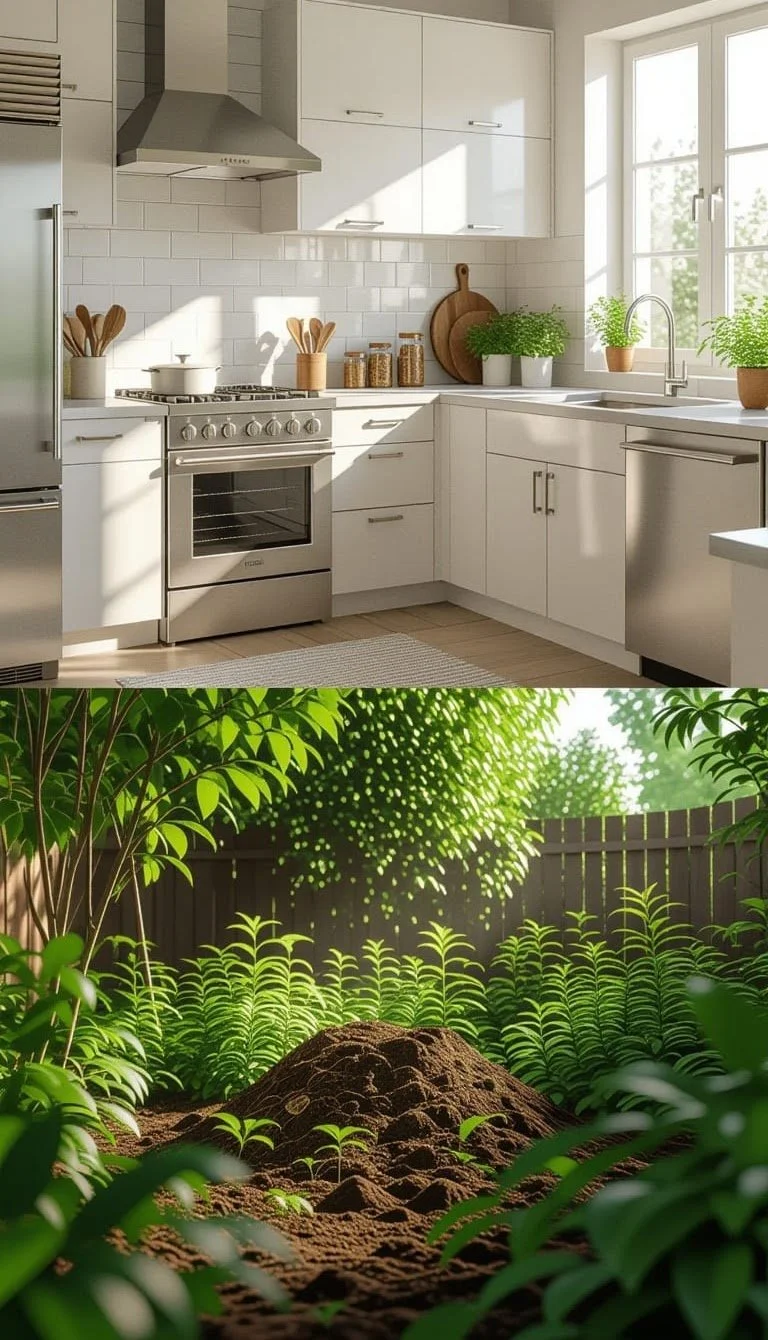
Welcome back. We have successfully closed the water and nutrient loops from the bathroom, turning human waste into clean water, energy, and fertilizer. Now, we turn our attention to the heart of the home: the kitchen. Every meal prepared generates organic "waste"—vegetable peels, coffee grounds, eggshells, and leftovers. In a linear world, this is trash destined for a landfill, where it rots and produces potent greenhouse gases. In our city, it is a valuable stream of energy and nutrients.
Step 1: The Organic Resource Chute
The process begins not in a bin, but with a seamless, integrated system in every kitchen. Instead of a traditional trash can for food scraps, each counter is equipped with an Organic Resource Chute.
How it Works: A small, sealed opening on the countertop leads to an integrated grinder. With the press of a button, food scraps are macerated (ground into a fine pulp) with a small amount of recycled greywater.
The Advantage: This eliminates the problem of smelly kitchen compost bins and makes the organic material "pumpable," ready for easy, automated transport through a dedicated plumbing line. It also dramatically increases the surface area of the material, making it easier for microbes to break it down in the next stage.
Step 2: Co-Digestion in the Bioreactor
This organic slurry is piped directly to the same neighborhood-scale Blackwater Bioreactor we designed for solid human waste. This is a critical synergy.
The Science of Co-Digestion: Mixing nitrogen-rich human waste with carbon-rich food waste creates a much more balanced "diet" for the microbes in the anaerobic digester. This process, known as co-digestion, significantly improves the efficiency of the bioreactor, leading to a much higher and more stable yield of biogas. More food waste means more clean energy for the city. The resulting digestate is also more nutritionally complex and balanced.
Step 3: The Alternative Path - Vermicomposting
While the bioreactor is the city's primary "workhorse," our city values resilience and biological diversity. Therefore, a secondary, more hands-on path exists for organic resources: Vermicomposting.
Community-Scale Worm Farms: In the city's agricultural modules and community gardens, dedicated vermicomposting systems are maintained. Here, red wiggler worms (Eisenia fetida) process food scraps and other organic matter.
The "Black Gold" Output: The worms' digestive process transforms the scraps into worm castings, a substance often called "black gold" by gardeners. These castings are one of the richest, most effective, and biologically active soil amendments on the planet. This high-value product is reserved for the most sensitive and important crops in our urban farms, such as nutrient-dense fruits and medicinal herbs.
Beyond the Dome: A Recipe for a Greener Earth
This two-pronged approach has immediate applications today. Municipalities are increasingly adopting co-digestion, mixing food waste from restaurants and homes with sewage sludge to boost their biogas production. At the same time, home and community-scale vermicomposting is a powerful tool for anyone to turn their food scraps into incredible fertilizer for their own gardens. By embracing both the industrial and the biological, we can drastically reduce landfill waste, generate clean energy, and restore health to our planet's soil.
Now that we have processed the organic matter, one last category of waste remains in the kitchen. Join us next time as we tackle the challenge of inorganic kitchen waste: the plastics, glass, and metals used in packaging and containers.