The Critical Path, Milestone 1: Designing the Regenerative Systems Testbed
(09/12/2025)
Welcome to "The Critical Path." For weeks, we have sketched the blueprints for a self-sustaining city. Now, we begin the practical journey of building it. The first milestone is not to build a city, but to build a laboratory—a terrestrial analog where we can test, refine, and perfect every one of our closed-loop systems before deploying them at scale.
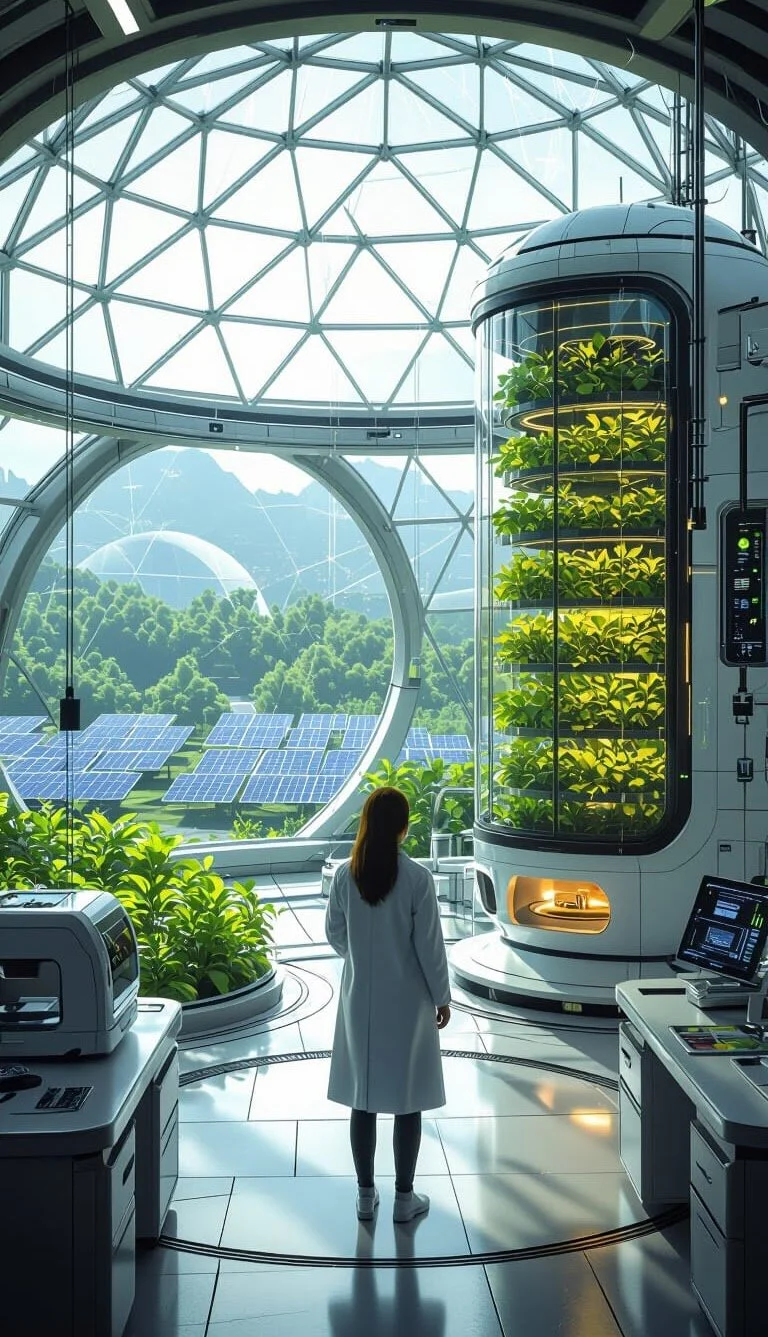
This is the Regenerative Systems Testbed (RST), a next-generation "Biosphere 3." Its mission is different from its predecessors. It is not designed to be an endurance test for a sealed-in crew; it is a flexible, data-rich laboratory designed to rigorously test our technology and operational strategies.
Core Principle: A Laboratory, Not a Prison
Unlike Biosphere 2, the RST's goal is not to prove long-term human isolation. Its purpose is to validate the systems. Crews would rotate in for shorter missions (weeks to months) to conduct specific experiments, test interfaces, and provide real-world feedback. The facility itself would be designed for easy access, allowing engineers and scientists to upgrade, repair, and reconfigure modules as we learn and innovate. It is a place to make our mistakes safely and cheaply here on Earth.
Architectural Design
The RST would be built on three core architectural principles:
Extreme Modularity: The facility would be a network of interconnected but fully isolatable modules. We would have a dedicated Agricultural Module, a Resource Recovery Module, a Habitat Module, and an Energy Module. This allows us to test systems independently and understand their precise inputs and outputs. We can push one module to its failure point (e.g., simulate a crop blight) to see how the other systems respond, without risking the entire facility.
Hyper-Instrumented Environment: Every pipe, wire, and square meter of soil would be saturated with advanced sensors. This creates a "digital twin" of the RST, providing a constant torrent of high-fidelity data. This data is the primary data for managing the unpredictable complexities of a living, breathing system before being deployed in a real city.
Material Honesty: The RST would be constructed from the very materials we intend to use on Mars or in future Earth cities. Walls would be 3D printed from regolith simulant; internal components would be made from recycled polymers. This allows us to test the long-term durability, structural integrity, and off-gassing properties of our chosen materials in a controlled, sealed environment.
Key Research Objectives
The experiments conducted within the RST would be focused and relentless:
Validating the Hybrid System: We would finally test our core hypothesis: can the "Engineer's" mechanical life support (ISS-style purifiers) and the "Gardener's" ecological systems (living machines, soil biomes) work together in a stable, symbiotic loop?
Forging the Regenerative Fabricator: We will intentionally break pumps, tools, and components. The Resource Recovery Module will be tasked with breaking down the "waste," and the Fabrication Lab will be tasked with 3D printing a functional replacement part from that reclaimed material. This tests our entire circular material economy from end to end.
Developing the Human-System Interface: Rotating crews will live in the Habitat Module to test everything from the psychological impact of the lighting to the usability of the "City Dashboard" and governance tools.
The RST is the crucible where our blueprints will be forged into proven, reliable technology. It is the single most important step in making our vision for a closed-loop city a reality.
With the design of our testbed established, the next step is to perfect the engine of its circular economy. Join us next time for Milestone 2, where we'll do a deep dive into the specific technologies of the Advanced Resource Recovery Hub.