The Critical Path, Milestone 2: The Advanced Resource Recovery Hub
(09/19/2025)
Welcome back. A truly closed loop has no dead ends. In our city, this means the concept of a "landfill" is replaced by a sophisticated, central processing facility: the Advanced Resource Recovery Hub (ARRH). This is not a recycling center in the traditional sense; it is a deconstruction and purification plant for all non-biological materials.
Its mission is to take any discarded object—from a worn-out chair to a broken atmospheric sensor—and break it down into its purest constituent elements, providing pristine, high-quality feedstock for the city's Fabrication Labs.
The Philosophy: Molecular Recovery, Not Downcycling
Conventional recycling often results in "downcycling"—a plastic bottle is turned into a lower-quality park bench, which can never become a bottle again. The ARRH is designed to reverse this. It employs molecular recovery to return materials to a virgin-like state, ready to be remanufactured into objects of equal or greater complexity, ensuring an infinite material loop.
The Process Flow: A Triage of Matter
Let's follow the journey of a broken tablet through the ARRH:
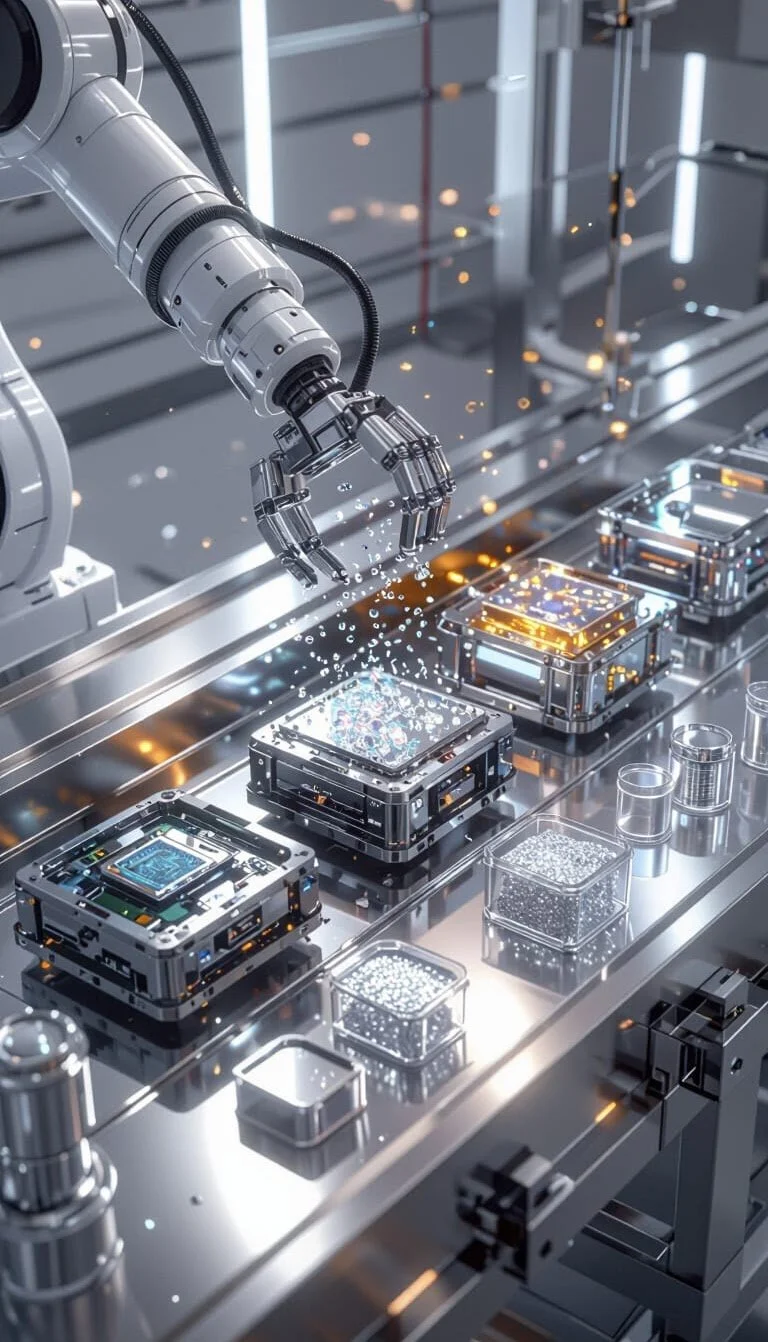
Automated Triage: The tablet enters the hub on a conveyor. AI-guided robotic arms using spectroscopic and X-ray scanners instantly identify its exact material composition—the aluminum casing, the lithium-ion battery, the glass screen, the plastic bezels, the rare earth elements on the circuit board.
Robotic Disassembly: The tablet is moved to a disassembly station. Because it was "designed for disassembly," robotic arms can quickly unscrew the casing, detach the battery, and separate the components without shredding them.
Material Channeling: The pure, separated components are then sent to one of several specialized processing lines within the hub.
The Key Technologies: Engines of Circularity
This is where the ARRH truly differs from any facility on Earth today.
For Pure Metals (Aluminum, Copper, Steel): These are the easiest. They are shredded, melted down in clean, efficient electric induction furnaces, and then atomized into microscopic powders, ready for advanced 3D printing.
For Complex Polymers (Plastics): This is the core challenge. The ARRH uses Pyrolysis. In a vacuum chamber, shredded plastics are heated to extreme temperatures without oxygen. This doesn't burn them; it "cracks" the long polymer chains back into their original, simple hydrocarbon oils and monomers. This syngas/oil is then refined and can be used to create brand-new, virgin-quality plastics.
For Hazardous Materials ("Forever Chemicals"): To deal with the most resilient pollutants like PFAS that might be found in old electronics, we use Supercritical Water Oxidation (SCWO). Water is brought to a state between a liquid and a gas, where it becomes a powerful solvent that can dissolve and completely destroy these robust molecules, breaking them down into their harmless constituent elements (carbon, fluorine, etc.). This is our ultimate purification and safety system.
For Electronics and Composites: A combination of precise mechanical pulverization and hydrometallurgy is used. Water-based chemical solutions (leachates) are used to selectively dissolve and recover trace amounts of precious and rare earth metals from crushed circuit boards.
The final output of the ARRH is not a bale of crushed cans; it is a series of hoppers containing pure metal powders, tanks of refined monomers, and vials of recovered precious elements. This is the true wealth of the city.
With the ability to flawlessly regenerate its own materials, our city is one step closer to true independence.
Join us next time for Milestone 3, where we'll explore the critical technologies needed to provide the immense power for systems like the ARRH and achieve total Energy Independence.