The Critical Path, Milestone 3: Technologies for Energy Independence
(09/26/2025)
Welcome back. "Energy Independence" in the context of our closed-loop city is an absolute term. It means 100% of the power required for every system is generated, stored, and managed locally, with zero reliance on external fuel shipments or terrestrial power grids. This is the ultimate guarantee of autonomy and survival. Achieving it requires an ecosystem of complementary, cutting-edge technologies.
1. The Foundation: Perovskite "Solar Skin"
While traditional silicon solar panels are effective, our city will leapfrog to the next generation: Perovskite Solar Cells.
The Technology: Perovskites are a class of materials with a specific crystal structure that are exceptionally good at converting photons into electrons. They are cheaper to produce than silicon and can be formulated into a liquid "ink."
The Advantage: This ink can be sprayed or printed onto flexible surfaces. This allows us to move beyond rigid panels and create a true "solar skin" that covers nearly every exterior surface of the city—walls, roofs, windows, and vehicles—without compromising architectural design. The entire city becomes a passive, massive power generator.
2. The Baseline: Compact Fission Power
Solar power is intermittent. To provide the unwavering, 24/7 baseline power needed for life support and heavy industry, especially during a weeks-long Martian dust storm, we must turn to the most energy-dense source known: nuclear fission.
The Technology: We will utilize a Compact Fission Reactor, based on real-world designs like NASA's Kilopower project. These are not the sprawling power plants of the 20th century; they are small, solid-state reactors with no moving parts, designed to be "walk-away safe."
The Advantage: A single, small reactor can provide a constant stream of megawatts for years on a small amount of fuel. It is the ultimate insurance policy, ensuring that critical systems never go down, regardless of the weather or time of day. Its reliability is the bedrock upon which the city's security is built.
3. The Keystone: Long-Duration Energy Storage
Generating power is only half the battle; storing massive surpluses is the key to resilience. We will employ a dual-storage strategy.
The Hydrogen Cycle: As a medium for storing energy, hydrogen is unparalleled. During periods of peak power production, surplus electricity is used to run highly efficient electrolyzers, splitting water into hydrogen and oxygen. This hydrogen is stored safely (perhaps in solid-state metal hydrides) and can be run through fuel cells to generate electricity on demand, with pure water as the only byproduct.
Molten Salt Storage: For grid-scale thermal storage, we use Molten Salt Batteries. Surplus electricity from solar or fission is used to heat a large, insulated tank of common salts (like sodium nitrate) to a molten state. This thermal energy can be stored for weeks with minimal loss. When needed, the heat is used to create steam and drive a traditional turbine, regenerating electricity. It is a simple, robust, and massively scalable storage solution.
4. The Conductor: The Predictive AI Grid
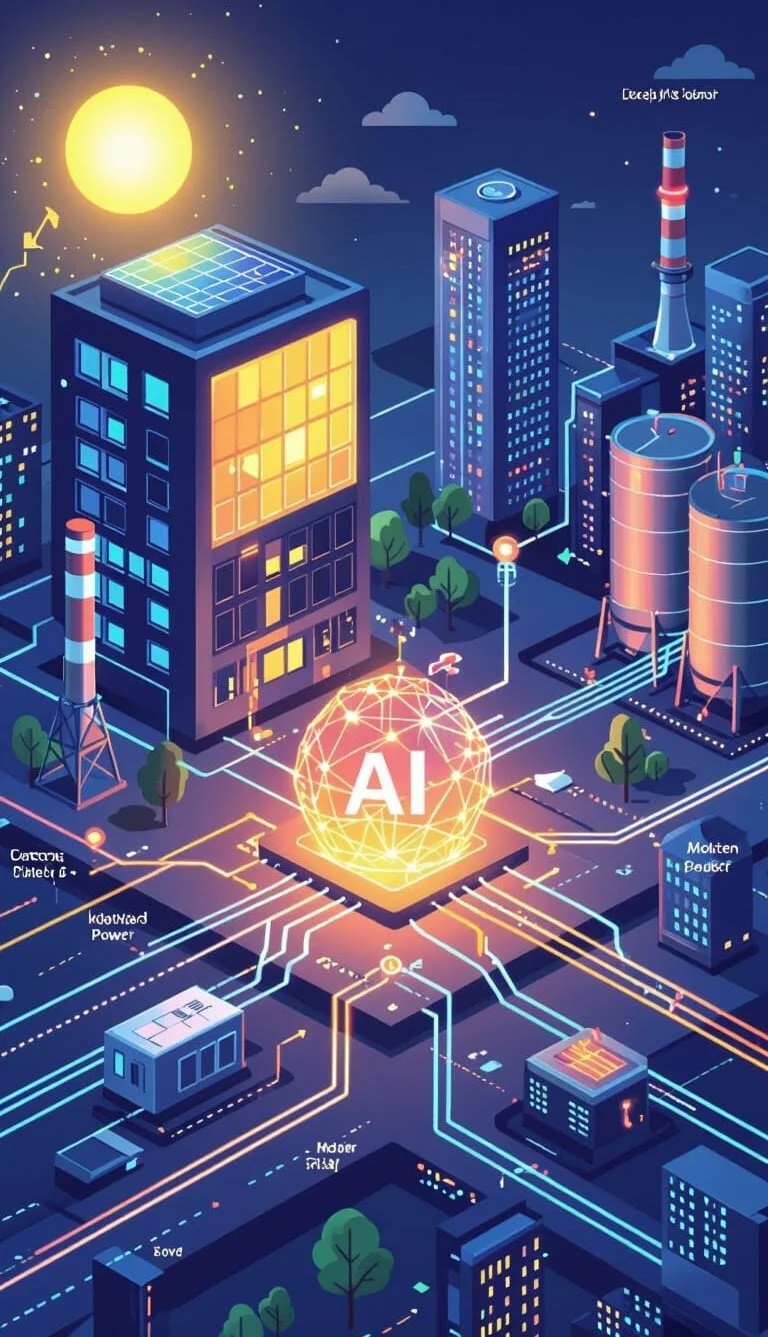
This complex ecosystem of generation and storage is conducted by next gen AI. AI's role is predictive and proactive. For example: AI would analyze Martian weather data and determine, "There is a 95% probability of a major dust storm arriving in 72 hours. AI could automatically prioritize all surplus power to top off hydrogen and molten salt reserves, while scaling back non-essential industrial processes to build a maximum energy buffer." This moves the grid from being reactive to being intelligently prepared.
With these technologies working in concert, our city is not just powered; it is truly energized, ready to weather any storm.
Join us next time for Milestone 4, where we will explore the Robotic Vanguard—the autonomous systems that will prepare the site and construct our city before the first human residents arrive.