The Engines of Negentropy: Installment 1 - The First Cleavage
(05/29/2026)
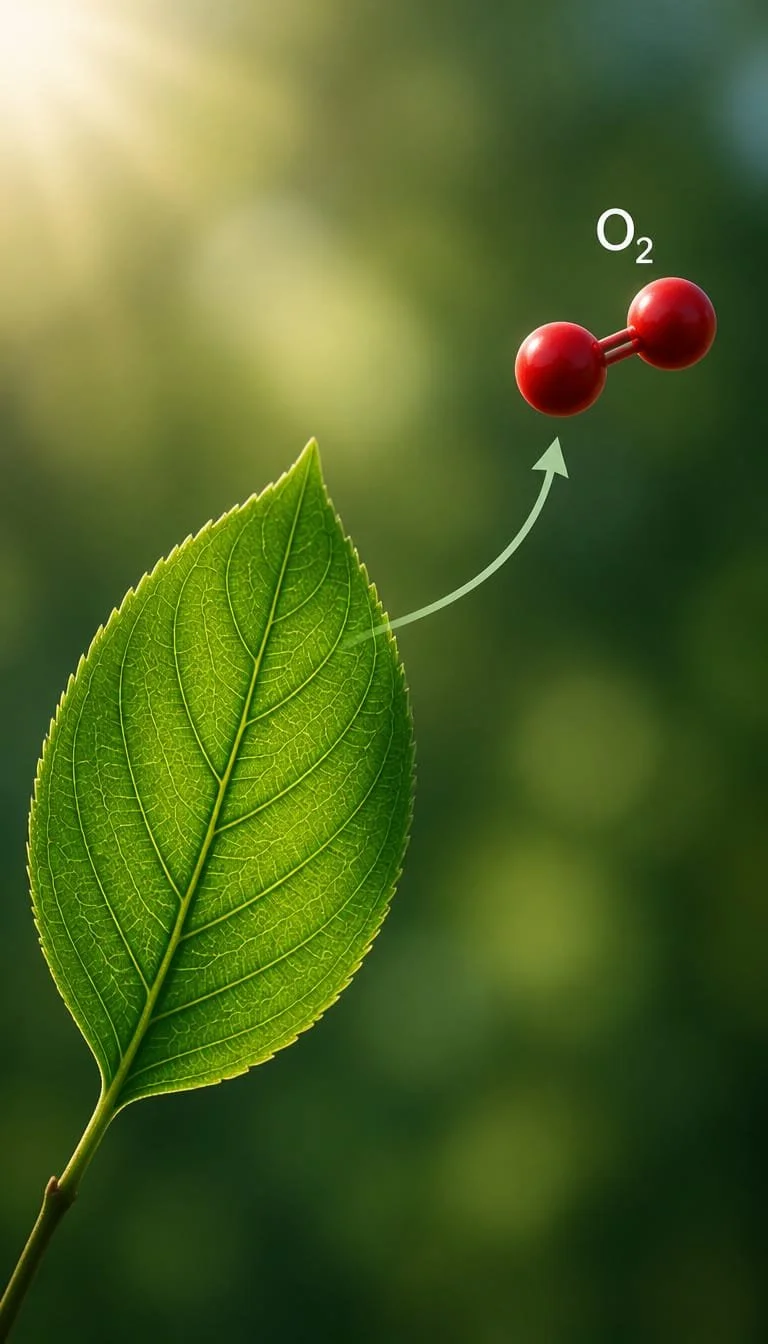
To build a closed-loop civilization, we must master the art of generating clean, high-energy fuel and recovering oxygen. In human industry, splitting water to achieve this requires massive electrolyzers, rare-earth metals, and significant electrical input.
Nature solved this problem 2.5 billion years ago. It performs this thermodynamic miracle every second of every day, using ambient temperature, neutral pH, and abundant earth metals. The machine that does this is Photosystem II (PSII), and its catalytic heart is the Oxygen Evolving Complex (OEC).
This is the genesis of the biological energy loop. This is the first cleavage.
The Problem of the Water Bond
Water is the thermodynamic ash of the universe. It is incredibly stable. Taking two H2O molecules and forcing them to release molecular oxygen (O2), four protons (H+), and four electrons (e-) requires a massive amount of energy.
If a biological system tries to rip all four electrons away at once, the energy barrier is insurmountable. If it tries to pull them away one at a time, it generates highly reactive, deadly free radicals (like hydroxyl radicals) that will immediately destroy the surrounding cellular machinery.
The OEC solves this by acting as a bioinorganic capacitor. It stores oxidizing equivalents, patiently winding up the thermodynamic spring until it has enough power to break the bonds all at once, safely.
The Engine: The Mn4CaO5 Cluster
At the core of the OEC is an asymmetrical cluster of metals: four manganese ions and one calcium ion, bridged by five oxygen atoms (Mn4CaO5).
Manganese is the perfect metal for this job because it possesses a rich coordination chemistry and can comfortably cycle through multiple high-valent oxidation states (from Mn(II) to Mn(IV), and potentially transient Mn(V). Calcium acts as a crucial Lewis acid, tuning the redox potential of the cluster and precisely positioning the substrate water molecules.
The Mechanism: The Kok Cycle and PCET
The process begins when a photon of sunlight strikes the P680 reaction center in Photosystem II. This excitation ejects an electron, creating P680+. This is one of the strongest biological oxidants known to science, generating a redox potential greater than 1.0.
P680+ is so "hungry" for an electron that it rips one away from a nearby tyrosine amino acid residue (TyrZ), which in turn rips an electron from the Mn4CaO5 cluster. This process happens four distinct times, driving the cluster through a series of oxidation states known as the Kok Cycle (labeled S(0) through S(4)).
Here is where the true genius of the enzyme lies: Proton-Coupled Electron Transfer (PCET).
As the cluster loses negatively charged electrons, it becomes increasingly positive. In classical chemistry, this buildup of positive charge would make it exponentially harder to pull the next electron away (a phenomenon known as redox leveling). To prevent this, the OEC simultaneously ejects a proton (H+) into the lumen for nearly every electron it loses. By shedding a positive charge at the same time it loses a negative charge, the overall charge of the cluster remains stable, allowing the redox potential to stay perfectly within the range of P680+.
The Climax: O-O Bond Formation
With the absorption of the fourth photon, the cluster reaches the S(4) state. It is now critically unstable, brimming with stored oxidizing power.
At this precise moment, the geometry of the high-valent manganese cluster forces two oxygen atoms (derived from the water molecules bound to the manganese and calcium) together. The O-O bond is forged. The cluster rapidly releases O2 gas and returns to its relaxed S(0) resting state, ready to begin the cycle again.
The Blueprint for the Retrofit
Why do we study the Mn4CaO5 cluster when designing a closed-loop city? Because it is the ultimate proof of concept for synthetic catalysis.
As we build the industrial infrastructure to manage our energy and material ledgers, we must move away from brute-force thermodynamics. We must engineer synthetic catalysts that utilize PCET to lower activation barriers, and we must learn to use abundant, non-toxic metals like manganese and iron to store energetic equivalents.
Photosystem II proves that absolute efficiency does not require extreme heat or pressure. It requires the perfect geometric and electronic tuning of a transition metal cluster. It is the first, perfect engine of negentropy.